
Continuing the series of portrayals of technology from the VHS era, here’s another contribution from Martin Brewer, who brought us the first episode of The Net. This is another BBC Two show, an episode of Horizon from 1993 on “The Electronic Frontier.”
The broad theme of the episode is the information economy, and it’s a whirlwind tour of influential people and tech in the pre-Web 1990s. They focus heavily on Microsoft, Apple, and General Magic, with interviews from key players from each. (Plus, great footage of their headquarters and workspaces.) There’s plenty of footage of vintage ’90s tech in here, including giant cell phones, Windows NT 3.1, the Newton, General Magic’s Magic Cap, Corbis, Encarta on CD-ROM, interactive TV and software agents. Some of the highlights, with screenshots, after the video below.
Note: Like all the other materials I post here, this video is completely out-of-print and unavailable commercially, digitized from an old VHS tape. If it ever comes back into print, or the copyright holders contact me, I’ll take it down immediately. (Update: YouTube is blocking my upload in some countries, so I replaced the video embed below with this copy from the Internet Archive.)
“We’re the kind of animal that consumes information. It’s a language we move through wherever we go, often unconsciously. Now, information is starting to redefine our world — its geography and its economy. What would the world look like with information as money? And who would be running it?”
The 50-minute documentary is narrated by writer/producer Sheila Hayman and hosted by Robert X. Cringely, credited as a columnist for Infoworld.
Here are all the interviewees and their titles, as listed on the show:
Microsoft – Bill Gates (Chairman/Chief Executive), Mike Murray (Vice President, Human Resources), Nathan Myhrvold (Advanced Technology), Stephen D. Arnold (President/CEO, Continuum Productions/Corbis), Therese Stowell (Software Goddess), Mark McPhee (Graphics)
Apple – Don Norman (Fellow), Joy Mountford (Human Interface Group), Michael Tchao (Manager, Newton), Neil Selvin (Director of Marketing, Portable Computing)
General Magic – Marc Porat (President/CEO), Andy Hertzfeld (Software Wizard), James E. White (Director, Telescript)
Others – John Evans (President/CEO of News Electronic Data), Howard Rheingold (Writer, “The Virtual Community”), Steve Roberts (Nomad/Journalist), Denise Caruso (Editor, Digital Media), Robert M. Greenberg (President, R. Greenberg Associates).
Highlights
The show starts at Comdex 1993, with a bizarre presentation by a Borg-like spokesperson for Microsoft. With that apron, Bill Gates looks like he was cooking barbeque. (1:20)
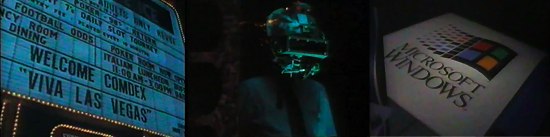
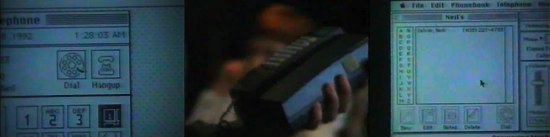
Apple press demo for a telephony application from Applied Engineering which “integrates data and fax and voice into a single communications structure in the Powerbook.” Love the shot of the “small, lightweight cellular phone.” I think he was being sarcastic. (3:10)
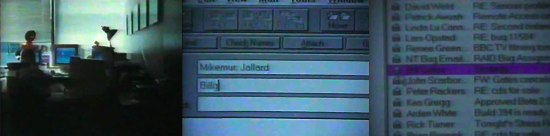
Off to the Microsoft campus, with some great shots of the offices and workspaces from that time. Several huge CRTs on every desk. Interview with Bill Gates, talking about email. (5:20)
Don Norman explains the design of everyday things at Apple headquarters, with the now-familiar discussion of door handles, elevator buttons, and light switches. Joy Mountford takes over to talk about designing for humans, instead of computers. (8:15)
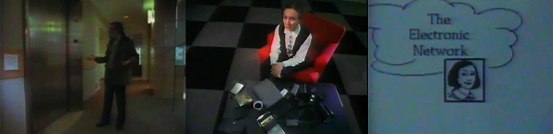
Michael Tchao, a Newton manager at Apple, shows off the device, the handwriting recognition, and sending a note and sketch by fax. (12:20)
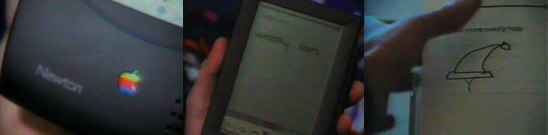
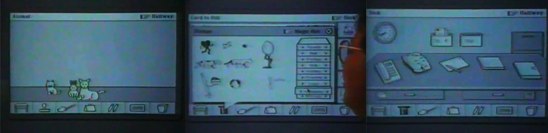
General Magic’s Marc Porat and Andy Hertzfeld give an in-depth demo of Magic Cap. For some reason, they interview James White about Telescript in the front seat of his car. (15:00)
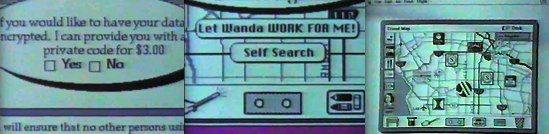
John Evans from News Electronic Data, a subsidiary of Rupert Murdoch’s News Corp., shows off an early ’90s agent called Oliver for the Mac, a golden retriever designed to retrieve personalized news and travel information. I especially liked the “virtual reality” preview of driving your route on the map, which reminds me of Desert Bus. (23:45)
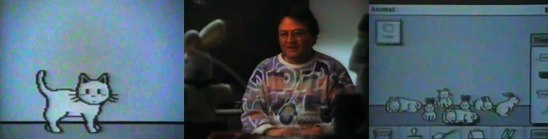
Andy Hertzfeld shows off Magic Cap’s virtual pets and talks about object-oriented programming. I love the footage of the General Magic offices and their individual desks. That, along with Hertzfeld’s Cosby Show sweater, nicely capture the era. (27:00)
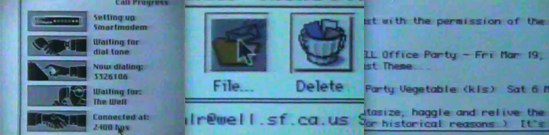
Howard Rheingold talks about technology as a communications tool, in the context of the WELL and Usenet. Great shots of dialing into the WELL at 2400 baud, and a WELL office party from March 1993. (29:55)
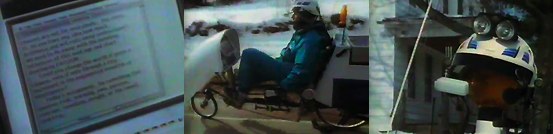
“Yuppie hobo” Steve Roberts shows off BEHEMOTH, the networked recumbent bicycle complete with “brain interface unit with a heads-up display which is a 720×280 computer screen called a Private Eye connected to a DOS system,” cellular modem, and a chordal keyboard for typing emails while he rides. This makes texting-while-driving look pretty safe. (31:30)
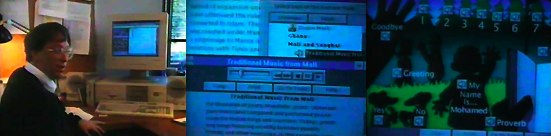
Bill Gates demos the CD-ROM version of Encarta in what looks like his own office. This leads to a nice segue into Corbis, then called Continuum. (36:40)
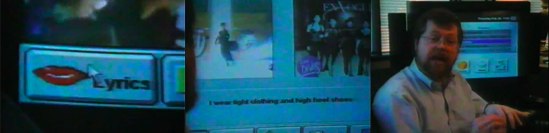
Nathan Myhrvold demonstrates Microsoft’s interactive television prototypes, viewing the lyrics from an En Vogue video and buying concert tickets from his TV. While some of the features he talks about were tackled by DVRs, most of the promise of interactive TV was instead fulfilled by the PC and high-bandwidth Internet connections. (41:45)
The final scene discusses digital manipulation of video imagery. They start with the classic Diet Coke ad pairing Paula Abdul with vintage film of Gene Kelly, Cary Grant, and Groucho Marx, then launch into a discussion of the potential misuse of the technology for nefarious purposes.
Where are they now?
Here’s where everybody is 15 years later, in order of appearance.
- Bill Gates is still Chairman of Microsoft, but retired from day-to-day operations in 2008, now spending most of his time on philanthropic efforts.
- Mike Murray penned the infamous Shrimp and Weenies memo before leaving Microsoft in 1999 to focus on philanthropy by founding Unitus, a microfinance company for the very poor. He’s now a Mission President for the Mormon Church.
- Nathan Myhrvold became Microsoft’s CTO in 1996 and left the company in 1999. He ‘s the founder and CEO of Intellectual Ventures, a controversial company that’s built a large portfolio of patents.
- Steve Arnold became a VP of Microsoft’s Broadband Media Applications, but left the company in 1994. He became a co-founder and general partner in Polaris Ventures, a VC firm in Seattle.
- Therese Stowell, the “software goddess,” founded an internal support group for female Microsoft employees called Hoppers that continues today. She left Microsoft in the mid-1990s to lead a software team at Sony, but in 2000, switched her focus to creating technology-inspired artwork in London.
- Don Norman left Apple in 1997, briefly heading the Appliance Design Center at HP before co-founding his successful consulting group with Jakob Nielsen in 1998. He’s the author of several essential books on user-centered design.
- Joy Mountford left Apple in 1992, later founding the idbias design consulting firm. In 2005, she joined Yahoo! to lead their User Experience Design group, but left the company during a round of layoffs last February. No word on what she’s doing next.
- After helming several Silicon Valley startups, including leading Global Village to their 1994 IPO, Neil Selvin is now President of Inlet Technologies.
- After leaving Apple in 1994, Michael Tchao starting a marketing consultancy for tech companies. After stints at Move.com and Onedoto during the boom and bust, he went to Nike in 2002 and is now the head of Nike+ at Nike’s Techlab.
- Marc Porat was CEO of General Magic until 1995, but remained a board member until its closure in 2002. He’s now the chairman of three companies focused on green construction.
- Andy Hertzfeld founded Eazel in 1999. After its closure in 2001, he volunteered for the OSAF for two years and started at Google in 2005.
- In 1995, John Evans bought News Electronic Data from Murdoch’s News Corp. and renamed it BizTravel.com, but the site folded in 2000. He was also the CEO of REM Productions, a design consultancy for media companies formed in 1995. Shortly after his retirement, Evans passed away in 2004 at the age of 66.
- Howard Rheingold became executive editor of Hotwired shortly after this documentary was filmed, and he left to form his own company Electric Minds in 1996. He continues to write at Smart Mobs, and teaches classes on online journalism and virtual community at Stanford and UC Berkeley.
- Steve Roberts took BEHEMOTH around the United States, clocking 17,000 miles from 1983 to 1991, before starting the Microship project which lasted over ten years. He now works on the Nomadness and writes about the process.
- Denise Caruso wrote the New York Times’ Digital Media column until 2000, and formed the Hybrid Vigor Institute in 2002, a non-profit dedicated to interdisciplinary problem-solving. She writes on their group blog frequently.
- Bob Greenberg still runs R/GA Digital, his production studio. This New York Times article from 2006 profiles Greenberg and his work.
I couldn’t find any information about General Magic’s James E. White or Microsoft’s Mark McPhee. Drop a line if you know what they’re up to.
THANK YOU for this!!
I enjoyed this and your “where are they now” research was wonderful!
Home run!
Like always a very nice article.
Wow, Cringely’s stilted speech is really quite painful.
Any chance of a torrent of this?
thanks
Mark McPhee left Microsoft to spend most of his time with his wife Molly and to help homeschool their 5 children. Mark spent a lot of time teaching art, irish tin whistle and chess in a 300 family homeschool cooperative. “Kids are great and they need focused parents and great role models.” Mark and Molly are presently the President and Secretary of Antioch Adoptions in Redmond. Antioch is an adoption agency dedicated to serving children by finding Forever Families without charging a price for the child. Large price tags for the buying and selling of children, in the adoption “marketplace”, have priced out and made unavailable too many great families and parents. This no fee commitment opens up many more options for families to step up and provide homes and lifetime families for orphans and children emancipated from the foster care system. Antioch Adoptions currently only handles domestic adoptions within Washington state but the model is starting to be replicated and researched across the USA. Check out what we are doing at Antioch Adoptions and donate your support.
Thanks, Mark!
This was a joy to watch and the additional research was really interesting, thanks.
Interesting bit of history, but 1993 is not “pre-Web”, just pre-popular-web. I was downloading mosaic and playing with it to see various sites back in 1993.
A particular feature of most tech-TV back in those days is being 6 months or more behind the curve. Hearing them talking about “the very latest thing” would just make me roll my eyes having read about it in the computer press or on a dial-up bulletin board.
True enough, the WWW was technically launched in August 1991. This documentary was recorded in late 1992 and the first three months of 1993, which places it before CERN’s announcement that the web would be free to use or the release of Mosaic 1.0. At the time it was broadcast, there were only about 150 websites, so it’s not too surprising it wasn’t mentioned. That’s still pretty fringe.
Thanks very much for putting this up. As a lover of IT/computer history, it was very entertaining and informative.
What I find most interesting about looking back at programs that were themselves trying to look to the future is how diffent the future turns out.
Nathan Myhrvold’s glimpses at a future of interactive television, are to my mind at least, still a long way from realisation.
I would heartily recommend some of Bob Cringely’s other 1990’s TV output in particular ‘The Triumph of the Nerds’ and ‘Nerds 2.0.1 – Brief History Of The Internet’.
Thanks again though for putting this up!
Thanks so much for putting this up – it was the program I remember really well and got me interested in doing more with computers!
Keep up to date the great composing.