
First, the bad news. Two days ago, I received a polite email from David Winton, the director of Code Rush, asking me to take the out-of-print documentary off of Waxy.org. As promised, I immediately complied.
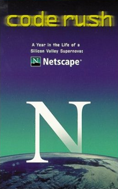
Now, the good news — In my reply, I asked David if he’d mind being interviewed, and he agreed! He’s an accomplished director and producer, the creator of the Big Thinkers series for TechTV, and the cofounder of Winton/duPont Films, located in San Francisco’s Presidio.
We had a wonderful conversation about the film, which revealed for the first time that he’s planning on not only re-releasing Code Rush digitally, but considering releasing the original outtakes (100 hours of footage) to the public domain on Archive.org.
I wish all my takedown notices were like this! Read on for the full interview, with selected clips from Code Rush, used by permission.
Andy Baio: Thanks for taking the time.
David Winton: Sure. I’d heard about the film being online, which isn’t, quite honestly, that big a deal to me. But while I decide what to do with it, I’m glad you took it down.
No problem at all. Whenever I post a video, I always add that big disclaimer saying I’ll take it down if it comes back into print or the copyright holders get in touch…
Yes, I saw it. And one of the feelings I had was just to make it freely available under the Creative Commons license. And I’ve thought about making the original material available, which we have about 100 hours of — the full interviews with the people in the film, like Marc Andreessen and Jim Barksdale, you know the whole cast of characters…
I can’t believe you kept it all.
I can’t believe I kept it either, to be perfectly honest with you, because I’ve looked at maybe an outtake or two, once in ten years, and [laughs] I’m not sure it’s of any real value, truthfully…
For people interested in the open-source movement, it’s a goldmine.
Out of curiosity, how would you recommend making it available to people?
I would put it on Archive.org…
Right, yes, and I’m very close to the people at Archive.org. I know the person who helped set up their online archive of films, a guy named Rick Prelinger…
Right, the Prelinger Archive?
Right. So I talked to Rick and said well, I’m happy to give this to you, but literally, it’s boxes upon boxes… If there’s somebody you know at Archive.org and you want to just drop them a note to have them call me, that’d be fine. I would be quite happy to make it available.
That’s incredible, I’ll see what I can do. I’m a big fan of historical computing and archival media.
I am too. I’m not a tech person, to be honest with you. But I came out here in the mid-nineties from New York City and, in a sense, the film was my own kind of valentine to the community and culture of Silicon Valley, which I found immediately upon arriving here to be an amazingly intoxicating experience compared to what I’d seen in New York and the East Coast.
I’m a big believer in supporting it in any way and I thought the open source movement was incredibly important, and that really launched our business on film and the TV documentary area. Prior to that, we made corporate propaganda films and TV commercials. It was the time I spent at Netscape that opened a whole other world of possibilities. I look back on all of those days and all of those people with a really great sense of appreciation and wonder about the whole thing.
You definitely went to the right place at the right time. When did you move to the Bay Area?
Well, I moved to the Bay Area from New York City in mid- to late-1995. I made a film for the Wall Street Journal in 1996 and frankly, I was a little bit prompted to move to the Bay Area because of Netscape and the phenomenon of Silicon Valley. We had a business making films about businesses, and the best businesses in the world were really unfolding here.
So I came out and, as luck would have it, Dow Jones said, “Will you go make a short film about Netscape Communications for us?” And I said, “I sure will.” And that got me connected with Netscape’s communications people. A couple of years later, as they hit the wall and were beginning to think radically about how to compete using the open-source movement, I said, “This is a good opportunity to go back and record what happens here.”
And that’s how we got inside. It was a series of lucky breaks that got us and kept us there because, as you know, the culture of privacy in Silicon Valley is really intense. It just happened that I had a couple of friends in [Netscape CEO] Jim Barksdale’s office who said, “Let this guy do what he wants to do.” I think they also realized, at the time, that this wouldn’t hurt and might even help them in their competition against Microsoft.
They really had nothing to lose, at that point.
Yeah. And they knew we weren’t going to do anything. We’re not muckrakers. We’re storytellers. So it was really an absolutely fantastic experience. I really enjoyed everybody I met. Everybody was, for the most part, extremely welcoming. I didn’t feel that they said things for my benefit. I’ve been at this long enough that I have a pretty good nose for what’s really real and what’s a contrivance, and I felt these were people as you would have actually seen them had you been there yourself without a camera.
The level of access is amazing. Not only are you in team meetings, all-hands meetings, and executive meetings, sitting in with Marc Andreessen calling Steve Jobs, but you’re also there for late nights at the offices, little pow-wows, people doing soda runs. I mean, you were there for everything.
Yeah.
How much time were you spending?
Well, we filmed it off and on. We were there intensely, every day and night, for the first couple of months of ’98. Then we came back in the spring and fall. We were there for the source code’s first release on March 31, 1998. And then I came back to follow up on what happened. I found, through the people at Netscape, this high school student who I think may still be at Netscape or AOL or whatever it is now. Maybe he is at Mozilla.
Are you talking about Stuart Parmenter?
Yeah. Where is he?
He still works at the Mozilla Corporation. He’s very influential. He ended up being a very core member.
Core guy, yeah. Well, you could see that was going to happen. So I think we went and filmed him sometime towards the end of his school year of 1998. And then we did a little bit more filming in the fall. And we cut the film, I think that summer, and then it got out, it got onto onto the air I think in the early ’99.
One of the benefits of shooting something over a long period of time is that you can kind of refine it as you go. We gave ourselves the time and the leeway to do that, and of all the things you can do to help yourself making a film, probably the best thing is to let time take its natural course. That becomes a simple dramatic device that carries you along, as long as interesting things happen in the interim.
The source material for the film, or the inspiration for the film was a great book written about 25 years ago by Tracy Kidder called The Soul of a New Machine about the building of the Data General minicomputer back in the East Coast. That’s a great book, by the way. That’s one of the great books of all time, actually.
It’s one of the few books that manages to relay the drama of computer programming.
Yeah, it sure does. And then another source of inspiration was a book called Show Stopper by a guy named Gregg Zachary, who followed the creation of Windows NT back in the ’90s.
I thought his book was terrific. And Zachary, who’s a friend of mine now, helped guide me on the process and he helped on some of the narration writing of the Netscape film. But I think that Show Stopper is actually a fantastic book. I’m not sure I still have my copy around. But it was once upon a time I read all the literature about the tech world and his was one of the few that really stood out I thought.
You’d think it would be hard to dramatize, especially on film, people writing code. But I found Code Rush completely gripping.
I know, it’s bizarre, isn’t it? Well, part of it is that you knew that they were always up against some impossible deadline. You just stick with it long enough and stuff happens, you know you get the things that you need. It’s not as hard as it looks.
So with traveling and trying to film people in Mountain View, did you have a big crew?
No, I think that was useful. We had a cameraman, a soundman, and me. That was pretty much it the whole time.
And it was back when were using then state-of-the-art video technology that allowed us to shoot in fairly low light. We made the decision not to get carried away with lots of extraneous equipment. I think that was one of our better calls.
Normally, there was a tradition of documentary filming back then where you’d spend a lot of time setting up and lighting before doing any shooting. We just decided to violate that rule completely. So, we were able to move incredibly efficiently. If we’d tried to impose the normal style of that kind of filmmaking, the style that was applied back then, we would have gotten none of this stuff.
Plus, computer programmers hate light.
Yeah, that’s for sure. So, anyway, that’s the background on it.
That kind of leads into another question I had. Computer programmers aren’t very extroverted. Personally, I hate being on camera. Did you have trouble getting them to open up?
No. You pick your battles. You pick people that you’re going to pay attention to and generally it’s pretty clear who’s comfortable doing this kind of thing and who isn’t. And as long as you’re discreet and not in their faces, a natural sort of comfort asserts itself. A person’s general ability to be him or herself asserts itself, and you just have to be there and back enough that you’re not getting in the way. So, people who ordinarily might otherwise be very tight or shy in front of a camera, just kind of lose the sense that you’re there.
I’m sure there were a couple people who avoided the camera, running away when you walked in, so we never saw them.
Yeah, there were definitely a few, but not that many; surprisingly few. And we were around so often that they became indifferent to our presence, if not comfortable. That helped, as well.
I don’t know if you remember this, but there’s this recurring theme from the engineering team that they’re “doomed.” They keep saying it over and over again, “We’re doomed. We’re doomed. We’re doomed.”
When I was there, that was a constant refrain. They were being mostly ironic on one level, but on another level I think they realized that they were in a complete mismatch… It was a combination of the mordant humor when you’re trying to get a job done.
It was an impossible deadline, so there was doom in that sense. But then there was even more the sense that they were trying an experiment that had never been tried and therefore they were courting disaster on that level. And then, finally, they were up against Microsoft and that was I think probably why it was spoken more often than normal.
And then, the AOL acquisition.
Yes… Dumb luck. Good luck. For them, great luck.
And yet, at the same time, the engineers seem devastated by it.
Well, financially it was a good thing, because it was everything that they had no interest in being and…
AOL was so hated back then in the geek community.
Yes, unfortunately it was AOL or somebody else like AOL that was going to be their lifeline. And definitely, nobody thought it was a good thing but for a few incredibly well-vested executives. But you know, many of those employees made out. They had a financial windfall that one rarely gets in one’s life. So for people like Scott Collins, it was an incredible, lucky thing, even though I think he never really wanted to be part of AOL after that.
There’s this disappointment that what you’ve created is likely going to be lost, but at the same time, there’s this profound sense of relief that it’s over. You caught virtually every key character in the documentary leaving Netscape shortly after that…
Yes, basically they did — that’s amazing, isn’t it? I liked them all and I think having done these things for awhile, I had a reasonably good nose for who to focus on, and they all turned out to be fantastic.
Occasionally, I think about going back and doing a followup, but it was such of that particular moment. Silicon Valley is a completely different place now, it seems to me. If they were all back at the same place, it might be kind of interesting. But it’s all diffuse now.
It was this one moment of time, but what’s so interesting about it is that you’re seeing the origins of Firefox, too. With Stuart coming in and talking to [Mozilla CTO] Brendan Eich…
Maybe Firefox, maybe there’s a story back there. Maybe there’s a way to go back and recapture that; see what it’s like. I did a lot of filming with Brendan, who didn’t get into the film particularly much at all. He was one of the few people who just didn’t quite come across on camera. But I thought he was great, incredibly smart. And maybe there’s a way to kind of rejuvenate it.
So you’ve got the first steps of this massive movement that’s going to come. But at the end of the film, you get the feeling that they felt that open-sourcing Netscape was a failure. They did it, but just felt it wasn’t a spectacular success.
Yeah, it was way ahead of its time, for sure.
But you did capture this moment with Jamie Zawinski after he’d left and had a chance to get some distance, where he gets sort of reflective. And he starts talking about the long-term impact of open-sourcing Mozilla and how that can’t be taken back. So, even if people are scared of the AOL acquisition, this code is out in the world and it can have a life of its own. It seems like he’s really the only person that’s sitting there in the documentary that’s saying, “You know, we really did do something important that can’t be undone.”
Yeah, that’s true. Well, I think part of the problem is that when you now think of technology companies, you really think only of one, unfortunately. And they seem to have swamped everybody’s boat. Is there some new insurrection that might occur because of Mozilla and because of Firefox?
Nothing’s really taking down Google just yet, no.
Yeah.
And actually Google is Mozilla’s primary source of income.
They’re supported by Google. Oh, that’s interesting. If anybody at Google who was once at Netscape, you know if there’s a way to get inside… I’m sure Google will never let anybody inside their walls, but that would be the equivalent, I think. Drawing some connection from Netscape to Google to whatever the next thing is going to be. That has a natural dramatic progression, I think.
Then, in the very end of the film, there’s a little bit of foreshadowing of the dot-com collapse where you talk about tech stocks trading with increasing volatility. And then Code Rush first aired on PBS in March of 2000, the same month the bubble started to burst.
Yeah, it started to completely fall apart. That was also good timing. Regrettable, though. Well, I think it’s fair to say that The Valley still lives on. Maybe I should just make a couple of calls to find out what the new, new thing is.
That would be great.
Well, thank you for your interest. I’ve talked to Rick Prelinger whom I’m going to see on Friday about handing over the dailies to Archive.org, but if there’s another person who wants to jump on it, feel free to have them give me a call here. I’m literally across the yard from Internet Archive.
Are there any plans for a DVD release?
Well, I’ve made copies and given them or sold them to people. I may try to make it available on iTunes or something like that if iTunes wants it. It’s easy enough to make a DVD of it.
And the last thing I wanted to ask — what browser do you use?
Firefox 3. [laughs]
Good choice. Thank you so much!
“Sure. I’d heard about the film being online, which isn’t, quite honestly, that big a deal to me. But while I decide what to do with it, I’m glad you took it down.”
Those two sentences are pretty scattered.
Wow, great interview. Too bad I missed watching it before you took it down. Hopefully we can see it somewhere soon!
Thank you David Winton and thank you Andy for an awesome interview!
Sad news indeed (about Code Rush being temporarily unavailable on the Internets).
David: If you’re reading this, we at Viddler would love to keep a version of the film on our site, via Andy’s account, due to the search-ability of the captions Andy put so much time into. We can also take the higher-quality version that you have, the master if you will, and host that file to serve to people for free download. We’d love to offer that to you for free if you’d like to use it.
Thanks Andy for all of your hard work with these videos.
Nice interview. It would be great to get Code Rush back online in some form. I misplaced my VHS copy a while ago being able to point people here was great.
Having the outtakes available would be great, even if just for my own trip down memory lane….
Oh come on, that sucks so tremendously that the open source guy asks to take the video down. Fuuuuuuu.
Anyone who fetched the copy, put it on Torrent or E-donkey!
Some people seem to not completely understand the meaning of OS and free sharing…
So, 10 cows are already died in the forest and this director guy still didn’t decide to share the old tape. What a … director! Andy, man, come on, drop me a line and tell where to fetch this gaddamit 30 mins of history. Please.
Hi Andy,
I desperately need to watch this documentary to keep me motivated. Is it now out on DVD?
Or how can I contact the Director in order for me to purchase a DVD from him directly?
Please respond here for the benefit of others and also to my email address.
Look forward to hearing from you.
Regards,
Victor