
Jude Buffum's Mushroom Recession
— 8-bit commentary on the recession, and explains where those pits go (via) #
Sam Winston's portfolio of word and letterform art
— don't miss Romeo & Juliet, Dictionary Story, and Pencil Drawing (via) #
GameSetWatch interviews Vector Park's Patrick Smith
— if you still haven't bought Windosill, we have nothing to talk about #
Panic cofounder Steven Frank's quitting the iPhone
— Arrington made the same move today, both fed up by idiotic recent App Store decisions #
Code Rush in the Creative Commons
Last year, to commemorate the release of Firefox 3.0, I posted a heavily-annotated copy of Code Rush — the commercially-unavailable documentary from 2000 about the open-sourcing of the Netscape code base and the beginning of the Mozilla project. Shortly afterwards, I interviewed Code Rush director David Winton about the film, who asked that I take the video offline while he decided what to do with it. Last week, he made a decision.
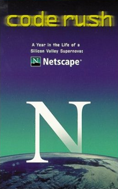
I’m happy to say that Code Rush is now released under the Creative Commons Attribution-Noncommercial-Share Alike 3.0 license. Winton and his colleague John Koten set up a dedicated homepage for the film, with links to stream or download the film in various formats.
They’re encouraging everyone to use the documentary in new ways, remixing or reusing the footage for any non-commercial use. In particular, I’d imagine the Mozilla Foundation should be very happy that they can finally use this historic footage of their origins.
Thanks to the new license, I’m able to put my annotated version of the film back up on Viddler. I’ve embedded it below. Update: Replaced with YouTube version, since Viddler is dead.
Best of all, David Winton’s announced that they’re planning on digitizing the original interview footage and making them available. “We are still working to get our hands on a digital Beta deck to digitize the original dailies, but hope to get up and running in a couple months.” If you can help them out, get in touch.
Update (August 6): I just discovered that unreleased footage from the documentary is being added to Archive.org.
MoneySeize, maddening and addictive Flash platformer
— losing your mind? try the walkthrough video #
Golan Levin at TED on using technology to make synesthetic art
— great followup to his 2004 presentation #
Yahoo! Developer Network on the Microsoft announcement
— BOSS and Searchmonkey up in the air, everything else unaffected (directly) (via) #
Leaked images from Epic Mickey, dystopian Disney videogame led by Warren Spector
— fantastically bizarre, and the biggest Cory Doctorow bait I've ever seen #
Loren Carpenter's Vol Libre, fractal CG short film from 1980
— online for the first time, with a wonderful backstory #
Kirrily Robert's OSCON keynote about women in open-source projects
— lessons learned from two OS projects with female majorities; related: this contentious comments thread (via) #
Computer vision project reconstructs 3D cities/landmarks in hours using Flickr photos
— they generated a skeleton of Rome in 21 hours using 500 compute cores and 150,000 photos (via) #
Ars Technica on AP's confusion over their own technology
— Yoz Graham interviewed the lead hNews guy, and there seems to be a gap between reality and the AP #
Yahoo gives up on search in 10-year Microsoft agreement
— the press site is the worst of both worlds; what's the fate of Delicious, BOSS, Search Monkey and their other search projects? #
Cory Arcangel's YouTube mashup of cats playing Arnold Schoenberg's Op11
— absolutely brilliant, don't miss the MP3 and his methodology (via) #
Moot's update on the now-lifted AT&T block on 4chan
— any bets on what the mystery news is, coming later this week? #
Andrew Plotkin's talk on rule-based programming in interactive fiction
— extended thoughts on Inform 7 and why existing languages don't work well for IF (via) #
Preview demonstration of Spotify's iPhone app
— it supports offline music listening, a first for streaming apps; Spotify's coming to the US later this year (via) #
Disney Imagineer unearths 50 minutes of unseen footage of Disneyland's construction
— time-lapse of every section of the park with wonderful narration (via) #
AT&T DSL blocks access to 4chan
— possible explanation: AT&T working around the ongoing DDOS against 4chan #
AP to crack down on article linking with impossible vaporware
— related: Associated rePress, a tumblelog I just created in five minutes using the AP's own RSS feeds (via) #
Chicago Public Radio helps indie bands fact-check their Wikipedia entries
— not very rigorous in its methodology, but still funny (via) #
Tron Legacy trailer
— directed by the guy who did iSpec; I like the little viral site, with imaginary Space Paranoids machine #
Jason Scott's uploading five years of 4chan to Archive.org
— it's vital Internet history, but are there privacy concerns when most everyone's anonymous? update: not so fast #
Kickstarter and the 1,000 True Fans
— 94% of projects that hit the 25% mark ultimately hit their goal #
Anil Dash on the Pushbutton Web
— the best articulation of the current real-time web trend I've seen #
Joel Johnson bought Wally Wood's 22 Panels That Always Work
— and offered up lovely high-quality scans; related: his awesome About page #
Harry Potter's media counterparts
— Nick Denton as Severus Snape: "Is he evil? Is he good? What does he have up his sleeve?" #
Vanish, self-destructing digital data
— the encryption key's distributed to multiple nodes and dissolves over time (via) #
Lisa Katayama's NYT profile on otaku with "2-D lovers"
— it's okay to love cartoons, as long as you don't love cartoons (via) #
Comic themes for iGoogle
— Renee French, R. Stevens, Jeffrey Brown, Dan Clowes, James Kochalka, Jim Woodring, and more #
Steven Frank's Internet Garage Sale
— I keep waiting for someone to replace eBay, since fraud made it completely useless #
Sam Raimi to direct World of Warcraft movie
— two hours of the protagonist grinding to level 60 (via) #
Khoi Vinh on two projects reviving newspaper comics in print
— see also: Newspaper Club and the upcoming McSweeney's newspaper project #
Kevin Spacey shows Twitter to David Letterman
— Letterman gets about 3.5M viewers nightly, about 425% more than Spacey's followers #