
News! This week, I started writing Codeword, a new weekly column for Wired.com. I’m covering a mix of data journalism, Internet culture, indie gaming, or whatever else I find interesting — the same kind of thing I’ve written here for almost a decade.
As part of the arrangement, I retain joint copyright and can republish my columns here after 24 hours, which I’m very happy about.
My first column went up on Wired yesterday, a thinly-disguised rant on Google’s removal of the + operator from search, which I noticed last Wednesday.
Obviously, this change isn’t the end of the world, but it got me thinking about how the importance of alpha users changes as services grow in popularity. I hope you enjoy it.
Google+ is the fastest-growing social network in history, with 40 million users since its June launch. To help them focus, Google’s quietly shuttered a number of products, removing iGoogle and Google Reader’s social features and closing Google Labs, Buzz, Jaiku and Code Search in the last two weeks alone.
But in doing so, they also killed off one of its oldest and most useful tools, from its most popular product.
On Wednesday, Google retired a longer-standing “plus”: the + operator, a standard bit of syntax used to force words and phrases to appear in search results. The operator was part of Google since its launch in 1997 and built into every search engine since.
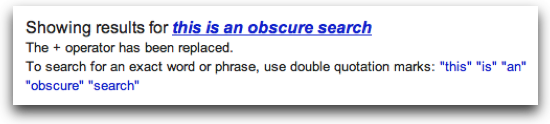
Unlike their other recent closures, the removal of + was made without any public announcement. It could only be found by doing a search, which advised the user to double-quote the string from now on, making “searches” look like “awkward” “Zagat” “reviews.”
Google wouldn’t disclose exactly why they phased it out, though it seems obvious that they’re paving the way for Google+ profile searches. When Google+ launched, instead of adopting Twitter’s @reply syntax, they coined their own format for mentioning people — adding a plus to the beginning of a name — triggering the future conflict with the + operator.
The fate of the “+” symbol was clear: protect a 12-year-old convention loved by power users, or bring Google+ profile searching to the mainstream? It was doomed from the start.
Geeks from Reddit and Hacker News were quick to condemn the move.
To understand why they’re upset about a single character, let’s step back to Google’s launch in 1997.
Why It Matters
For the first 12 years of its life, from its launch until early 2009, Google worked like this: every term you searched for appeared on every web page in its results. Nerds call this an “and” search — a search for “cherry pie” becomes “cherry AND pie.”
By comparison, the popular convention at the time was to return pages with any of the search terms present — an “or” search. The results were noisy and unhelpful.
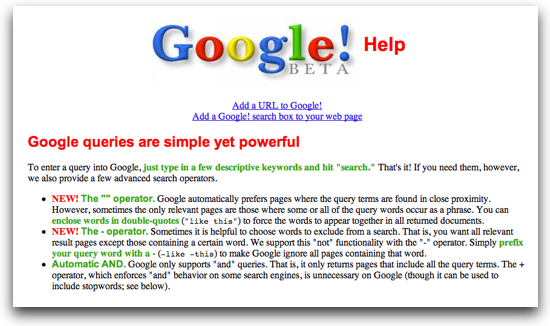
Google’s own help page, archived in February 1999, explained it:
Google only supports “and” queries. That is, it only returns pages that include all the query terms. The + operator, which enforces “and” behavior on some search engines, is unnecessary on Google.
At the time, this new feature was a godsend for savvy users. Because every term appeared in results, you could continue to refine your queries by simply adding new words to the search bar until you found what you were looking for.
As Google grew in popularity, this didn’t scale. Non-technical users don’t know what search terms to use or how to use search modifiers, and they shouldn’t have to.
Instead, Google needed to read minds to find what their mainstream audience was looking for, even if it meant ignoring what they actually wrote.
They started with the introduction of spelling suggestions, with “do you mean?” prompts introduced in 2003. By 2009, these were so successful that Google replaced the user’s search with the corrected words by default, though they always explicitly explained the change.
In January 2009, however, Google began experimenting with silently ignoring search terms completely.
For anyone deep-diving Google for the dark corners of the Internet, this change was hard to swallow. For the first time, searches were unreliable — an “or” search instead of an “and” search.
Journalists and software engineers, two classes of people who commonly search for obscure terms, objected to the change most.
“It’s incredibly annoying,” wrote Peter Rojas, gdgt founder and co-founder of Engadget and Gizmodo. “I hate how they don’t want you to do searches for exactly the words you’ve entered and nothing else.”
“I also use + constantly. It’s such a long-standing convention,” wrote Mat Honan, senior reporter for Gizmodo and former contributing editor to Wired.
Even Matt Cutts, head of webspam at Google, personally agreed. “My fingers are crossed for coming up with a better approach to this,” he said on Twitter. “As a power user, I want my escape hatch/safety valve for ‘Yup, I want exactly that weird word’ too.”
So, should we just “search” “like” “this” forever? Naturally, enterprising hackers are already routing around the perceived damage.
The Alternatives
As Google marginalizes its core base, it’s opened the door for smaller, more nimble startups, such as DuckDuckGo, a one-man project that’s quickly becoming the go-to search engine for discriminating nerds.
With a corpus of powerful search modifiers and a hard-line stance against tracking and personalization, it was created and maintained for the last four years by a single engineer, Gabriel Weinberg. This month, Weinberg announced DuckDuckGo accepted funding from Union Square Ventures and hired his first full-time employee.
For those unwilling to leave Google’s deep index, there are other solutions. One pseudonymous hacker made FindErr, a simple proxy that adds quotes to every search before shuttling the user off to Google.
My personal favorite is this simple userscript created by electrotype for Hacker News, which instantly adds quote marks to every submitted search. It works in Chrome natively and Firefox with the Greasemonkey plugin.
Too Hardcore
As a service grows in popularity, alpha users outlive their usefulness. The core users that helped build a service by word-of-mouth often find themselves dwarfed in numbers by people with very different needs.
Take the recently-announced changes to Google Reader, for instance. Reader is the most widely-used and deeply-loved feed reader ever made, steamrolling over several startups in the mid-2000s in the process. Any startup would be thrilled to have their devoted audience; within Google, Reader seems like a distraction.
Last week, the Reader team announced the removal of all of its social features, used by a relatively small but rabid fanbase.
Courtney Stanton, a Boston-based product manager, called Google Reader “the best social network created so far” in a passionate rant on her blog. “For me, this is the destruction of the only online space I truly give a shit about.”
There’s no easy solution. Should a company be expected to maintain features indefinitely because a tiny fraction of their base loves them? There are tangible costs to maintaining old code, and fringe features can clutter an interface, making user experience worse for those that don’t use them.
For those people, removing features is more than an inconvenience. It shatters an entire community. But, ultimately, their usage is a rounding error in the overall product activity.
With Google Search and the + operator, the consequences are far less dire. I asked Google what inspired the + removal, and how they balance the needs of power users with those of their mainstream base. “We’re sensitive to the needs of both newer users and ‘power users’ alike, and we’re always looking for ways to improve search for both groups,” a Google spokesperson said. “We make changes to search after rigorous testing shows that they improve the user experience.”
At Google’s scale, user testing can hide the behaviors and passions of entire subcommunities. The long-term implications of small changes like these are very hard to predict, especially with early adopters.
Who knows? If Google’s search engine dominance started with an “and,” it might just end with a “+”.
Maybe it’s just me as a librarian but I have always used quote marks and Boolean Operators when looking for phrases/word combos.
My understanding is that google pays attention to data (in this case, data it gathers on how its search engine is used) more than to its users. While this may seem wrong, it really isn’t. The data regarding usage is “pure” whereas users will bias what they say based on their experience, knowledge, preferences, etc. I’m a design researcher, so I know about this stuff.
Obviously, I don’t know what google’s thinking really is, but I’d wager that their data is telling them that there is an overall benefit for the most users by removing the +.
I like the + and I’m sad to see it go. But I’ve rarely been let down by google, so I’m happy to give them the benefit of the doubt.
Of course, that was the basic premise of my article… The needs of the many (mainstream, non-technical users) are far outweighing the needs of the few (power users).
I’m sure Google’s changed are making things better for those users, at the cost of potentially alienating their original core base.
I agree with your analysis, but I dispute the conclusion that this was always the destiny of Reader Share.
Reader’s social features were awkwardly implemented and poorly advertised and never given room to breathe. Imagine if Google had done what Twitter did and promoted celebrity sharers, and made it clear in the UI exactly how “you, too, can be a sharer.”
Instead they moved sharing into a separate place in the UI, and called it something weird (“People You Follow” and “Comment View” instead of just “Shares”) and then failed to integrate it with Plus… although they did get Buzz integration working ultimately, but again didn’t promote it, so even a Reader power user like me didn’t know how it worked until just now: https://plus.google.com/107397735779828096052/posts/5M2xjLwo5qp
Yet another entry in the Disturbing Internet Trend of treating users as consumers instead of creative peers.
Rumors coming out of the Silicon Valley… a new networking platform with advanced search capability that allows a non-nerd to find people for business, research, venture capital, business plans, marketing ops, etc. The platform is HD video-based. see me now is the phonetic name for it. I haven’t seen a logo yet. nothing shows up on Google (surprise). Anyone heard or seen anything about this?
While this might be upsetting to people now.. I don’t this it will have any long term implications. They didn’t actually remove the feature, they just changed how you have to do it.
I personally have very rarely used the + operator in google. I myself have always used quotes. Maybe searching methods like what I use are more prevalent among power users than you think? Only Google knows.
Yesterday, the Google Reader team rolled out the new Google Reader to almost unanimous disapproval. Almost no one likes it ( http://www.google.com/support/forum/p/reader/thread?tid=5a14d4898b83412c&hl=en ).
I thought Google was supposed to be this leading edge tech company. More like the Wizard of Oz.
Turning some searches to OR is annoying, but doing so without any notification is completely user unfriendly.
The plus and quote operators were never really synonymous, though, were they?
Quoting is useful as a means of indicating the exactness of a search term. The difference between a quoted and unquoted search for web is that the latter will also match pages that include webs, website, etc., while the former only matches exact instances of the word “web”.
The plus operator is (err, was) a means of indicating the necessity of a search term. Google uses the context of links to a page in addition to the page’s own content when evaluating its relevance for search terms — this meant that results could occasionally include a page that didn’t include one of your search terms, but was still deemed relevant to your search because the term was present in a context that linked to that page. The plus operator overrode that behaviour, and signalled that the term must be present in the actual result.
Both are, to a degree, pro tools to override Google’s prevailing guess-what-you-really-meant behaviours, but they were not synonymous in concept or in function.
I just did a couple quick tests, and the current behaviour for quoted terms seems to include an implied +, but I don’t know if that’s always been the case.
More importantly, the change removes the ability to force a +ed but not quoted behaviour: There are situations where I absolutely want pages containing a certain search term, but I’m not picky about the form of that term (e.g., I’m open to pluralizations or synonyms). There seems to no longer be a way to specify that.
AltaVista had the plus syntax before Google, and it may have been a search engine standard even before AV: http://notess.com/write/archive/9606.html
Yes, the + and “” operators were always synonymous. At least, for the past several years. I did a little wayback-machine searching, and Google’s help page was unambiguous:
“Google employs synonyms automatically, so that it finds pages that mention, for example, childcare for the query [ child care ] (with a space), or California history for the query [ ca history ]. But sometimes Google helps out a little too much and gives you a synonym when you don’t really want it. By attaching a + immediately before a word (remember, don’t add a space after the +), you are telling Google to match that word precisely as you typed it. Putting double quotes around the word will do the same thing.” (Feb 2009)
This description remained essentially unchanged up until the + went away last week.
Note that this says nothing about the *necessity* of the term (as you describe it). There was no operator that limited your results to pages *containing* your search term. I suspect people have been attributing that behavior to + for years, out of habit, wishful thinking, or (perhaps) an undocumented weighting factor that Google has been phasing out.
SRC: Yes, it was standard for search engines. As Google said in their 1999 help pages, the big innovation was that you didn’t *need* to use it, unless you were searching for stop words. Every search was an AND search, until Google started changing it a couple years ago.
As a power-user I would have to admit I am struggling to find a replacement for the ” + ” symbol…
@Andrew Plotkin:
Ahh. Thanks. I humbly stand corrected.
Yeah, I’d chalk up the mistake to a combination of wishful thinking, and a misleading mental model. From the outside, there’s no reason to assume that + and “” would be synonymous. The general connotations of these symbols are quite different. (For what it’s worth, my use of the quotes operator was normally reserved for multi-word terms, anyway.)
@Wes Campaigne:
“There are situations where I absolutely want pages containing a certain search term, but I’m not picky about the form of that term (e.g., I’m open to pluralizations or synonyms). There seems to no longer be a way to specify that.”
Actually, there is a way to do that, but it is tedious: the OR operator. Continuing the previous example of “web”, your search term would become:
“web” OR “webs” OR “website” OR “internet” OR …
You may also use the tilde operator to specify that synonyms are fine, e.g. “~web”, or the wild-card (*) operator for, um, wild-cards, but I’m not sure if these work inside quotes the way you would expect.
By the way, Code Search has not been closed yet. Rather, it has been announced that it will be closed early next year.
I don’t think Google invented this + symbol. It was part of other search engines before.
Never said they did. In fact, I think I was pretty clear about that when I mentioned that their help page from 1999 said the “+” symbol wasn’t necessary, unlike other search engines of the day.
I must say I did realise that google search was getting more and more difficult to get thru.
i just never got to know that they changed the and to an or – i was thinking the internet is just getting overcrowded ^^
i personally am a power user (might not use reader) but i literally grew up with google! i know the guy who made it (indirectly) but as soon as i had my pc with 8 is when google started and since then nothing else.
but now it looks like it’s a duckduckgo era
ps: i was always aware of the ” ” possibility but it’s just annoying 😛
At first I was a little upset at reading this, until I realized that I actually use “quotes around an exact phrase” and the – far more frequently than I use + as a search operator — both of which still appear to work as I need them to, to whittle down results.
I frequently search for mutli-word media titles, such as the film “Martha Marcy Mary Marlene” (and I had to use [“movies from 2011” mary] minus brackets, to find the title I couldn’t think of just now). The only reason I can recall having ever used + is to deliberately include a word in a search result, to the opposite effect that adding – before a word removes results with that word in it. Memorable searches have had over a dozen -excluded words. For instance, I just tried searching for the above title using only [mary movie 2011] but got so many stray results I had to modify it with [ -kay -margaret -bridal -jesus -meeker -louise -2.0 -sister -bloody -proud -blige -buttons -hello -ward -christ -call -surratt -olsen] before giving up, although still glad that the -exclude option remains.
I was using include and exclude searches for things back when Infoseek was my primary search engine, before it got purchased by ABC/Disney.
Check out this opera extension I wrote. It automatically puts every word intelligently in quotes, also tries to disable google instant and what not nonsense they messed it up with since 2007.
Just wrote it today, works for me, will develop it further some time for fun.
https://github.com/mathias-steiger/opera_gsearch_sanitizer
I just want a way to make search for what I tell it to and not just whatever the hell it wants! Its like googles tripping you And saying I just tripped you because I knew you didn’t want to go that way! See I helped! I’m helping!!
what the…what!
I once yet again get myself personally paying way too much time each studying and writing comments.