
I spent last weekend revisiting the “supercut” meme, with a talk at WFMU’s Radiovision conference in New York and my new Wired column, which you can read below.
To cap it off, I spent a night revamping Supercut.org into a comprehensive, browsable database of supercut videos, with the help of Twitter’s Bootstrap CSS toolkit.
I’m very happy with how the site came out, so let me know if you have any suggestions and please submit any videos I missed. I also just added RSS and you can now follow @supercutorg for updates. Thanks!
For the last few years, I’ve tracked a particular flavor of remix culture that I called “supercuts” — fast-paced video montages that assemble dozens or hundreds of short clips on a common theme.
Many supercuts isolate a word or phrase from a film or TV series — think every “dude” in The Big Lebowski or every profanity from The Sopranos — while others point out tired cliches, like those ridiculous zoom-and-enhance scenes from crime shows.
Since 2008, I’ve added every supercut I could find to a sprawling blog post. With nearly 150 of these videos, and more being added weekly, it’s turned from a blog post into a minor obsession.
Earlier this year, I collaborated with NYC-based artist Michael Bell-Smith on Supercut.org, a 24-hour hack to make a supercut composed entirely out of other supercuts, along with a randomized supercut browser.
Today, I’m happy to announce that I’ve relaunched the site to let you browse the entire collection in different ways, subscribe to updates, or submit your own to the growing list. I’m also releasing the entire dataset publicly, which you can download at the end of this post.
To understand the rise of this new genre, let’s take a look back at how it began and how it’s evolved in the last three years.
The Proto-Cuts
While the web popularized the genre, the art world was experimenting with similar film cut-ups for years before YouTube was a gleam in Chad & Steve’s eyes.
Brooklyn-based critic Tom McCormack wrote the definitive history of the supercut, tracing its origins back to found-footage cinema, like Bruce Conner’s A MOVIE from 1958.
But it wasn’t until the 1990s that clear descendants of the genre emerged. Matthias Müller’s Home Stories (1990) reused scenes from 1950s- and 1960s-era Hollywood melodramas, filmed directly from the TV set, to show actresses in near-identical states of distress.
Christian Marclay’s Telephones (1995) showed famous actors answering ringing telephones in a string of surreal, disjointed conversations throughout Hollywood history. Edited together, the cadence and rhythm of nonstop clips feels very reminiscent of modern supercuts.
Apple tried to license Marclay’s film for the launch of the iPhone in 2007, but he refused. Instead, they made their own, borrowing the idea wholesale. (Marclay decided not to sue.)
As far as I can tell, the earliest supercut native to the web was Chuck Jones’ Buffies from 2002, which isolated every mention of “Buffy” from the first season of Buffy the Vampire Slayer.
While there were rare exceptions, supercuts really didn’t start proliferating online until around 2006. Why then? The likely cause: YouTube.
Before YouTube, it was incredibly difficult to both find and share video. After YouTube’s launch in 2005, searching through big chunks of film and TV’s recorded history became simple. Perhaps more importantly, sharing the video with others didn’t require server space, a huge amount of bandwidth, and a deep knowledge of video codecs. It just worked.
The result was that clips were easy to find and even easier to distribute. Combined with the rise of BitTorrent and the availability of affordable, easy-to-use video editing software like iMovie, it was the perfect environment for video remixing. The only missing ingredient is the time and passion to make it happen.
Supercut as Criticism
When I first started tracking the trend in 2008, almost every example was created by a superfan. Creating videos with hundreds of edits takes a staggering amount of time, and the only people willing to do it were those who were in love with the source material.
In the last three years, the form seems to have evolved from fan culture to criticism.
Rich Juzwiak may have started the trend by calling out reality TV contestants for their overused “I’m not here to make friends” trope. That directly led to supercuts criticizing lazy screenwriting, from “We’ve got company” to “It’s gonna blow!”
But recently, it’s being used for more serious criticism: calling out politicians and the news media. The Daily Show pioneered the reuse of archival news footage and quick edits to point out the absurdity of the news media and political figures, but online video remixers are taking it much further.
Video remixing group Wreck & Salvage took Sarah Palin’s speech about the Arizona shootings and removed everything but the sound of her breathing. The result, Sarah’s Breath, was a creepy example of supercut as political speech.
In March, artist Diran Lyons released one of the most epic supercuts ever — chronicling every time President Obama says “spending” in the complete video archive posted to the White House website. The result is six minutes long with over 600 edits.
The results are effective. Just as it was used to point out film cliches, a supercut sends a message about a public figure’s speech in a very short period of time. For that reason, I wouldn’t be surprised to see supercuts make their way into 2012 campaign ads.
Breaking It Down
I wanted to learn more about the structure of these videos, so I enlisted the help of the anonymous workforce at Amazon’s Mechanical Turk to analyze the videos for me.
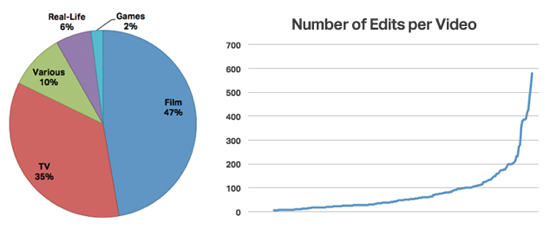
Using the database of 146 videos, I asked them to count the number of clips in each video, along with some qualitative questions about their contents. Their results were interesting.
When looking at the source of the videos, nearly half come from film with a little over one-third sourced from TV shows. The rest are a mix of real-life events, videogames, or a combination of multiple types, as you can see below.
According to the turker estimates, the average supercut is composed of about 82 cuts, with more than 100 clips in about 25% of the videos. Some supercuts, about 5%, contain over 300 edits!
I asked the turkers whether each supercut was comprehensive, collecting every possible example, or if they were just a representative sample. For example, collecting every one of Kramer’s entrances from Seinfeld vs. a selection of explosions from action films. The results were split, with about 60% comprehensive. This could be attributed to film cliche supercuts, which don’t attempt to be thorough.
Finally, I was wondering whether each video’s creator was a fan or critic of the source material. The workers surveyed said that most supercuts were created by fans, about 73% of the time. This style of video remixing may be useful for criticism, but for now, it seems to mostly be a labor of love.

The Data Dump
Want to do your own analysis, or do some video remixing of your own?
You can view the full supercut database below or on Google Docs, or download the data as a comma-separated text file or Excel spreadsheet.
And, of course, let me know if you find any that I missed!
This one is missing and HAS TO BE: http://www.youtube.com/watch?v=Sxcei2eOCMo
The first supercut I saw was Julie Chen on CBS saying “but first”, back in the wee early days of youtube: Julie Chen-Bot. I think it counts as part of this list, for its sheer pioneering efforts.
And totally free-associating, I remember someone posting Connie Chung has lost it around the same time. (This has nothing to do with the first other than them both being early viral videos. Remembering one opened up the other in the encyclopedia in my head.)
Vson: The Julie Chen video was one of the first added to Supercut.org. Thanks!
Should you be not too hectic looking for focus, all I hear is a variety of moaning about something you may resolve.