
I don’t watch sports, but every four years, I lose myself in the horse race of the U.S. presidential elections. That competition kicked off in earnest Monday, as Gallup started its daily tracking polls for the general election between Barack Obama and Mitt Romney.
In 2008, I was hooked on one drug for my daily fix: Memeorandum, a completely automated aggregator that surfaces popular stories from political news sites, often within minutes.
As you’d expect, the universe of political blogs is largely split in two, with conservative and liberal blogs rarely covering the same stories or linking to the same sites. But it can be very challenging to tell their political leanings at a glance, especially with names like “Balloon Juice,” “Weasel Zippers,” or “The Volokh Conspiracy.”
So, four years ago, I launched a project with Delicious/Tasty Labs founder Joshua Schachter to visualize the linking biases of various political blogs on Memeorandum by looking at their past behavior.
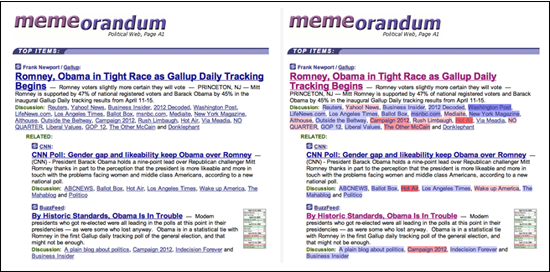
Using singular value decomposition, the linear algebra at the heart of your Netflix recommendations, we reduced the entire matrix of blogger-to-article relationships to a single dimension. Imagine a single line grouping like-minded blogs together based on the diversity of the stories they cover, with hardcore left- and right-leaning blogs on opposite sides of the spectrum.
Using those precalculated values, we load the data from Google Spreadsheets and color the links on Memeorandum, based on where they fall on the spectrum. The brighter the color, the more frequently they only cover stories by their counterparts.
This simple visualization leads to some interesting insights. Compare these two articles, which were trending on Memeorandum at this writing:
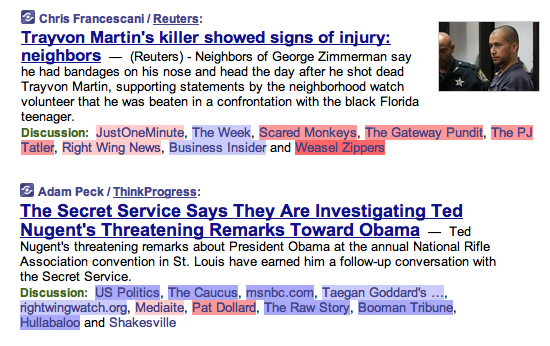
Seeing each site’s potential bias provides the context for understanding how news is spread. Right-leaning blogs are eager to point out new evidence that George Zimmerman was hurt the day he shot Trayvon Martin, but left-leaning blogs aren’t covering that story. Likewise, only left-leaning news sites appear to be covering the news of Ted Nugent’s threatening remarks to the president, but conservative blogs aren’t. This visualization also makes it easy to spot outliers, the sources that are breaking away from their past behavior to link to something beyond their usual circle.
This browser add-on is free and open source on Github. We’ve updated the data sources for the first time since 2008, and Memeorandum Colors now works natively in Chrome, in addition to Firefox.
You can try the browser add-on by following these simple directions.
Google Chrome
- Click the memeorandum_colors.user.js link.
- In the warning dialog at the bottom of Chrome window, select “Continue.”
- Visit Memeorandum and wait a moment for the links to color.
Firefox
- Install Greasemonkey.
- Restart Firefox.
- Click the memeorandum_colors.user.js link, wait three seconds, and Install.
- Visit Memeorandum and wait a moment for the links to color.
Four Years of Data
Along with this release, we now have four years of historical activity to work with. The collected scores are on Google Fusion Tables, and I’ve included a dump of the activity in Github.
Looking at historical activity can reveal some interesting trends, especially in how attitudes have shifted since the last election.
For example, Little Green Footballs is a long-running political weblog started by Charles Johnson, a web developer who aligned himself with the conservative right wing after the World Trade Center attacks. In late 2009, he publicly parted ways with the right.
That shift away from conservatism was reflected in his linking behavior at least a year before his public statement. If you look at the timeline below, you can see that Johnson started linking to a wider variety of stories outside the conservative conversation, until his activity was mostly neutral in early 2010. Now, his activity tends neutral but slightly favors articles popular in the liberal blogosphere.
Bias In Linking, Not Beliefs
Memeorandum was created by San Francisco developer Gabe Rivera, who followed its introduction with aggregators for media, celebrity gossip, and baseball news. The most popular of these is Techmeme, a daily destination for tech industry watchers.
A month after Obama’s election, Rivera announced he’d hired a human editor for Techmeme to help prevent inaccurate results from the algorithm. This editorial oversight would affect any link-based analysis on Techmeme, but he confirmed that Memeorandum is still completely machine-driven.
This automated analysis is not a commentary on the personal opinions and beliefs of any blogger — no amount of linear algebra can prove that. What this shows is the biases in their linking behavior: the stories that each site chooses to cover, or not cover, and their similarity to others like them.
If you’d like to learn more about the math behind how this works, there’s more detail and links to tutorials on my original blog entry.
Let me know if you have any questions and I’ll try to answer them in the comments.
Great article! Keep it up!