
Salon lays off The Well staff, put it up for sale
— I have an archive of every pre-2005 post, just in case #
The Kleptones' Paths to Graceland mixtape
— trying to track down and reconstruct the mythic tape that inspired Paul Simon #
Profile of Mike Merrill, publicly-traded person
— full disclosure: I'm bidding on several shares in the public auction #
Anil Dash on clouds for people and EC2 for poets
— love this idea, something I spent lots of time on at Expert Labs #
Google Compute Engine launches
— like EC2, access to the virtual machines instead of App Engine alone #
Google Chrome and Drive launching on iPhone and iPad today
— likely only using Apple's rendering engine, so not as significant as it seems #
Google's Project Glass demo at I/O
— live skydiving onto Moscone; attendees can preorder for $1500, ships next year #
Idea Channel on mashups and the shifting value of genre definitions
— between Off Book and Idea Channel, PBS is doing interesting online work lately #
Rock-scissors-paper robot wins every time against human opponents
— high-speed vision analyzes your move and responds before you finish throwing #
Jess & Russ's wedding invitation
— it took six months and the help of 15 star illustrators and designers #
Louis CK selling complete tour direct through his site
— no ticket agencies, flat rate, no sales tax #
Facebook switches all users to facebook.com email addresses
— idiotic, especially since all emails from non-friends end up in the Other black hole #
Ars Technica feature on the rise and fall of Winamp
— including interviews with members of the former Nullsoft team #
Jonathan Coulton on the future of music, 3D printing, and scarcity
— a reaction to Emily the intern and the resulting kerfuffle #
Can't Wait for iOS 6? Renegade Developers Trade Access for Cash
Every year, Apple’s keynotes hype the latest and greatest iOS software, receive unprecedented media coverage, and tout hundreds of new features on the Apple homepage. But then, like an evil Santa Claus, Apple asks their most passionate fans to wait months to play with the new toys. This year, like the year before, they didn’t announce a release date, promising only sometime “this fall.”
If you’re a diehard Apple fan that desperately wants to run a buggy beta version of iOS 6 right now, your only legal option is to shell out the $99 to join the iOS Developer Program. Affordable for a developer, the barrier to entry is high enough to keep out casual fans from accidentally bricking their phones and cluttering up the Genius Bar.
But over the last couple years, a cottage industry’s popped up around illicit UDID activations — startups exploiting Apple’s Developer Program to sell access to prerelease iOS software, usually for less than $10 per device. The craziest thing? Apple doesn’t seem to care.
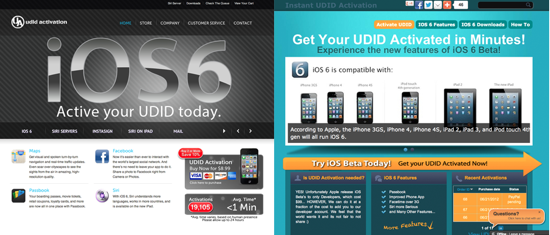
Do a search for “UDID Activation” and you’ll find a dozen web sites, including some advertising on Google, with SEO-friendly names like ActivateMyiOS, Activate My UDID, UDID Registration, and Instant UDID Activation. Unlike casual registration trading of the past, these new startups offer secure payment options, solid customer support, Twitter and live chat, and quick turnarounds. One service even offers an AppleCare-like guarantee called “SafetyNet” that protects you if you lose your device or buy a new one.
Behind the scenes, each service uses the same simple backdoor: Registered iOS developers can activate up to 100 unique device IDs (or UDIDs) for their account, an essential tool for testing apps on multiple devices. Once registered with Apple, the activated device is also able to run prerelease versions of iOS, though developers are forbidden from sharing prerelease software outside their own team.
Ignoring these warnings, activation services charge a small fee to add a customer’s device to their developer accounts. When they hit the 100-device limit, they just register a new account with Apple.
I spoke to the founder of UDID Activation, an activation service based in Galesburg, Illinois, who asked not to be named. “I set up a new Apple developer account every time I need another list,” he said. “I have 30 developer accounts, all with the same name and address, and Apple’s never said anything.”
There have been isolated reports of Apple disabling developer accounts, but some of these services have been running uninterrupted for years without any apparent consequences.
“It’s obvious it’s there, and there are tons of people doing it,” said UDID Activation’s founder. “If they wanted to look into it, it wouldn’t be very hard for them to find out what was going on. I’ve been doing this for about three years and I’ve never been contacted by Apple, and they’ve never shut down my accounts or anything. It really does seem like they don’t care that much.”
I chatted over instant message with a support representative from a competing service that claimed to have ten iOS developer accounts and a bot to reactivate expired UDIDs. I asked how often Apple kills their accounts. “Never in five years,” he said.

Apple clearly states in its Developer Program License Agreement, and on its Developer Portal, that membership can be terminated if a developer provides pre-release Apple Software to anyone other than registered employees, contractors, or others with a demonstrable need to know or use the software to build and test applications. Apple adds that unauthorized distribution is prohibited, and may be subject to both civil and criminal liability.
Despite Apple’s threat of “civil and criminal liability,” the service operators I spoke to didn’t seem concerned. “In the developer section, there’s a notification that says selling spots to your developer account can get it shut down,” said UDID Activation’s founder. “But I’ve never heard of anyone getting their account shut down for selling spots.”
It might not be that simple. Detecting fraudulent activity isn’t as straightforward as it seems, unless Apple actually purchased activations from each service to identity the account holder. Purchased accounts don’t look any different than normal beta testers, though the rate of registrations could be an indication of service violations.
For a small developer, unauthorized activations are a lucrative business that’s likely worth the risks. UDID Activation publishes their order queue on their official site, which shows over 2,300 devices activated in the last week alone. At $8.99 for each activation, that’s over $20,600 in revenue, with $2,277 paid to Apple for the 23 developer accounts. Their homepage claims that over 19,000 devices were activated so far, and that’s only one of several services.
Outside of commercial services, some fans are forgoing commercial services and self-organizing, using discussion forums to crowdfund shared developer accounts, as these Reddit members did last year. On Twitter, authorized developers trade UDID activations for followers and retweets, or just offer them for fun.
Apple may not like it, but all of these back-alley transactions are clearly meeting a market demand. The software may be buggy, incomplete, and not ready for mainstream consumption, but a sizable class of power users doesn’t care and is willing to pay to use it.
For these cheap and impatient users, activation services offer an easy, affordable, and low-risk way to experiment with the cutting edge before the rest of the world. And until Apple starts cracking down, there’s little reason not to use them.
Kickstarter releases detailed stats page, updated daily
— finally, a feature every Kickstarter knockoff won't try to copy #
First Person Tutor
— a proofreading FPS, part of the experimental 7dfps game challenge; some other highlights #
Trailer for Perspective, a crazy first-person puzzler
— taking some of the Fez gameplay mechanic into a first-person shooter #
Owning Your Own Words
— good discussion with Anil Dash, Gina Trapani, Paul Ford, Mathew Ingram, and Winer by proxy #
Satellite Eyes
— Mac freeware changes your desktop to the satellite imagery of your current location #
Joshua Topolsky on the Microsoft Surface tablet
— a first step away from useless concept videos, and towards bringing R&D to the real world #
Origami artist sues over abstract paintings of unfolded designs
— ongoing battles over the definition of transformative fair use #
Progression of an animated scene from Tangled
— live-action reference shots, layout, lighting, and more #
FunnyJunk lawyer files suits against The Oatmeal, IndieGogo, National Wildlife Federation, and the American Cancer Society
— the redacted complaint is up on Carreon's site; I love part 26 #
PBS Off Book's tribute to the animated GIF
— I recommend just playing this full screen all day today #
Jay Smooth on sexist gamer dudes
— 12 hours left to back Anita's project; in case you somehow missed it, the awful backlash and media response #
Technology Review profile on Cameron Marlow and the Facebook Data Team
— they're doing great work, I just wish they had an RSS feed; here it is #
Pattern analyzing the chord structures of 1,300 songs
— I'd love to see an app that always suggests what chord to play next #
Busting the iOS 6 Transit Map Myths
There’s a ridiculous amount of misinformation spreading online about the new maps in iOS 6, compounded by incorrect press reports, vague statements by Apple, and the developer NDAs. I’m even guilty of spreading it myself, based on reports I’d seen on the blogs.
Using information provided to me by an anonymous Apple developer, I’ve pieced together the facts. Keep in mind that iOS 6 is still prerelease beta, and Apple may change anything at any point. Everything below is based entirely on the existing beta software and documentation that Apple’s provided to developers.
Were walking directions removed in iOS 6? Some press reports have stated that walking directions are removed from iOS 6. This is completely false, and walking directions are still in iOS 6. Here’s a screenshot of walking directions in iOS 6, courtesy of Philip Bump.

Were biking directions removed? Bike directions have never been available on the iPhone, and still won’t be in iOS 6.
Were public transit directions removed? As of this beta, inline public transit directions are gone from the Maps application in iOS 6. Clicking the public transit button will display a list of third-party apps that support routing in the defined map area, and will launch the app when clicked. Here’s the current screen in the beta, with no apps registered.

By release, this blank screen will be populated with a default list of appropriate apps from the App Store. The documentation states, “If the user’s device does not currently contain any routing apps, Maps refers the user to apps on the App Store that do.”
What about the new Transit APIs? The new Transit APIs, referred to by Scott Forstall at 108:58 in Monday’s keynote, allow developers to register their app as a directions provider for routing directions for a particular set of coordinates. It will then be displayed in the list of available third-party apps for transit. Clicking a transit app launches that app, passing the start and end values to the app. Contrary to other analysis, transit routes can’t be displayed inline from the Maps app.
How do the Transit APIs work? Apps can enable directions support by setting the type of directions they support, a geoJSON file specifying the map regions they support, and uploading it to iTunes Connect. Developers can specify a category (Car, Bus, Train, Subway, Streetcar, Plane, Bike, Ferry, Taxi, Pedestrian, Other).
Directions requests from Maps are handled by a special URL. From the documentation: “When the user asks the Maps app for directions and chooses your app, Maps creates a URL with the start and end points and asks your app to open it.” From there, the app can “compute and display the route using your custom routing technology.”
Of course, any of this may change before release. But, for the moment, the APIs simply don’t support inline transit routes from within the Maps app.
Are Street View photos removed? Yes, these were also provided by Google.
Why is Apple doing this? Do they hate public transit?! Of course not. Transit directions aren’t in iOS 6 because Apple replaced Google’s maps with their own solution, which didn’t include access to transit data. Maintaining transit feeds and keeping it up-to-date for hundreds of cities was presumably too difficult to attempt for this first release, so they decided to outsource it to third-party apps.
Is Google going to release a Maps app for iOS? We don’t know. Google hasn’t announced any plans for a native Google Maps for iPhone. And there’s a big unknown: if they developed it, would Apple approve it?
Hope that helps. Hit me up with any more questions, or if you have internal information, I’ll happily honor your anonymity.
Reddit user's ten-year Civilization II war spawns a following
— fanfic, comics, and attempts to resolve the war at the new subreddit #