
OK Cupid covers the effects of age on dating and attractiveness
— as always, some incredible dataporn mined from their community via Delicious #Bunnie Huang's forensic research into irregular MicroSD cards
— “Kingston is revealed as simply a vendor that re-marks other people’s chips in its own packaging” via bunniestudios.com #Plants vs. Zombies released for iPhone
— one of my favorite games from last year, a steal at $2.99 #Esquire profiles Roger Ebert
— I’ve said it before, his journal is one of the best things around right now #Clive Thompson on obscurity and social scaling
— “It’s no longer a bantering process of thinking and living out loud. It becomes old-fashioned broadcasting.” #Blaise Aguera y Arcas demos augmented reality maps at TED
— in addition the recent Flickr integration, live geospatial video and space visualization #Nathan Myhrvold's Death Star laser kills mosquitoes in flight
— built from parts found on eBay to fight malaria and demonstrated at TED #Google Chrome for Mac beta gets extensions
— I switched primary browsers last month, my first change since Firebird in 2003 via Daring Fireball #DEN.net and the Top 100 Websites of 1999
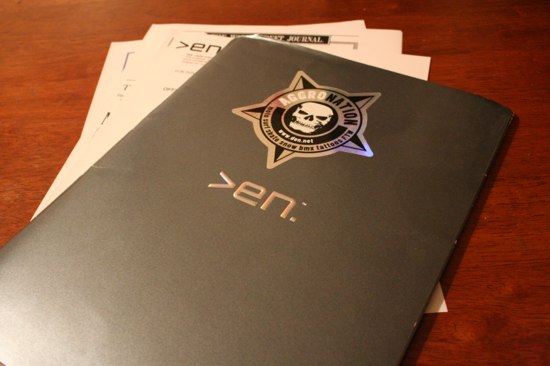
While digging through some books, I stumbled on this DEN.net press packet from November 1999, six months before the notorious video startup’s collapse.
The packet’s a nice little time capsule of their dot-com excess, with promo materials, a breathless press release about their relaunch (“Youth Culture Network Creates Groundbreaking Content That Revolutionizes The Interactive Entertainment Experience”), and copies of articles from the New York Times, USA Today and the Wall Street Journal.
They took the site down for three full days to launch their redesign, something you don’t see often these days. “DEN is here and we’re changing the face of entertainment for Gen Y audiences, bringing this age group an interactive experience unlike anything they’ve known,” said then-CEO, Jim Ritts. (He was ousted three months later after their IPO was shelved.)
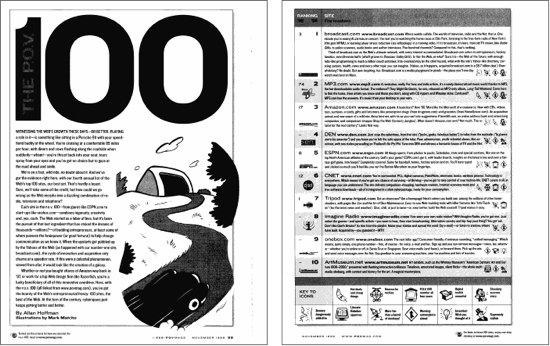
For me, the highlight is an included copy of “The 4th Annual P.O.V. 100 Best Web Sites,” where they appeared at #4. Published by the short-lived P.O.V. magazine, which itself shuttered a month before DEN declared bankruptcy, it’s a nice artifact of the era.
All the usual suspects are there — Broadcast.com, hot off their $5.7B acquisition by Yahoo!, Third Voice, and Six Degrees, alongside webzines like Feed, Word, and Brunching Shuttlecocks and proto-blogs like Cardhouse, Obscure Store, and Jeffrey Zeldman Presents. Debuting on the list at #93, a new search engine named Google that “really works, scouring billions of links for junk-free matches — and it does so quickly.” #100 is Joshua Schachter’s Memepool, “an ever-expanding set of links from smart folks who exist only in cyberspace.”
I was going to scan it in, but managed to find a PDF created by the author himself. With his permission, I’ve mirrored it locally:
Surprisingly, DEN.net is still online, an archive of some old videos and documents, with the intriguing tagline “We’re back…” But since it’s stayed exactly the same since August 2007, I wouldn’t hold my breath for a relaunch.
Ars Technica covers moot's TED talk
— low-quality video of his talk; 4chan’s raw nature is fueled by anonymity and no memory #Bing Maps adds augmented Photosynth street views with Flickr photos
— a detailed window into time using every CC-licensed geotagged Flickr photo from Seattle, Vancouver, and SF; requires Silverlight #

Confused Facebook users think ReadWriteWeb is the new Facebook login page
— they’re searching for “facebook login” on Google, using FB Connect, and posting hundreds of confused comments #CNET's Daniel Terdiman digs into the evolution of Glitch's back story
— including rejected concept ideas, inspired by paper cutouts, automatons, and daydreams #Adam Kempa helps spot the hidden image on New Yorker's 85th anniversary covers
— covers by Brunetti, Tomine, Clowes, and Chris Ware, who also wrote an essay #Google launches Buzz, social updates and sharing
— Friendfeed makes its way into Gmail and mobile; now live, with Reader integration and APIs #Tiny Speck announces Glitch, Flash MMO coming later this year
— CNET has the exclusive behind-the-scenes and in-depth preview of the game #ChatRoulette, videochat with a random person
— like Omegle with a webcam, randomly NSFW; YouTube has some great video captures via Kottke #Penn & Teller's Invisible Thread
— 1987 short film finally digitized by a fan; cameos by James Randi, Andy Warhol, and Whodini #Choire Sicha interviews Paul Ford, Harper's web editor
— “YOU ARE THE STUPIDEST WEBSITE IN STUPIDTOWN BECAUSE I WANT EVERYTHING FREE RIGHT NOW!” #Record Tripping
— turntablist-inspired game samples Alice in Wonderland and music by Gorillaz, Beck, Death Cab for Cutie, and Spoon via Boing Boing #Shutup, disable comments on popular websites
— related: Engadget disables comments and the Macheist team adds them to Daring Fireball #Pirating the 2010 Oscars
Avast, ye scurvy dogs! The Oscar nominees were announced yesterday, which means it’s time again to revisit the eternal war between the MPAA and Internet movie pirates.

I’ve updated my spreadsheet with all the current available data, eight years of data tracking the online distribution of every Oscar-nominated film since 2003. I’ve added this year’s 34 nominated films to the list, a total of 245 films. (Read about my methodology at the end of the entry.)
View or download all the data below, including a second sheet with some interesting aggregate statistics. As always, I’ll keep it updated until the Oscar broadcast. (And let me know if you find any mistakes.)
View full-size on Google Spreadsheets.
Download: Excel (with formulas) or CSV
Findings
Since 2003, I’ve tracked the online distribution of Oscar screeners, and every year, the piracy scene manages to release nearly every film by nomination day. Last year, all but three films were leaked in DVD quality by nomination day.
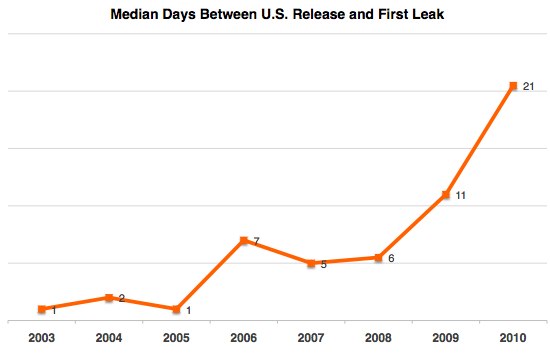
The tide may be turning. There’s still a month out before the Academy Awards, but so far, fewer Oscar screeners leaked online this year — only 14 out of 34 nominated films, the lowest percentage ever. And they’re taking twice as long to leak — a median 21 days after theatrical release, up from 11 days the previous year.
It’s not limited to screeners, either. Camcorder and telesync releases dropped this year. Even the percentage of retail DVD rips has dropped, though this will likely shift before the broadcast. In the chart below, you can see the percentage of films that were released in each format. (For example, 21% of this year’s films had a cam release and 44% had a retail DVD leak.)
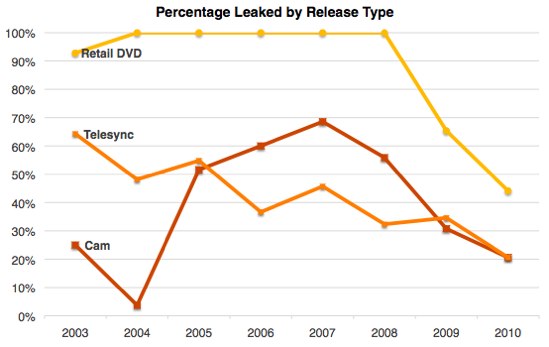
And the R5 DVD releases that dominated previous year’s Oscars is now mostly dead. I’m guessing the studios are moving away from the early distribution of R5 DVDs entirely.
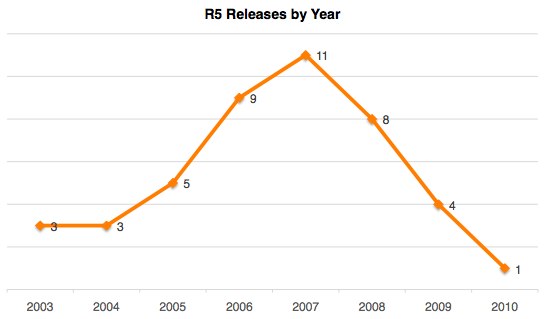
But why the shift this year? Are studios doing a better job protecting screeners and intimidating Academy members? Or was this year’s crop of films too boring for pirates to bother with? I can’t tell if this is a scene-wide trend or localized to the Oscars only. If you have access to historical data tracking scene releases, get in touch.
And if you have any theories or inside information, leave a comment.
Other fun facts:
- Academy members received screeners for 30 of the 34 nominated films.
- The Avatar screener was the last to be received by Academy members (Ken Rudolph received his on January 15). Amazingly, it hasn’t leaked online yet. February 4: It leaked today.
- The Hurt Locker and The Young Victoria were both leaked online in DVD format over six months before their theatrical release.
- As far as I can tell, The Secret of Kells is the first film since I started tracking to be nominated without a U.S. theatrical release. It’s currently slated to come out in March.
Methodology
As usual, I included the feature films in every category except documentary and foreign films (even makeup and costume design). I used Yahoo! Movies for US release dates, always using the first available date, even if it was a limited release. Cam, telesync, R5, and screener leak dates were taken from VCD Quality. I used the first leak date, with the exception of unviewable or incomplete nuked releases. Finally, the official screener dates came from Academy member Ken Rudolph, who lists the date he receives every screener on his personal homepage. Thanks again, Ken!
For previous years, see 2004, 2005, 2007, 2008 (part 1 and part 2), and 2009.