
Improbable Island
— sprawling 16-year-old new-to-me browser text adventure RPG with sweary British vibes and a unique code of conduct via Hacker News #kala.watch
— hypnotic visualization of different units of time passing in a number of styles, “cardioid” is beautiful via b3ta #John Herrman on the future impact of Google adding an AI text generator to Chrome
— “We have the technology, in other words, for a web that publishes itself. Will anyone want to read it?” via @jwherrman #Where’s Madeleine?
— find Holly Gramazio’s cat in this charming little game made with Downpour, v buckenham’s upcoming no-code game-making app via @hollygramazio #How beloved indie blog The Hairpin turned into an AI clickbait farm
— the domain was snapped up by a scumbag SEO, plagiarizing many of the original articles under fake bylines alongside machine-generated sludge #Deadpubs
— one man’s highly opinionated, and weirdly soothing, reviews of London pubs on TikTok via Web Curios #iFixIt’s CES Worst in Show 2024
— from Ecovacs’ surveillance vacuum and Instacart’s AI shopping carts to BMW’s AR goggles and Sennheiser’s $300 disposable earbuds #The Living New Deal Map
— mapping 18,359 public works and artworks funded by the New Deal, with tens of thousands still to be added via Chris Glass #Trolls have flooded X with graphic Taylor Swift AI fakes
— a failure of content moderation, federal legislation, and basic human decency, the images originated in a Telegram group for non-consensual AI-generated porn #YouTube deletes 1,000+ deepfake celebrity scam ads after 404 Media investigation
— this little indie publication has been killing it, happy to be a supporter since launch #Buzzfeed’s “dire” debt problem
— their stock is down 98% since going public, they need to repay $150 million in debt by late 2024, and are looking to sell off assets to stay alive #The voice-cloned George Carlin special was not written by AI
— a modern update of Keaton Patti’s old “I forced a bot” schtick, but tacky and unfunny #People Make Games explains Jubensha, the murder-mystery social deduction game that took over China
— a multi-billion dollar immersive role-play sensation that doubles as a way to make friends and meet new people #F.a.l.J’s mathgames
— a growing collection of beautiful art/code math visualizations with P5.js, try Pong B&W in fullscreen via @lefredj #VICE talks to Lyle the Therapy Gecko, the internet’s unofficial therapist
— Lyle Drescher found an online audience livestreaming conversations with anonymous strangers in a gecko costume #OpenAI quietly scraps promise to disclose governing documents to the public
— not only for its for-profit arm, but for the 501(c)3 nonprofit parent organization as well #Neon Knives
— free two-player local multiplayer game in the browser, take out your enemy in a field of randomly-roving NPCs a la Hidden in Plain Sight #90% of top news outlets now block AI bots, right-wing sites mostly allow them
— an extension of the free vs. paywall news gap, quality journalism is expensive to produce compared to polarizing clickbait #Feedle
— new-to-me search engine for blog posts and podcasts, with an RSS feed for every search and a solid trending posts list #Discmaster rises again
— offline since June, the semantic search engine for thousands of vintage shareware/compilation CD-ROMs is back online #Old’aVista, a guide to the old internet
— launched in 2021, a search engine indexing early personal websites plus Yahoo directory listings from 1996 to 2003 via MetaFilter #Ode to Internet
— a modern orchestral arrangement of the 56k dialup modem handshake, paired with unrelated ’90s film footage via b3ta #How platforms killed Pitchfork
— Casey Newton on the challenging environment it faced, from the ad market to personalized algorithmic recommendations #Conde Nast is folding Pitchfork under GQ, with layoffs
— its editor-in-chief, Puja Patel, was also laid off from the 28-year-old music magazine #The Quiet Death of Ello’s Big Dreams

Ello launched on August 7, 2014 with big dreams and big promises, a new social network defined by what it wouldn’t do.
They laid it all out in a manifesto, right on their homepage:
Your social network is owned by advertisers.
Every post you share, every friend you make and every link you follow is tracked, recorded and converted into data. Advertisers buy your data so they can show you more ads. You are the product that’s bought and sold.
We believe there is a better way. We believe in audacity. We believe in beauty, simplicity and transparency. We believe that the people who make things and the people who use them should be in partnership.
We believe a social network can be a tool for empowerment. Not a tool to deceive, coerce and manipulate — but a place to connect, create and celebrate life.
You are not a product.
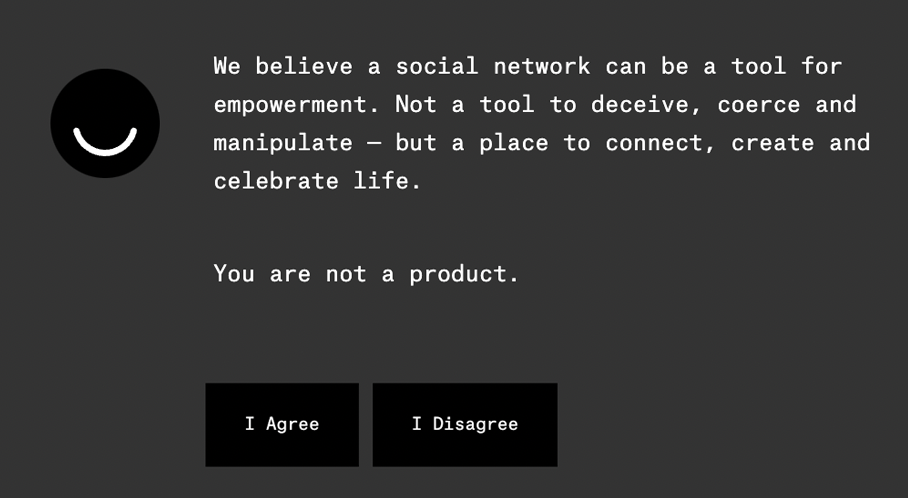
From its launch, Ello defined itself as an alternative to ad-driven social networks like Twitter and Facebook. “You are not a product.” (The “I Disagree” button linked to Facebook’s privacy page.)
I’d link to that manifesto on Ello’s site, but I can’t, because Ello is dead.
In June 2023, the servers just started returning errors, making nine years of member contributions inaccessible, apparently forever — every post, artwork, song, portfolio, and the community built there was gone in an instant.
How did this happen? What happened between the idealistic manifesto above and the sudden shutdown?
It’s a story so old and familiar, I predicted it shortly after Ello launched.