Social Media Founders on Undisclosed Mass Promotion

As I was writing up yesterday’s article on The Times, I realized that there’s a wide range of opinions from social media founders about undisclosed mass promotion on their communities. (Mahalo’s Jason Calacanis doesn’t mind, while Matt Haughey drops the banhammer on any Metafilter user who tries it.)

I contacted several founders affected by Sitelynx’s activity to see their official (and personal) stance on this questionable practice.

Continue reading (800 words) ⇢ 13 Comments

The Times (UK) Spamming Social Media Sites

Yesterday, I discovered that The Times (UK), a well-respected newspaper owned by News Corp., is involved in an extensive campaign to spam social media websites with links to Timesonline.co.uk articles.

Since 2004, The Times retained the established SEO consulting firm Sitelynx to handle their search engine marketing. Working on behalf of The Times, a Sitelynx employee posted thousands of links to community and social news websites, including Mahalo, Del.icio.us, StumbleUpon, Metafilter, Yahoo! Answers, Ma.gnolia, and Netscape’s Propeller. His actions were done without any disclosure of his affiliation to Sitelynx or The Times and were, in some cases, posted under the assumed identity of his wife. Update: The Times didn’t know what Sitelynx was doing, the Sitelynx employee was fired suspended, and The Sun is also involved. See the updates at the bottom of this entry.

What do the creators of Del.icio.us, Metafilter, and Mahalo think of this? I asked them!

The accounts were all created by Piotr (or Peter) Wyspianski, an SEO Manager at Sitelynx since June 2007. (Though his LinkedIn resume says “Executive.”)

Before coming to Sitelynx, Piotr had a history of promoting his own business, an online jewelry store called Signature Gems, by using his profiles on sites like Myspace, Flickr, and Yahoo 360 to manipulate his search engine rankings. After coming to Sitelynx, he continued to use this technique to promote The Times. (A full breakdown of his accounts on each site is below.)

For me, it’s disappointing to see a well regarded, legitimate newspaper using these tactics to gain headway against their online competitors. Founded in 1785, The Times is one of the world’s longest-running papers, the namesake for the New York Times and the paper that originally commissioned Times New Roman. I’m sincerely hoping that The Times didn’t authorize undisclosed, deceptive spamming in their partnership with Sitelynx. It’s even possible that Wyspianski is a rogue SEO working autonomously, and Sitelynx isn’t even aware of his actions.

To find out, I contacted Graham Hansell yesterday, the founder of Sitelynx and head of strategy, but he didn’t respond. I’m not having any luck finding an appropriate contact at The Times either, but if you know someone there who can help address these questions, please get in contact with me immediately by email or IM. (Update: The Times contacted me, see more in the updates below.) This quote from a 2004 article, which seems to be The Times’ only public statement on working with Sitelynx:

Simon Christy, marketing manager at Times Online, which has just signed up Sitelynx to improve its search visibility, agrees. “In the past it has been down to the techies to get their heads around SEO, but it’s now moved into the remit of marketers,” he says. “I see it as the fundamental building block or starting point for any search marketing strategy. Once you have the natural side sorted, then you can start spending money on the PPC side.”

Each of the accounts below is used exclusively for posting links to Timesonline.co.uk, his jewelry business, or a combination of both. (In case the accounts get removed, I’ve included the date he began posting and a rough count of the number of Times links.)

Continue reading (850 words) ⇢ 53 Comments

Personal Ads of the Digerati

Yesterday, I saw the Richard Stallman personal ad on Craigslist for the first time. While the text is authentic, the free software activist almost certainly didn’t post it to Craigslist himself, since he doesn’t really use the web. (Instead, he reads web pages by sending an email to a daemon, which retrieves the URL with wget and emails it back to him. Yes, this is not a joke.)

Stallman’s ad immediately reminded me of Dave Winer and his very first post on The WELL, a personal ad from 1994 that shows another side of the tech pioneer.

From: Dave Winer (dwiner)

Date: 1994-08-17 17:52:00

Conference: singles

Topic: Personal Ad experiences

Well, here goes -- my first message on The Well. I've just been lurking for the last few days, trying to figure out what's going on. It's pretty daunting, but maybe I'm getting the hang of it... You all seem like VERY nice people.

Photo by Kris Krüg on Flickr

Anyway, I wrote a personal ad last week, and sent it via email to a bunch of friends, most of them women, for their reaction. Here's the ad:

SWM 39, 6'2", athletic build, Bay Area, software entrepreneur turned massage therapist, gentle hands, romantic, emotionally developed, born-again hippie. Loves gardening, road trips, walking, skiing, writing. Looking for a great gal who's ready to create a safe space for love and lots and lots of play. Send email to: [email protected].

One of my friends had a pretty animated response:

"You're going to find a nurse or a chiropractor. Why? The self-description sounds too needy, as if you're looking for succor. Anyway, i never describe you that way to anyone i know. Your description entirely omits your shining INTELLIGENCE -- you're a genius; you assimilate new ideas like most people consume their morning cereal. You see shapes when there are only nebulae. You're also kinetic, always soul-searching. grounded and yet ready to leap. You're body's pretty irrelevant, but obviously you want to be of athletic build (for what sport, exactly, would your body be considered athletic? no offense, but REALLY). As long as you've got some hair left and your sexual organs, your body's functioning, or do you really want to be a combination of Yogi Berra and Albert Einstein? -- Love, Sylvia"

Of course I liked Sylvia's version of the ad better. ;->

Dave

PS: I'm a great skier. Definitely athletic.

I finally understand why John Brockman dubbed him The Lover in Digerati! Even in the age of Netscape 1.0, Dave was using technology to connect with people. I emailed him to find out the story behind his WELL posting and follow up on his current relationship status. No response yet, but his Facebook profile says he’s still single and looking for a relationship.

I find the personal side of these technology giants to be fascinating. In just a few words, it shows a warmer, more human side to an often-controversial man. If you can think of any other examples, leave them in the comments!

February 7 Update: Surprisingly, the only people that seemed to care about Dave’s personal ad were Valleywag, Eye on Winer (the newest in a long line of Dave Winer watchdog sites), and Dave Winer himself. He commented on it a few times on his Twitter account, but that was about it. (Related, Eye on Winer posted this Knight-Ridder article from 1986 about American bachelors, with Dave Winer in the lead story.)

Many more people took note of the bit about Richard Stallman’s extremely unusual web browsing habits, culled from this post I dug up from a discussion list late last year. That link ended up on Zawodny’s blog and, later, the top of Reddit. I emailed RMS some questions, to ask him more about this, leading to the shortest interview ever:

I’m fascinated with a message I read about how you read the web with a wget demon. Could you elaborate on it?

It is a program that runs wget and mails me back the result.

Do you then convert the HTML to plain text and read it by email, or do you load the retrieved file in a browser? (If so, which browser?)

I can do either one.

Finally, is it free software, or something that you’d be willing to release?

I did not write it, but our sysadmins say it is kludgy.

Thanks for that elaborate explanation, Richard! As Philipp told me, “He answers like a programmer. If you stopped him on the street to ask, ‘Do you know the time?’ he’d say ‘Yes’ and leave.”


8 Comments

Colin's Bear Animation

Remember Colin’s Bear Animation, the disgruntled demo reel I linked to a few weeks ago? First, watch it again. (It’s only 15 seconds long.)

In the spirit of investigating things nobody cares about but me, I decided to track down and interview Colin Sanders to find out the story behind the demo reel.

Continue reading (650 words) ⇢ 37 Comments

Exclusive: Yahoo! Brickhouse launches BravoNation

Today, Yahoo! Brickhouse launched BravoNation, the newest release from their San Francisco-based incubator program. Gordon Luk, the leader of the project and my fellow Upcoming founder, graciously offered to give me an exclusive preview of the launch.

BravoNation is an experimental platform for people to send virtual awards and achievements to their friends and family, and a robust set of APIs for developers to build achievements into their own software. It reminds me of a web-native equivalent of XBox Live’s achievement system, abstracted to work with any online community.

From its genesis as a Hack Day project to my departure from Yahoo! last month, I was a close observer of this project and I’m thrilled to be the first to write about it publicly. Gordon gave me access to the “Rough Draft” release of the site this morning, and I’ve included my screenshot-heavy tour below.

Continue reading (700 words) ⇢ 85 Comments

Outgoing

Five years ago this January, I wanted to solve a personal problem: finding events I cared about and sharing them with my friends. Nine months later, Upcoming.org popped out and changed my life forever.

After five years of working on Upcoming and two years after its acquisition, I’m moving on. This Friday is my last official day as a Yahoo!, after which I’ll go back to being a lowercase yahoo.

Continue reading (450 words) ⇢ 119 Comments

Five Years of Waxy

I started this blog five years ago today with a basic idea: keep it original and keep it relevant. Unfortunately, I left out “keep it updated.” As you can probably tell, Waxy is taking the back seat these days to other priorities, namely work and family. (I don’t even have the time to weed out comment spam.) I terribly miss the quirky form of investigative reporting I used to do and I certainly miss spending more time exploring the backroads of the web. I promise I’ll be back. In the meantime, the infrequent updates continue. Happy birthday, little blog!

38 Comments

Tracking Twitter's Message Growth

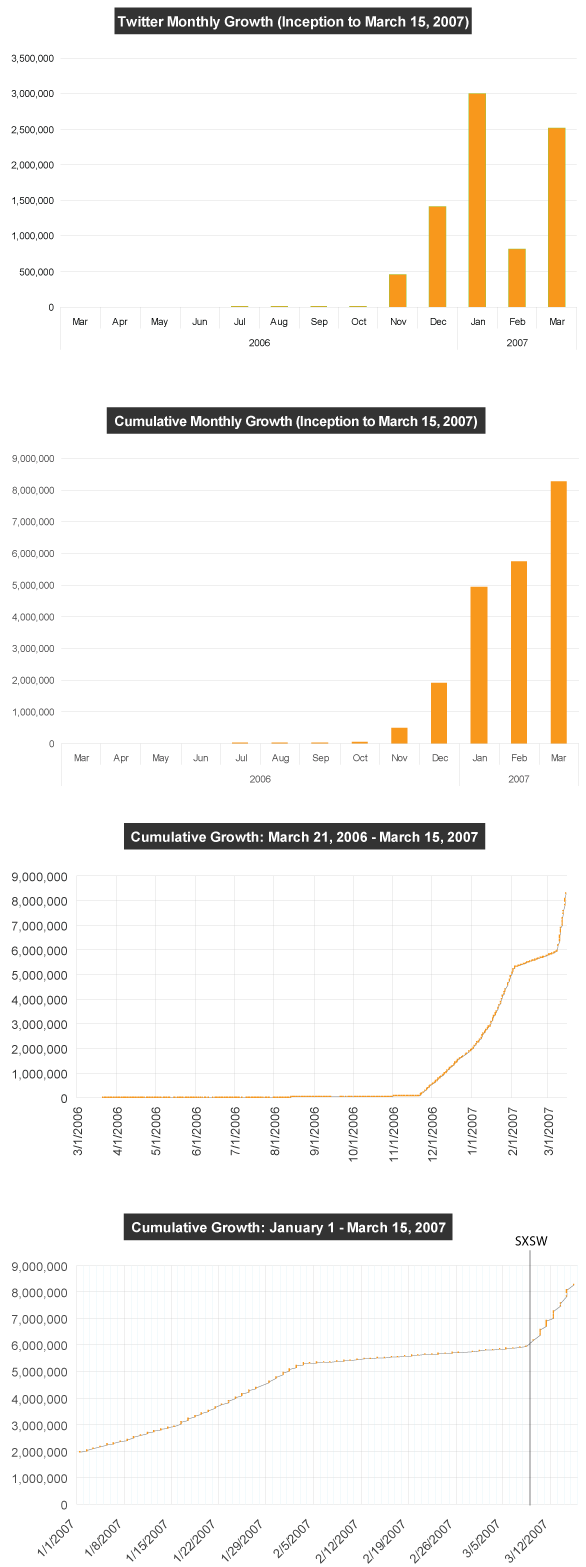
By now, everyone knows that Twitter exploded at SXSW and everybody’s seen the Alexa charts. But this is mostly a mobile app, so pageview traffic is only part of the story. How fast is Twitter really growing?

I decided to find out by using Twitter’s founder Evan Williams himself, albeit indirectly. Since Ev’s Twitter history goes from message #28 in March 2006 to #8,281,991 about three hours ago, it’s a convenient snapshot of Twitter’s growth since it began. Update: The data from November 2006 to present is faulty, since they apparently switched to non-sequential IDs. More information below.

I threw it all in Excel and charted the sequential IDs and dates for each of Ev’s 1,226 messages. The moment SXSW started, Twitter’s growth curve changed radically and hasn’t slowed down. (The huge orange bar for March is only half the month.) But more interesting to me are two other dates: November 23, when Twitter’s growth rate sped up drastically and then on February 5, when the rate seriously slowed. Are there problems with my data? If so, I can’t find it. If you have any sense of what triggered those changes, please comment and let me know.

To help with your search, and any other visualization, I’ve posted the full Excel spreadsheet with inline charts and tables. Enjoy!

Note! The last three are cumulative charts, not month-to-month growth numbers. That means there were not 8 million messages sent this month, but 8 million total since Twitter started.

Twitter Growth

Update: Jason and I just discovered that the IDs since November 2006 have not been sequential, rendering these charts useless. The jumps in activity were largely artificial. Jason has more information.

28 Comments

Pirating the 2007 Oscars

For the last few years, the movie industry’s battles with Internet pirates offered an entertaining diversion during Oscar season. Their problem: they need to “leak” their films to Academy members for consideration, but don’t want those official leaks to fall into the hands of pirates. In 2003, the MPAA banned all screeners, causing a massive uproar from directors, actors, critics and indie studios. The plan was eventually scrapped in December 2003, but they stepped up their legal efforts, using encoded watermarks to bust 70-year-old character actor Carmine Caridi and a “piracy ring” of three employees of a post-production shop for distributing screeners.

Since then, they’ve tried other approaches, from sophisticated watermarks to shipping out custom DRM-laden DVD players. In 2004, a company named Cinea spent $5 million distributing custom DVD players to Academy and BAFTA members with very mixed results. Lately, it seems the new strategy is to stop trying. Maybe the industry is finally realizing that the best way to get recognized is for people to see your movie, despite the risk of piracy. For example, Munich was very likely snubbed for a British Oscar nomination in 2005 because the screeners were late and defective. The best case study is Lionsgate’s promotion of Crash vs Disney’s Cinea-encrypted screeners:

In a way, Lionsgate’s strategy was the opposite of Disney’s. While the indie sent its film to as many voters as possible, upping the odds copies could be pirated, the Mouse House focused on minimizing piracy, with the result that at least 26% of Oscar voters didn’t watch its screeners.

The outcome: Crash shocked the world by winning Best Picture over the favored Brokeback Mountain, while Disney only got Best Makeup for The Chronicles of Narnia.

After the MPAA decided to ban all screeners in 2003, I started tracking the distribution of Oscar screeners online to see how effective their ban was. I found that screeners for all but one of the 22 nominated films were leaked. I followed up the following year, but took a break last year. So, how did they fare this year?

Findings

I researched every nominated film, excluding the documentary and foreign film categories. Out of those 34 films:

  • Academy members received screeners for 30 out of 34. (Everything except Click, Monster House, Poseidon, and Black Dahlia.)
  • 31 out of 34 films were released online in some form, including camcorder footage. (Everything except Letters from Iwo Jima, Notes on a Scandal, and Venus.)
  • 24 screeners were leaked online. (In several cases, they were leaked months before Academy screeners were mailed.)
  • The average length of time between a film’s USA release and its first appearance online is 12 days.
  • 9 screeners appeared online before they were mailed to Academy members.
  • On average, a screener appears online 24 days before it’s received by Academy members. (Excluding these early leaks, the average time is 13 days.)

Notes

Some notes on terminology: A cam is a low-quality bootleg, usually filmed with a camcorder inside a theater. The next level up is a telesync, which has a direct audio feed to match the low-quality movie footage. A screener is the holy grail — a (generally) high-quality promotional video for industry insiders only, including the Academy members that pick the Oscar winners.

Also, for some films, the retail DVDs were released before October, rendering the scene’s screener release pointless. This is almost certainly why Thank You for Smoking and Pirates of the Caribbean never saw a screener leak.

If you notice any other interesting trends in the data, or want to poke holes in my analysis, feel free to add a comment and I’ll post updates.

Raw Data

The full results are below. Click on any date to view the NFO file for that particular release. Click the photo icon to see a screen capture for each video, where available, so you can compare the quality for yourself.

Continue reading (200 words) ⇢ 29 Comments

Kim Jong Il's Ringtones and Wallpaper

In yesterday’s New York Times, Tom Zeller writes about Internet access in North Korea, touching on their almost non-existent web presence. Among the tiny handful of official sites mentioned is the Korea Computer Centre’s Naenara (or “My Country”) — the nation’s official portal. Hosted in Germany and translated into a number of languages, it’s a very entertaining glimpse into the public exterior of the DPRK.

In addition to being a mouthpiece for national propaganda and a free e-mail provider, they also have an unusual and quirky web-based store. Aside from the usual books, CDs, and software (?), they offer an entire section of both cell phone ringtones (“handphone melodies”) and wallpaper (“characters”). (Cell phones are banned in North Korea, so these must be designed for sympathizers outside of the country.)

The wallpapers section is particularly good. For only US$0.50, you could have an animated caricature of George W. Bush as a panting dog with American flag necktie. Or head to page two for delightful animations of burning American flags, giant fists crushing the White House, or what appears to be an American soldier with a missile embedded in his chest, sulking dejectedly to a graveyard. They take Mastercard and Visa, so buy now!

I couldn’t read the ringtone pages, but let me know if one of them has the melodious voice of Kim Jong Il. (I’d take that over Fergie any day.)

Oh, and they have really, really great error messages. If you try to link directly to any of their images (like this one), you get this error: “You are fool!”

29 Comments