Skip to content
Waxy.org
Archives
About

Criminal Creativity: Untangling Cover Song Licensing on YouTube

Posted May 14, 2012 by Andy Baio

We all break laws. Every day, millions of people jaywalk, download music, and drive above the speed limit. Some laws are obscure, others are inconvenient, and others are just fun to break.

There are millions of cover songs on YouTube, with around 12,000 new covers uploaded in the last 24 hours. Nearly 40,000 people covered “Rolling in the Deep,” 11,000 took on “Pumped Up Kicks,” 6,000 were inspired by “Somebody That I Used to Know.”

Until recently, all but a sliver were illegal, considered infringement under current copyright law. Nearly all were non-commercial, created out of love by fans of the source material, with no negative impact on the market value of the original.

This is creativity criminalized, quite possibly the most popular creative act that’s against the law.

I don’t think it’s an act of civil disobedience; nobody’s making a statement. Most people don’t know that cover songs need a synchronization license, and even if they did, trying to get one is a confusing and expensive proposition. Unlike the mechanical licenses used to release a cover song on an album, video sync licenses don’t have an affordable flat rate and require the publisher’s explicit permission.

Even as YouTube forges agreements with publishers to handle the synchronization rights for cover songs, it’s nearly impossible for musicians to tell whether their songs are covered or not.

This week, I set out to answer a seemingly simple question: when are YouTube cover songs legal, and how can we do this better?

Conflicting Information

Even trying to determine if a cover song is legal can be confusing for most musicians. There’s no shortage of answers online, but most of them are conflicting. Publishers, musicians, and lawyers all give different answers, none of which are totally accurate. Even YouTube’s own FAQs are incomplete, made inaccurate by recent settlement agreements.

Like any area of copyright law, there’s no shortage of armchair lawyering on blogs and discussion forums about cover songs. A common belief is that cover songs fall under the “fair use” provisions of the Copyright Act, but the question of whether a non-parody cover song could fall under fair use is untested in the courts. Despite this, over 60,000 cover songs on YouTube cite “fair use” in their title or description. (Whether uploaders actually believe that or are preemptively using it as a defense is anyone’s guess.)
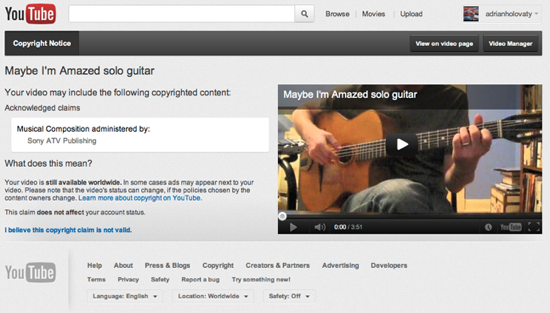
Content ID detects one of Adrian Holovaty’s cover song

While they happily encourage fans to upload covers, YouTube makes it clear that users must have the rights to all content they upload. “We tell users they must own the copyright or have the necessary rights for any content they upload,” said a YouTube representative. “It’s ultimately their responsibility to know whether they possess the rights for a particular piece of content.”

Their only specific guidance for cover songs is in their Copyright FAQ, which says, “Recording a cover version of your favorite song does not necessarily give you the right to upload that recording without permission from the owner of the underlying music.”

But this answer isn’t fully accurate. YouTube’s negotiated blanket synchronization licenses for its users from thousands of publishers, most notably the settlement with the National Music Publishers Association last August. This agreement allowed publishers to opt-in to a program that let them take a cut from a $4 million advance pool and up to 50 percent of the advertising revenue from any cover song they own the rights to.

Frustratingly, we have no idea which publishers have signed on. The NMPA doesn’t publish the list, making it impossible to figure out whether your song is covered by the agreement or not. (I contacted the NMPA, but a spokesperson confirmed that information appeared to be unavailable, but was looking into it.)

Begging for Forgiveness

In reality, the only way to tell whether a song is legal is to risk breaking the law and losing your YouTube account — by uploading the video and waiting for copyright notices.

In the last few months, YouTube has quietly expanded Content ID beyond original recordings to detect cover versions and live performances using the underlying melodies. A YouTube representative confirmed with me, “Content ID’s technology allows us to identify works in an original sound recording, or in a cover version (by identifying the underlying melody of a song), using information provided to us by the publishers.”

YouTube hasn’t talked much about its melody matching technology, but it was in the news recently after a drunk Edmonton man belted “Bohemian Rhapsody” in the back of a police car. After the Content ID identified the song, EMI initially decided to take the video down, but soon changed its mind and authorized it with advertising.
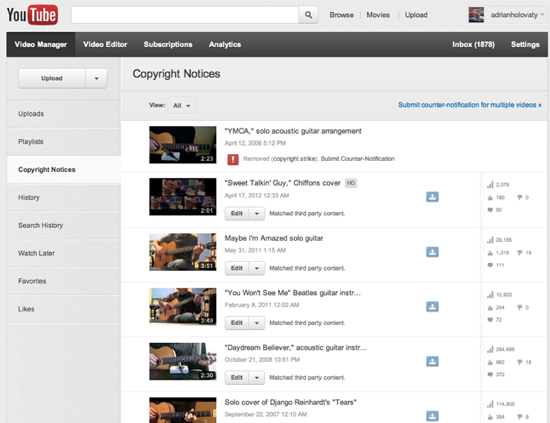
Adrian shared a screenshot of his copyright disputes page.

Everyblock founder Adrian Holovaty is well known on YouTube for his acoustic guitar covers, which have amassed millions of views. I asked him if Content ID identified the melodies in any of his videos. So far, seven of his videos were identified, with all but one rights holder choosing to leave the video online and collect the revenue. Only one video his cover of the Village People’s “YMCA,” was taken down by the songwriter, leaving Adrian with a “copyright strike” on his account. YouTube’s policy allows three strikes before the account is terminated and all videos removed.

The Flaws in the System

The system’s not perfect, though. Unscrupulous individuals are routinely using Content ID to claim content they don’t own to harvest ad dollars from unsuspecting users. For example, two of Adrian Holovaty’s disputed tracks are Django Reinhardt songs from the 1930s, claimed by an obscure company named “Social Media Holdings.”

Other copyright claims may be accidental, as material they don’t actually own finds its way into the Content ID database, like this poor guy who’s received eight consecutive claims from companies claiming to own George Romero’s public domain Night of the Living Dead.

And Content ID isn’t immune to false positives, like the bird calls misidentified as music. Worse, for all these case, disputed Content ID claims bypass the DMCA process for counter-claims entirely, as I wrote about in February.

How can a musician decide what’s legitimate or worth fighting?

Still, YouTube’s Content ID is pushing publishers and rights holders into the modern age. It’s an ingenious approach for an otherwise dysfunctional copyright system that’s too hard for amateurs to navigate, making money for everyone involved while still allowing free creative expression.

The Need for Change

But there’s something strange about this begging-for-forgiveness approach to copyright. It’s like driving without traffic signs, only finding out you broke the law when you’re pulled over.

The real question: Why is it illegal in the first place?

Cover songs on YouTube are, almost universally, non-commercial in nature. They’re created by fans, mostly amateur musicians, with no negative impact on the market value of the original work. (If anything, it increases demand by acting as a free promotional vehicle for the track.)

The best solution is the hardest one: To reform copyright law to legalize the distribution of free, non-commercial cover songs.

Copyright law was intended to foster creativity by making it safe for creators to exclusively capitalize on their work for a limited period of time. Cover songs on YouTube don’t threaten that ability, and may actually prevent new works by chilling talent that could go on to do great things.

As we’ve seen with countless breakout artists from YouTube, budding musicians have built their careers from cover songs that evolved into original material. Karmin, Pomplamoose, Julia Nunes, Greyson Chance…. Even Justin Bieber started with covers of Chris Brown and Nee-Yo before getting discovered.

Now, the next generation of budding pop stars are covering Justin Bieber, with about 216,000 of them so far. It’s all part of the virtuous cycle of culture: We take from it, build on it, and then give back in return. The law should help that along, not hinder it.

Update: I originally published this column over at Wired on May 2. The woman I spoke to at the NMPA confirmed the list of publishers appeared to be unavailable, but promised to look into it. I haven’t heard back, so I followed up again. I’ll update here if I hear anything.)
4 Comments

History of Yahoo CEOs: Tenure vs. Stock Price

Posted May 14, 2012 by Andy Baio

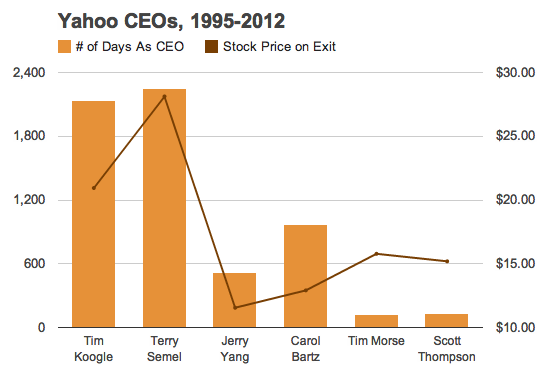
Just for the hell of it, I charted the tenure for every one of Yahoo’s CEOs against the starting and ending stock price. Man, what a mess.

Just so nobody else ever has to do this, here’s the data, culled from Google News reports and YHOO stock quotes. Download as a CSV.

2 Comments

Super Mario Summary Shame

Posted April 27, 2012 by Andy Baio

Is there a word for being totally proud of something and completely ashamed at the same time?

Context: Super Mario Summary reworks every level of Super Mario Bros. on a single screen, turning a side-scrolling platformer into a devious, addictive puzzle. Amazingly, it was built in only 48 hours by Swedish developer Johan Peitz as part of the Ludum Dare game competition. Read his postmortem of making the game.

4 Comments

In a Rigged Game, Twitter's IPA Lets Developers Rewrite the Rules

Posted April 19, 2012 by Andy Baio

Last month, in response to Yahoo’s wrongheaded patent infringement lawsuit against Facebook, I wrote about my experience filing patents at Yahoo. Patents I helped to file, ostensibly only for defensive purposes, were turned into blunt weapons to thwart innovation and extort money.

As I said, “I thought I was giving them a shield, but turns out I gave them a missile with my name permanently engraved on it.”

This week, Twitter announced their Innovator’s Patent Agreement, an open source contract intended to guarantee patents will only be used defensively, even when sold. The IPA seems to directly address the issues raised in my article.

Adam Messinger, Twitter VP of Engineering, wrote that, “With the IPA, employees can be assured that their patents will be used only as a shield rather than as a weapon.”

Every one of Twitter’s existing patent filings, including Loren Brichter’s famous pull-to-refresh patent, will fall under this agreement later this year.

Still, the IPA isn’t perfect, and it needs work to protect the intentions of designers and engineers. Instapaper founder Marco Arment pointed out that the contract’s definition of “defensive” is overly broad, allowing an unethical company to initiate a lawsuit for a range of reasons without requiring the inventor’s permission.

Hypothetically, if Yahoo had adopted the IPA, would it have prevented them from later suing Facebook for patent infringement? Maybe not. Facebook’s threatened several startups over trademark name issues in the past, including Lamebook, Placebook, and Teachbook. If any of them were also users, customers or affiliates of Yahoo, then Yahoo could bypass the Patent Agreement and file a patent lawsuit. (Though, if they did, the inventors could choose to sublicense their patents directly to Facebook.)

These problems are correctable though, and Twitter should be commended for taking this important first step. In a deeply broken patent system, it’s heartening to see an established company proactively try to work around its flaws. I hope agreements like these find wide industry adoption.

But this isn’t a real fix. Union Square’s Fred Wilson dubbed it Twitter’s “Patent Hack,” and that’s exactly what it is — it’s duct tape to patch a broken system, but it doesn’t solve any of the underlying problems.

The ideal would be patent reform, or if the system’s beyond reform, the abolition of business method patents entirely.

Marco Arment wrote, “A truly innovative stance would be for a large technology company to avoid filing patents, and to lobby aggressively for progressive patent reform to make that a practical choice for every technology company.”

Like I did last month, Marco vowed not to file any patents. “I fundamentally disagree that software patents (and many other types of patents) are a net gain for society, and I can’t participate in that system in good conscience.”

After all, if you only use them defensively, why do you need patents at all? Publish your work and establish prior art.

Sadly, prior art only works in an ideal world. As we’ve seen, the U.S. patent office routinely grants patents even when prior art exists. The recently passed reforms to the patent system, switching from a first-to-invent to a first-to-file system, make this more likely than ever.

For the moment, avoiding patents entirely isn’t a realistic legal strategy for large companies. Maintaining a patent arsenal won’t ward off shell company-style patent trolls, but it can protect you from competitors by allowing cross-licensing settlements. But all of that feeds into the “cold war” mentality of stockpiling patents you never hope to use.

Until we have real reform or abolition, ethical tech companies are forced to play the patent game, but at least engineers and designers now have a way to rewrite the rules in their favor.

3 Comments

Memeorandum Colors 2012: Visualizing Bias on Political Blogs

Posted April 18, 2012 by Andy Baio

I don’t watch sports, but every four years, I lose myself in the horse race of the U.S. presidential elections. That competition kicked off in earnest Monday, as Gallup started its daily tracking polls for the general election between Barack Obama and Mitt Romney.

In 2008, I was hooked on one drug for my daily fix: Memeorandum, a completely automated aggregator that surfaces popular stories from political news sites, often within minutes.

As you’d expect, the universe of political blogs is largely split in two, with conservative and liberal blogs rarely covering the same stories or linking to the same sites. But it can be very challenging to tell their political leanings at a glance, especially with names like “Balloon Juice,” “Weasel Zippers,” or “The Volokh Conspiracy.”

So, four years ago, I launched a project with Delicious/Tasty Labs founder Joshua Schachter to visualize the linking biases of various political blogs on Memeorandum by looking at their past behavior.

Using singular value decomposition, the linear algebra at the heart of your Netflix recommendations, we reduced the entire matrix of blogger-to-article relationships to a single dimension. Imagine a single line grouping like-minded blogs together based on the diversity of the stories they cover, with hardcore left- and right-leaning blogs on opposite sides of the spectrum.

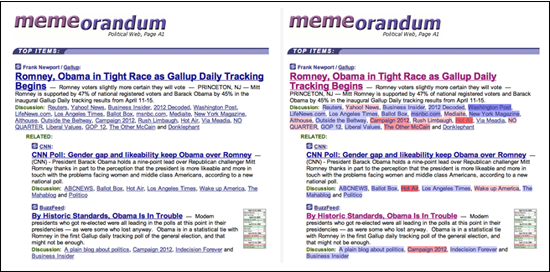
Using those precalculated values, we load the data from Google Spreadsheets and color the links on Memeorandum, based on where they fall on the spectrum. The brighter the color, the more frequently they only cover stories by their counterparts.

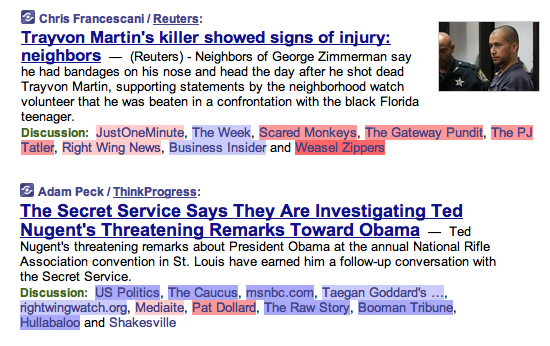
This simple visualization leads to some interesting insights. Compare these two articles, which were trending on Memeorandum at this writing:

Seeing each site’s potential bias provides the context for understanding how news is spread. Right-leaning blogs are eager to point out new evidence that George Zimmerman was hurt the day he shot Trayvon Martin, but left-leaning blogs aren’t covering that story. Likewise, only left-leaning news sites appear to be covering the news of Ted Nugent’s threatening remarks to the president, but conservative blogs aren’t. This visualization also makes it easy to spot outliers, the sources that are breaking away from their past behavior to link to something beyond their usual circle.

This browser add-on is free and open source on Github. We’ve updated the data sources for the first time since 2008, and Memeorandum Colors now works natively in Chrome, in addition to Firefox.

You can try the browser add-on by following these simple directions.

Google Chrome

  1. Click the memeorandum_colors.user.js link.
  2. In the warning dialog at the bottom of Chrome window, select “Continue.”
  3. Visit Memeorandum and wait a moment for the links to color.

Firefox

  1. Install Greasemonkey.
  2. Restart Firefox.
  3. Click the memeorandum_colors.user.js link, wait three seconds, and Install.
  4. Visit Memeorandum and wait a moment for the links to color.

Four Years of Data

Along with this release, we now have four years of historical activity to work with. The collected scores are on Google Fusion Tables, and I’ve included a dump of the activity in Github.

Looking at historical activity can reveal some interesting trends, especially in how attitudes have shifted since the last election.

For example, Little Green Footballs is a long-running political weblog started by Charles Johnson, a web developer who aligned himself with the conservative right wing after the World Trade Center attacks. In late 2009, he publicly parted ways with the right.

That shift away from conservatism was reflected in his linking behavior at least a year before his public statement. If you look at the timeline below, you can see that Johnson started linking to a wider variety of stories outside the conservative conversation, until his activity was mostly neutral in early 2010. Now, his activity tends neutral but slightly favors articles popular in the liberal blogosphere.

Bias In Linking, Not Beliefs

Memeorandum was created by San Francisco developer Gabe Rivera, who followed its introduction with aggregators for media, celebrity gossip, and baseball news. The most popular of these is Techmeme, a daily destination for tech industry watchers.

A month after Obama’s election, Rivera announced he’d hired a human editor for Techmeme to help prevent inaccurate results from the algorithm. This editorial oversight would affect any link-based analysis on Techmeme, but he confirmed that Memeorandum is still completely machine-driven.

This automated analysis is not a commentary on the personal opinions and beliefs of any blogger — no amount of linear algebra can prove that. What this shows is the biases in their linking behavior: the stories that each site chooses to cover, or not cover, and their similarity to others like them.

If you’d like to learn more about the math behind how this works, there’s more detail and links to tutorials on my original blog entry.

Let me know if you have any questions and I’ll try to answer them in the comments.

1 Comment
⇠ Older Posts
Newer Posts ⇢
Waxy.org
Archives About