
Original Spelunky ported to Javascript
— using GameMaker Studio’s new HTML5 support; no sound, but very playable #The first functional 3D printed gun
— weapons are now disallowed from Thingiverse, but the model’s still up there #Wired on the design of the Def Con 20 badges
— crypto puzzle, viral game, and reprogrammable platform rolled into one #Diana Kimball's case study of Cards Against Humanity
— going from an idea to a Kickstarter-funded Amazon bestseller #Robin Sloan's book review written in Javascript
— so good; related: Kill Screen’s interactive memoir of Ico #Portland man found not guilty for stripping at TSA checkpoint
— the TSA may still choose to fine Brennan and place him on the no-fly list #Polygon's The Evolution of PC Games
— music remix with audio culled exclusively from the original games #Books of Adam on falling in love with videogames
— owning Earthbound as your very first game would set the bar pretty high #Fez technical postmortem
— I liked the bits on the designer vs. programmer dynamic; crazy that it was a two-person game #Marissa Mayer becomes Yahoo's new CEO
— first smart move Yahoo’s made in years, but it’s hard to turn that ship around #David House's grand jury testimony in the Bradley Manning hearing
— that guy has balls of steel via Kottke #Marc Maron interviews Dan Harmon on the end of Community
— six years after Arrested Development, networks still don’t know how to handle fan favorites #Betaworks buys Digg assets for a rumored $500k
— the end result of their disastrous redesign and not listening to their users; patents and team sold separately for more #Kyle McDonald's story of his Secret Service raid following People Staring at Computers
— you might remember his project, setting up software on Apple Store computers via @atduskgreg #Analysis of the 450,000 leaked Yahoo Voices passwords
— apparently Associated Content, the content farm they acquired in 2010, stored passwords in plaintext #Using Echo Nest to use music preference to predict political leaning
— Democrats appear to have more diverse tastes via @mattcutts #A Lip-Sync Six Years in the Making
— “I think it’s simultaneously the best and worst idea I’ve ever had.” #Rabble digs into the history of the @reply on Twitter
— using Kellan’s oldtweets, a searchable archive of Twitter’s first year #Spelunky Pancakes
My eight-year-old son and I are completely obsessed with Spelunky, the brilliant 2D platformer-meets-Roguelike game that launched last week on XBLA.
How obsessed? Yesterday, at brunch at Slappy Cakes, he asked me to make this:
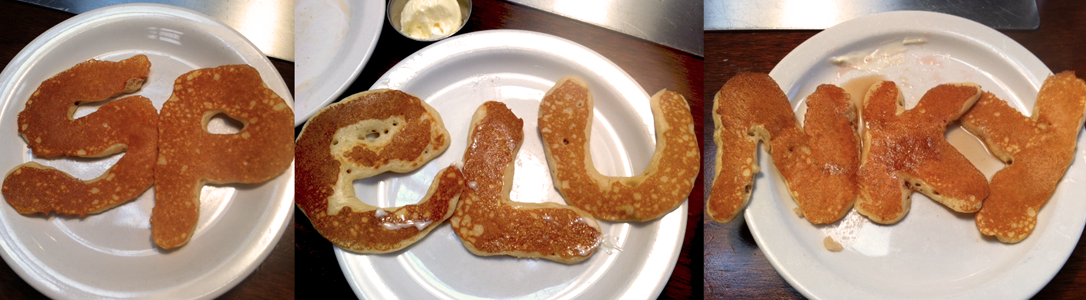
Tasty!
The new Spelunky is a reboot of the brilliant 8-bit freeware game that Derek Yu released in 2009, still available for Windows, with an unofficial Mac port.
Spelunky borrows two elements I hated back in the 8-bit era — randomized levels and no way to save progress — and makes them eminently enjoyable. Like NetHack meets La-Mulana, Spelunky is brutally hard. Like other Roguelikes, when you die in Spelunky, you’re dead. There’s no way to continue.
In an interview with Anthony Carboni, Derek Yu said, “When you die and have to start from the beginning, it makes death meaningful, just like in real life.” I’d recommend watching the interview, and Derek trying to play his own game, on New Challenger.
Unlike other hard games, Spelunky feels fair to me. Every time I die, I know that it was my fault. I never felt cheated because of awkward controls or unpredictable behavior, because the processes running the environment are so consistent and learnable. You can palpably feel yourself mastering the game, learning the mechanics and traps and creature movement and every other detail, until the next time you stupidly fumble.
To feel what it’s like to play Spelunky, and how deep it goes, I’d recommend reading Tom Francis’ quest to find the lost city of gold.
P.S. Eliot just came downstairs to tell me he finished the Worm level, grabbed the Crysknife, and unlocked the Super Meat Boy character. If you’ve played the game, you know how hard that is. My boy!