
The Hidden Game Within Microsoft Flight Simulator
— using the photo mode to turn it into a walking simulator, exploring the glitchy planet from ground level #Lauren Goode on algorithms that won’t let her forget her canceled marriage
— six years ago, Eric Meyer wrote about inadvertent algorithmic cruelty via Belong.io #New Yorker’s Rachel Aviv profiles memory researcher Elizabeth Loftus
— her controversial research on false memories made her a popular expert witness casting doubt on claims of sexual assault via Today in Tabs #Yahoo Answers shutting down on May 4
— just like Yahoo to delete 16 years of community-contributed content with 30 days’ notice #NYT on the Trump campaign’s dark design patterns for fundraising
— they tricked donors into emptying their bank accounts with automatic weekly donations via Nelson Minar #StyleCLIP, manipulating StyleGAN imagery with text
— don’t miss the absurdly impressive demo video via @ak92501 #Anil Dash on inventing NFTs with artist Kevin McCoy in 2014
— their haha-just-serious Seven on Seven presentation is worth watching, if you’ve never seen it via @anildash #How QAnon Is Tearing Families Apart
— VICE interviewed three dozen people about their QAnon family members of widely-varying backgrounds #Reddit’s Second
— try to guess the second-most voted picture, or wait to see vote counts for fewer points #Slamilton, A Basketball Musical
— Space Jam mashed up with Hamilton shouldn’t work this well, but it does #Skittish March Updates
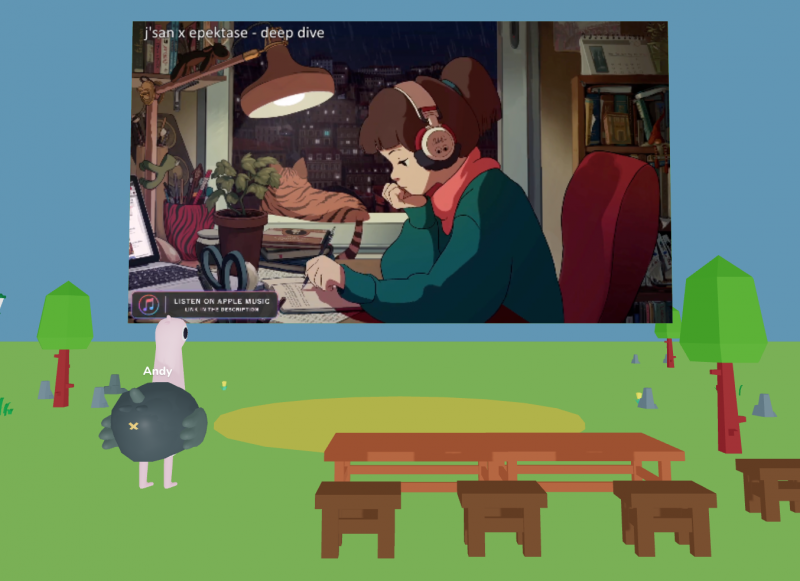
After announcing Skittish last month, we’ve cranked ahead on development, adding a bunch of new stuff in the last month. I wanted to show all of it off, but social media felt too limiting, so I did what I do best: started a blog.
I also recorded a little video tour showing off some of the new features, which demonstrates how much it’s changed just in the last few weeks.
If you have any interest in following development, you can subscribe to new.skittish.com via RSS, follow on Twitter or Instagram, or get on our announcement list for major updates by email.
Imaginary Friends Reunited
— a social network for imaginary friends like Gloop, Dracula CEO, and Tears for Fears #68k.news, a lo-fi Google News for retro computers
— “Tested on Netscape 1.1 through 4 on a Mac SE/30” via Kottke #Simone Giertz makes a chair for needy pets
— fun to see her creative process and missteps along the way #Sixtyforgan, playing church organ music on a modded Commodore 64
— the flipside of his Chipophone project, turning an organ into an 8-bit synthesizer via Kottke #The New Yorker digs into the Lawyer Cat Zoom call
— they found the source of the avatar, bafflingly set as the default webcam software for some Dell computers in the late 2000s #Search Record
— visualize your Google Search history as poetry or a wall of questions via Caitlin Dewey #The Pudding visualizes the names of 6,816 complexion beauty products to reveal bias
— “nude” and “natural” mostly describe light skin tones, while darker shades are named after objects #Pirating the Oscars: Pandemic Edition
For nearly two decades, I’ve tracked the illicit distribution of Oscar-nominated films online to learn how the film industry’s new and innovative ways of thwarting pirates inevitably fail.
The end result is this spreadsheet, now documenting 611 Oscar nominees from the last 19 years, with metadata for every aspect of their online journey from handheld camcorder recordings in the theater to 4K Blu-Ray rips, and everything in between.
I used to do analysis every year, but after a five-year break, I thought it was worth coming back to revisit this incredibly strange year.
The pandemic touched every aspect of our lives and the film industry was no exception. As theaters closed nationwide, theatrical releases were delayed, forcing some studios to release their films as rentals, while others partnered with streaming services like Disney+, Hulu, and Netflix for exclusive streaming rights.
With theaters closed, a common source of low-quality camcorder leaks dried up, and the floodgates opened to a new one: theatrical releases in our homes on release day.
This year, the pandemic spawned two trends that shattered all records since I started tracking this data in 2003, seemingly in conflict with one another:
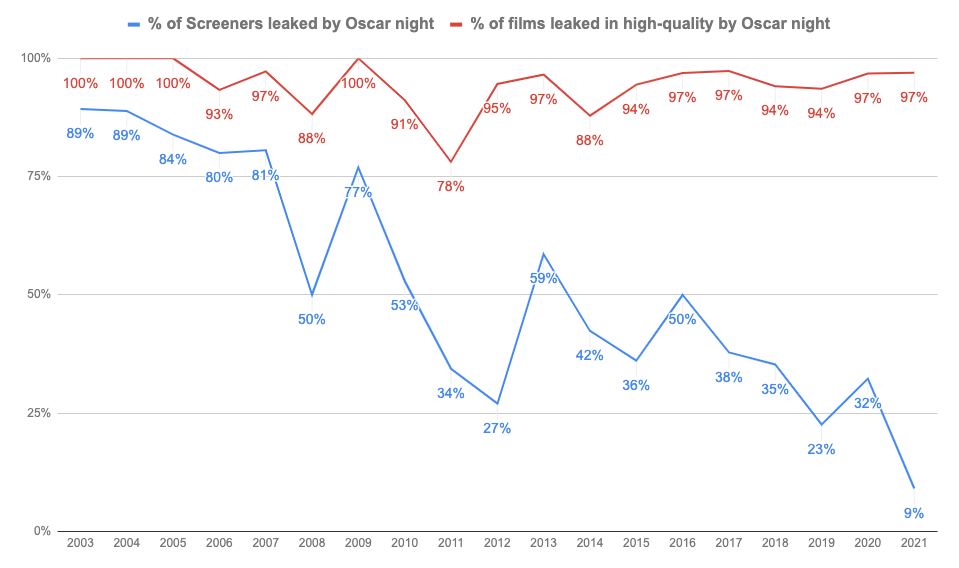
- Fewer screeners leaked online than ever, with only 9% of screeners leaking compared to 32% the previous year.
- Nominated films leaked online faster than ever, in a median 7 days between first release to leak, compared to 73 days the previous year.
At first glance, it seems like the MPAA finally beat the pirates at the screener game. The blue line in the chart below shows that a record low of 9% of this year’s nominees had Oscar screeners leaked online, continuing a downward trend.
But the red line tells a different story: that fully 97% of nominees, all but one film, have already leaked online in a high-quality format.
So what’s going on here? Let’s take a look at the data to understand the unique impact of the Covid-19 pandemic on how movies were released and leaked online.
Death of the Screener
When I first started tracking this data, DVD screeners were highly desirable because they were an opportunity to leak a high-quality version of the film months before its home video release, often while it was still in theaters.
Five years ago, I wrote about how screener desirability was changing as pirates were increasingly getting access to higher-quality 720p/1080p versions of films than Academy voters, who were stuck with 480p DVDs. In 2015, I wrote that “a staggering 44% of this year’s crop of nominees leaked as a high-quality rip from some source outside of traditional screeners or retail releases — the highest percentage since I started tracking films in 2003.”
For the second year in a row, most screeners were available digitally. Instead of just Best Picture nominees this year, virtually every nominated film was available for streaming by Oscar voters this year. But as far as I can tell, only three of those easier-to-access digital screeners leaked online. Why?
This year, the vanishing window between theatrical and streaming release dates made screeners completely meaningless. Why would anyone risk waiting to pirate an Academy screener when they could get the exact same quality sooner from Netflix, Hulu, Amazon Prime Video, or a streaming rental service?
The key chart is below, showing how the median number of days between the U.S. theatrical release date to its first high-quality rip, typically from a streaming site, cratered in 2020.
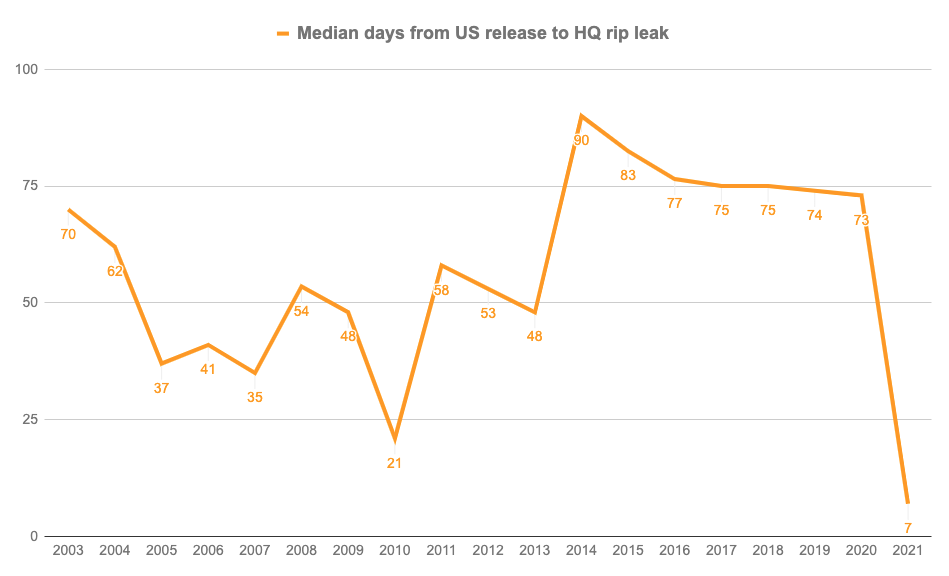
The theatrical window stayed remarkably consistent for the last five years at around 75 days. In 2020, it was seven days — a mere week from theatrical release to an HD stream rip, simply because virtually every movie was released online.
So, that’s basically it. With every theater closed, most movies first released online and on streaming services, making them instantly available to pirates before screeners were even distributed to voters, making screeners moot.
The big question: what will happen when the pandemic recedes and theaters reopen? Will studios push for once again staggering release dates between theatrical and streaming debuts? Is the 90-day window gone for good? Will the leaked screener make a comeback?
Let’s find out together in 2022. Stay tuned! 🏴☠️