If you’re in the Portland, Oregon area, I’ll be at Powell’s Books at Cedar Hills this Thursday interviewing Matt Kirkland, the creator of the enormously popular Dracula Daily, which originally serialized Bram Stoker’s 1897 novel as a Substack newsletter, creating an internet-scale book club with over 240,000 subscribers, now published as a gorgeous hardcover volume annotated with memes, fan art, and comics from the community.
Bram Stoker’s Dracula is an epistolary novel, told in the form of a series of diary entries and letters, and Dracula Daily delivers each one to subscribers “as-it-happens,” on the day that each message is dated, pacing it out over a period of six months from May to November.
In the parallel universe of last year’s Weird: The Al Yankovic Story, Dr. Demento encourages a young Al Yankovic (Daniel Radcliffe) to move away from song parodies and start writing original songs of his own. During an LSD trip, Al writes “Eat It,” a 100% original song that’s definitely not based on any other song, which quickly becomes “the biggest hit by anybody, ever.”
Later, Weird Al’s enraged to learn from his manager that former Jackson 5 frontman Michael Jackson turned the tables on him, changing the words of “Eat It” to make his own parody, “Beat It.”
This got me thinking: what if every Weird Al song was the original, and every other artist was covering his songs instead? With recent advances in A.I. voice cloning, I realized that I could bring this monstrous alternate reality to life.
Earlier this month, I wrote about Tiny Awards, a tiny prize to honor websites that “best embodies the idea of a small, playful and heartfelt web.” I was invited to be a part of the inaugural award’s selection committee, and helped narrow down the 270 submissions to 16 finalists, which were then open to public voting.
This morning, Tiny Awards announced the winner: the dizzying and delicious Rotating Sandwiches by Lauren Walker. When I linked to it here back in March, I described it simply as the “best of the web, right here,” so I’m pretty happy with this result. Lauren will receive a $500 prize and a tiny trophy. Congrats!
The organizers of the award also released the full list of all 272 nominated websites, a “dizzying snapshot of the boundless creativity and artistic endeavor (and, occasionally, silliness) of the web (and, by extension, the people who make it).”
The organizers originally asked each member of the selection committee to decide on their top two picks from the full list of nominees. Given the volume, diversity, and quality of the entries, this was no easy task.
Now that the winner’s announced, I thought I’d share my own decision-making process, along with my personal list of runners-up.
In May, the creators of two of my favorite newsletters, Naive Weekly and Web Curios, reached out to see if I’d consider joining the selection committee of Tiny Awards, a tiny prize to honor websites that “best embodies the idea of a small, playful and heartfelt web.” I loved the idea and quickly accepted.
There were some additional rules: sites must have launched in the last 12 months, work on mobile and desktop without requiring an app or download, made by individuals or a group of creators (i.e. not agencies or brands), and should be primarily non-commercial.
Nominations were free and open to the public, unlike some other web awards, and the selection committee ended up reviewing over 270 submissions, which we narrowed down to a shortlist of 16 finalists, a wonderfully eclectic collection of websites.
The winner is decided by public voting, which is also free and easy, and closes next Thursday, July 20. I hope you take a look and cast your vote. Here’s a little about each of the finalists. Update:The winner was announced!
For the last two days, Elon Musk has claimed that Twitter is under attack from “several hundred organizations” who were conducting “EXTREME levels of data scraping,” forcing them to bring “large numbers of servers online on an emergency basis” and enact emergency measures.
Yesterday, Twitter started blocking all logged-out access to Twitter, requiring signing in to view any tweet or profile. Elon Musk called it a “temporary emergency measure,” claiming they “were getting data pillaged so much that it was degrading service for normal users!”
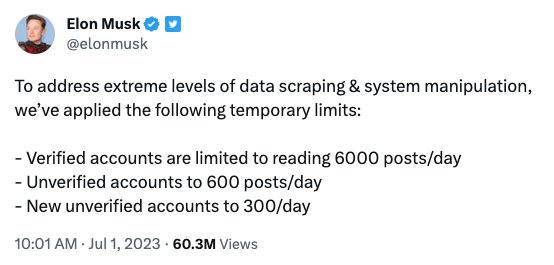
Apparently, it didn’t stop the crush of traffic and, this morning, Musk announced they escalated their actions against supposed “extreme levels of data scraping” by rate-limiting the number of tweets you can view.
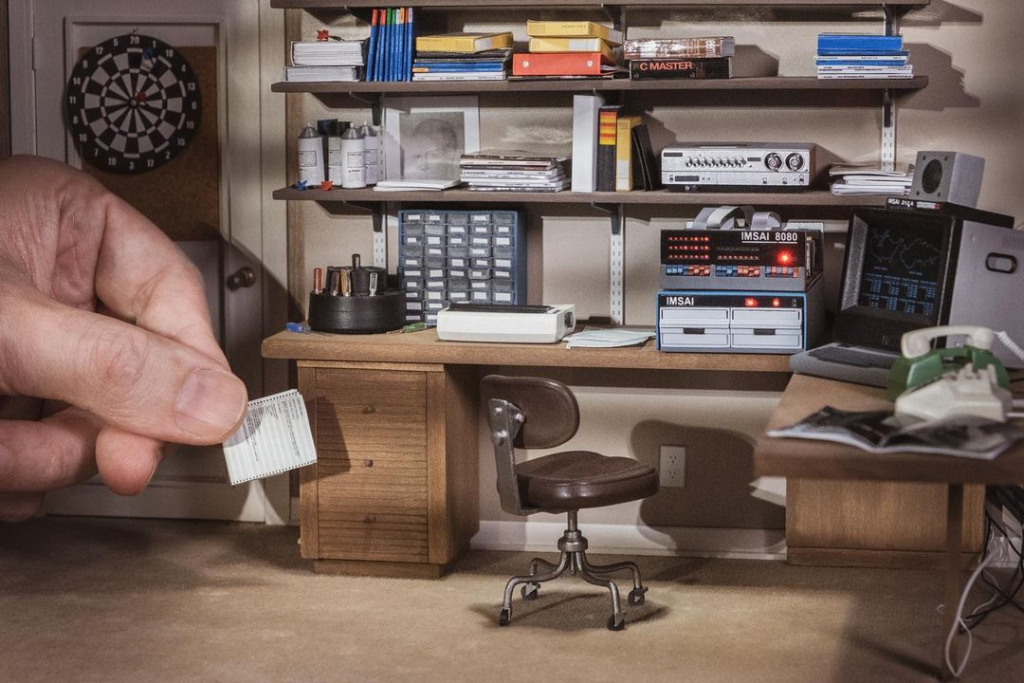
Under the moniker Miniatua, Montreal designer Nicolas Temese makes hyperrealistic scale replicas of vintage computers, real and fictional, in stunning detail with animated displays and period-accurate LED lights.
His latest project is a scratch-built 1:12 model of David Lightman’s bedroom from 1983’s WarGames, complete with IMSAI 8080 microcomputer, 8″ inch floppies, Epson RF 80 FT dot matrix printer, JVC model HR-3300 VHS VCR, and 1960s Naugahyde Steelcase Armless chair, among dozens of other smaller props.
The pseudonymous Irishman known as “Bobby Fingers” has only made three videos since launching on YouTube last August, but each one is an unhinged masterpiece.
If you haven’t seen them before, Bobby Fingers makes elaborate 1:9 scale dioramas depicting embarrassing moments in the lives of famous men, showing off his talents in model-making with a range of techniques from Bronze Age wax casting to modern 3D laser scanning.
But each video veers off wildly in different directions, interspersed with field trips, interviews, deadpan commentary, surrealist humor, and inevitably, a musical number.
This morning, I was shaken to learn Heather B. Hamilton (formerly Heather Armstrong) aka Dooce is no longer with us. I learned the news from a post to her Instagram, confirmed by several friends after and then the Associated Press, announcing the tragic news that she died yesterday at the age of 47.
I’m shaken and sad, and my heart goes out to all her family and friends feeling her loss right now, but especially her two children.
We weren’t close friends, but as part of the same old-school blogging cohort, we hung out over the years at conferences and meetups, getting together whenever she was in town.
Red Team Blues, the latest novel from my old friend Cory Doctorow, is out today, the first in his new series of near-future techno-thrillers. The protagonist, Martin Hench, is a 67-year-old forensic accountant on the verge of retirement, doing one last big job for an old friend.
Hench spent his career on the red team, in the cybersecurity meaning of the word, identifying vulnerabilities and exploiting weaknesses to track down crooks and cheats hiding and laundering their money. But when the job goes sideways, he’s forced to switch to the blue team, going on the defense and thinking like his attackers to stay alive.
I just finished the advance copy Cory sent me this morning and it’s a wild ride. It reminds me of some of my favorite detective noir, from The Maltese Falcon to Chinatown, but in a near-future setting grounded in real technology.
The plot centers around a critical piece of digital information: the signing keys for the secure enclaves on mobile devices, which are used in the book to verify transactions on a fictional cryptocurrency ledger. This approach to trustless computing is a risky idea for reasons that quickly become clear, and explained well in cryptographer Matthew Green’s book review.
If you’re in the Portland area, Cory and I will be talking about the book at Powell’s at Cedar Hills on Tuesday, May 2. If you’re not in Portland, his book tour kicks off today in San Diego, with dates across the U.S. and Canada. Hope to see you there!
While trying to fix my printer today, I discovered that a PDF copy of Satoshi Nakamoto’s Bitcoin whitepaper apparently shipped with every copy of macOS since Mojave in 2018.
I’ve asked over a dozen Mac-using friends to confirm, and it was there for every one of them. The file is found in every version of macOS from Mojave (10.14.0) to the current version, Ventura (13.3), but isn’t in High Sierra (10.13) or earlier. Update: As confirmed by 9to5Mac, it was removed in macOS Ventura 13.4 beta 3.
See for Yourself
If you’re on a Mac, open a Terminal and type the following command:
open /System/Library/Image\ Capture/Devices/VirtualScanner.app/Contents/Resources/simpledoc.pdf
If you’re on macOS 10.14 or later, the Bitcoin PDF should immediately open in Preview.
It’s Oscar night! Which means I’m curled up on my couch, watching the ceremony and doing data entry, updating my spreadsheet tracking the illicit distribution of Oscar-nominated films online.
The results are in, and once again, nearly every nominee leaked online in HD quality before the broadcast. All but one of this year’s 30 nominated films leaked online — everything except Avatar: The Way of Water.
But not a single screener for a nominated film leaked by Oscar night — for the first time in the 20 years I’ve been tracking it.
But after digging through Google, YouTube, Vimeo, DailyMotion, C-SPAN, and the Twitter archives myself, it seemed to be true: an iconic moment of ’90s political pop culture appeared to be completely missing from the internet.