
Ferrofluid Synth
— the latest project from Swedish audiovisual artist/mad scientist Love Hultén via Good Internet #Gwern searches Wikipedia for unused three-letter acronyms
— a case study of coding with GPT-4 with interesting visualizations of the resulting dataset #Jeff Bezos Rowing Boat
— instead of a miniature diorama, Bobby Fingers goes supersize for his latest unhinged video #GitHub releases Monaspace font family
— monospace OpenType fonts that intelligently adjust glyphs and kerning to improve readability while staying in the grid #A Coder Considers the Waning Days of the Craft
— James Somers reflects on the changing nature of programming with AI assistance via Jeremy Keith #YouTube will require labeling “realistic” AI-generated content, let music partners request removal of deepfake vocals
— it’s like they’ve created their own parallel version of fair use’s balancing test #Internet sleuths search for a mystery pop song from a 17 second clip
— Miles Klee on another low-stakes unsolved internet mystery, like Celebrity Number Six via Garbage Day #NailStudio
— paint your nails in a retro website heavily inspired by MacPaint and Kid Pix via Chris Glass #Connections with James Burke returns 45 years after it first aired
— streaming now on Curiosity Stream #Recursive Recipes
— click ingredients to expand them, giving you instructions on how to make Eggs Benedict from scratch in a mere 17.5 years via b3ta #G/O Media shutters Jezebel after 16 years, lays off staff
— they should give the domain back to Heather Champ via Kottke #Omegle shuts down after 14 years over sexual abuse litigation
— it boomed during the pandemic for live performance and personal connection, but has always struggled with sexual predators #Barack Obama talks to The Verge’s Nilay Patel
— on AI regulation, free speech on social networks, and the future of democracy and the internet #Ex-Kotaku staffers launch Aftermath, a worker-owned, reader-supported videogame news site
— I love the trend of small journalist collectives going indie, like Defector, Hell Gate, and 404 Media #When NYC Put a Celebrity in Every Taxi
— David Friedman’s outstanding oral history of NYC’s Celebrity Talking Taxi program, also available in article form and on the Internet Archive #Decker
— heavily inspired by HyperCard, a free multimedia tool for making interactive documents on or off the web via bryanbraun.com #DAK and the Golden Age of Gadget Catalogs
— Cabel Sasser tells the history of a quirky 1980s electronics catalog, scanning 55 of them for the first time #DreamerJazz covers “Now And Then” like the early Beatles
— I think I like this one-man-band version better than the original song #Making “Now and Then,” the final Beatles song
— Peter Jackson’s team used a voice separation model to isolate John’s vocals from his muddy 1977 demo #Photo preservationist saves 4,000 glass plate negatives from the trash
— selections from the archive documenting life in New England between 1850-1920 can be found on Cappucci’s site, Facebook, and Instagram #Let’s Get Creative
— a growing collection of free online creative tools for all ages, open to submissions that meet the criteria via joy.recurse.com #Searching for Humanity in Fortnite
— playing a battle royale as a pacifist turns into a parable about survival in a world that discourages solidarity and mutual aid #CGP Grey’s interactive Rock, Paper, Scissors game on YouTube
— deeper than it appears with over 100 unlisted videos and multiple secret endings #Amiga ASCII Art
— a 2015 thesis on the history of ASCII art focused on its use in the Amiga warez and BBS scenes, translated and updated for 2023 via Good Internet #Boston Dynamics turned its robot dog into a talking tour guide with ChatGPT
— their autonomous murderbots are much more fun with a top hat, googly eyes, and British accent via Good Internet #Now add a walrus: Prompt engineering in DALL-E 3
— fascinating post by Simon Willison with details about how ChatGPT was instructed to use DALL-E 3 #This woman on TikTok is building a tunnel system under her house
— her side quest is building a castle from the stone she’s quarried, I just wonder what her neighbors think #Separating fact from fiction on social media in times of conflict
— Bellingcat’s tips for spotting misinformation and disinformation using real, recent examples #The restaurant nearest Google
— Mia Sato investigates whether the SEO-driven trend of naming your business “X Near Me” actually works #Neal.fun’s Internet Artifacts, an online museum of artifacts from the early internet
— including the first spam email, first MP3, first livestream, and dozens of notable early websites with a working browser and Flash emulation #SANANDREAS.TXT
— a GTA V mod that lets players leave floating persistent messages anywhere in the game world for others to find #Interviewing Dracula Daily’s Matt Kirkland at Powell’s Books
If you’re in the Portland, Oregon area, I’ll be at Powell’s Books at Cedar Hills this Thursday interviewing Matt Kirkland, the creator of the enormously popular Dracula Daily, which originally serialized Bram Stoker’s 1897 novel as a Substack newsletter, creating an internet-scale book club with over 240,000 subscribers, now published as a gorgeous hardcover volume annotated with memes, fan art, and comics from the community.
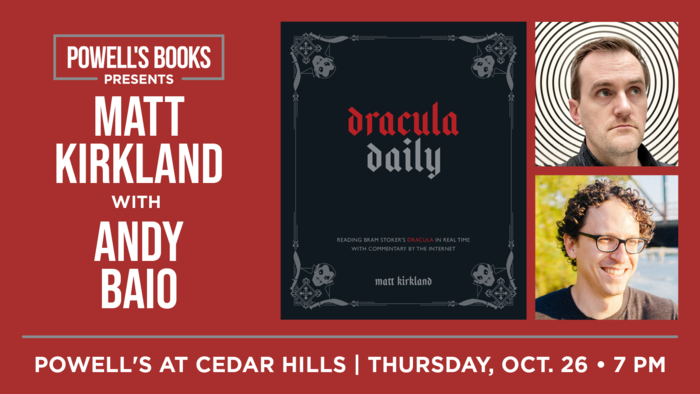
Bram Stoker’s Dracula is an epistolary novel, told in the form of a series of diary entries and letters, and Dracula Daily delivers each one to subscribers “as-it-happens,” on the day that each message is dated, pacing it out over a period of six months from May to November.