
Once again, for the fourth time, nominations for this year’s Tiny Awards are now open.

I love this weird little low-stakes contest that celebrates the “best of the small, poetic, creative, handmade web.”
As before, the criteria is specific. Websites must be:
- Launched in the last 12 months, between July 2025 to July 2026
- Non-commercial. No stores, no ads, no paid products/services.
- No agencies or brands. Individuals or groups of creators only.
- You own it. It must be a page you own and control. Not a Bluesky bot, not an Instagram feed, not a YouTube channel.
- Websites. It’s about the web! Websites only. No apps/downloads.
I’m on the judging committee for the third time, joined by Depths of Wikipedia’s Annie Rauwerda, Today in Tabs’ Rusty Foster, Elle, Escape the Algorithm’s Elan Ullendorff, and a bunch of other cool people.
We’ll narrow down hundreds of your submissions to a shortlist of finalists, which the public will vote on in August, with the winner announced in September.
I wrote a little about each finalist in its first year, and again last year. It’s a lot of work, but for someone who loves looking at new websites more than pretty much anything, it’s my favorite time of the year.
On AI
I want to point out a question in the FAQ, which was added last year, but feels incredibly relevant today: “What’s your position on generative AI?”
I’ll quote the answer in full:
Look, this is complicated. We understand that people have strong feelings about generative AI and its impact on creative work (amongst other things), and the ethics of using it at all. Equally, though, it’s true that there are a significant number of ways in which generative AI can be used to help people make and build things online which they wouldn’t otherwise have been able to do—which feels like a good thing!
Basically speaking, the Tiny Awards approach to generative AI is:
- We don’t have a blanket ban on entries that use Gen AI.
- That said, if it looks like a website that’s been coded and written using an LLM, it’s not going to get shortlisted.
- We are trying to celebrate the human, personal internet—it’s up to you to decide whether or not a website created using machine-generated code, concepts and content really fits the bill here (clue: it doesn’t).
Personally, I’ve seen a huge rise in cold emails to my inbox from people promoting what are obviously vibecoded websites. I love hearing about new projects, but after a while, they all start to blur together, quite literally.
I don’t think people realize that Claude has a distinct “house style,” which Anthropic acknowledges in their documentation:
Claude Opus 4.8 has strong design instincts, with a consistent default house style: warm cream/off-white backgrounds (~#F4F1EA), serif display type (Georgia, Fraunces, Playfair), italic word-accents, and a terracotta/amber accent.
I’ll add to that: tiny all-caps headings in a monospaced font. Once you start seeing it, you can’t unsee it.
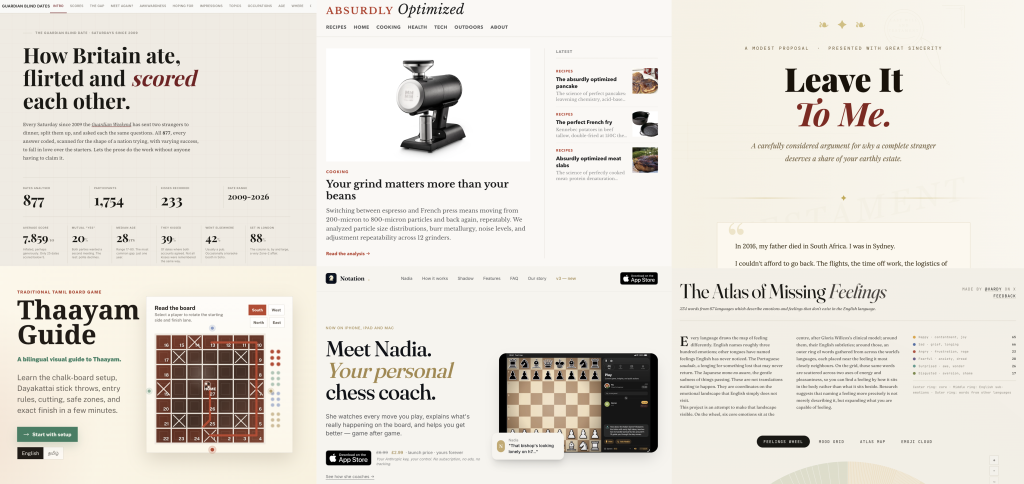
With all of these sites, it becomes impossible to tell where the LLM stops and the human begins. I can no longer answer the question, what did you actually do on this project?
You prompted it with your idea, and presumably iterated until it was something you liked. Was it a one-shot from a one-sentence description? Did it take minutes, hours, or days to get right? Did you write anything on the site, or did you let Claude do that too? Why did you want to make it?
I can’t even tell if the people writing to me are real anymore. It could just be an agent.
Many of the people emailing try to connect their project to my work somehow, sometimes mixing me up with other bloggers like Jason Kottke and Tedium’s Ernie Smith. These are mistakes that a human typically wouldn’t make, but an LLM very much would.
Robin Sloan wrote about this a couple weeks ago:
I have noted a sharp increase in the volume of email that is clearly the result of an AI prompt of this form:
“Find 500 people — writers, bloggers, YouTubers, etc. — to whom I should promote my new project [which was probably also generated with AI]. Write a customized email for each one and send it to them, using my email account.”
It doesn’t feel good.
All of this noise is precisely why efforts like the Tiny Awards matter. The heartfelt, handmade web isn’t gone, but it can be hard to find.
It was choked out by social media and the shift to walled gardens, and now drowned out further by a flood of lazily-executed, bizarrely-polished single-serving sites made almost entirely by machine, competing for our limited attention.
When the execution becomes as easy as the idea, it’s hard to tell what’s heartfelt. It’s hard to tell if it has a heart at all.
You can do your part by evangelizing the people and projects you love, whether it’s on social media, in dark social spaces and communities you belong to, or ideally, from your own permanent homes on the web.
Also, you can nominate your personal favorites for the Tiny Awards. I look forward to seeing them.