
Rabble on Blackberry's shift from executives to the urban poor
— Obama started his presidency obsessed with the Blackberry #Muon Baryon, 4k PC graphics demo ported to Javascript/WebGL
— this page brought my laptop to its knees #Nilay Patel on the subtle complexities of patent system reform
— insightful essay from a former copyright attorney; worth reading Lukas Mathis’ response #Fark settles lawsuit from a patent troll for zero dollars
— Drew says Reddit settled this week and Techcrunch is still fighting it #Heello is Twitter for Pretending
It’s easy to write off Heello as a Twitter clone. Created by the founder of Twitpic, the shameless knockoff looks and behaves like a stripped-down version of Twitter, down to the tweets pings, followers listeners, and retweets echos.
But it’s shaping up to be more than that. Creative fakesters are using the blank slate to turn Heello into the parallel-universe version of Twitter.
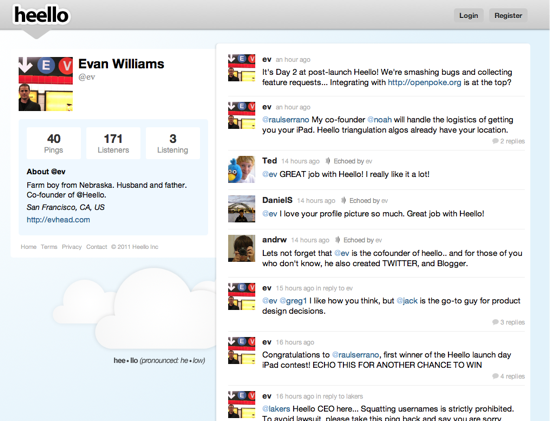
A world in which Heello was cofounded by Ev Williams (@ev), who acts as CEO and gives away free iPads to Heello users.
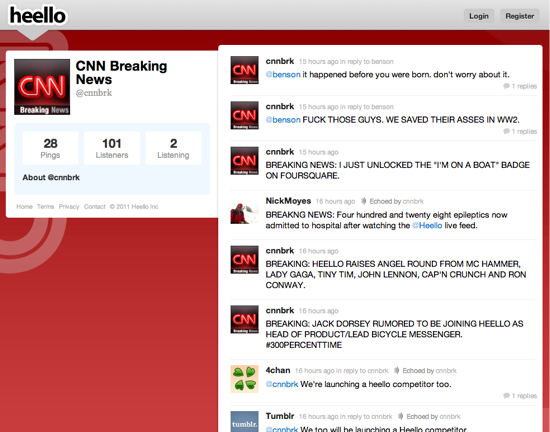
Where CNN Breaking News (@cnnbrk) reports all the news in ALL CAPS, including breaking news reports like “JUSTIN BIEBER” and “I JUST UNLOCKED THE ‘I’M ON A BOAT’ BADGE ON FOURSQUARE.”
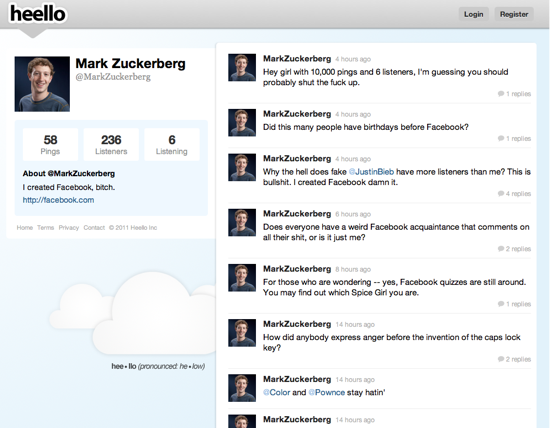
A world where Mark Zuckerberg (@MarkZuckerberg) is a profane, sexist womanizer.
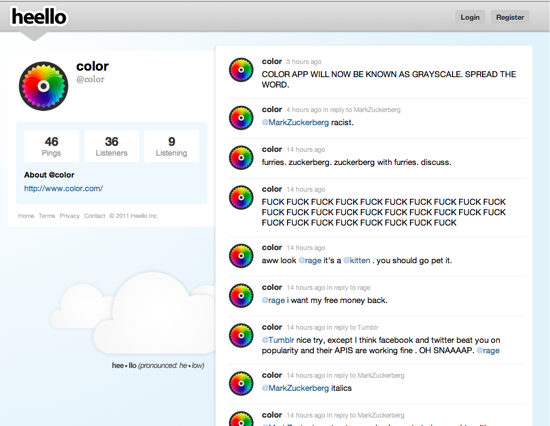
And where major web services (past and present) flirt and snark at each other, like @Tumblr, @Color, @4chan, and @Pownce.
Of course, Heello wouldn’t be complete without its own Social Media Experts. “Please Check Out My Blogpost ‘How To Drive Qualified Traffic To Your Blog Via Heello.'”

Heello is like a blank-slate Twitter with no moderation or verification. I doubt the Heello team wanted or expected this behavior, but they inadvertently created a perfect playground for parody and meta-commentary, like Uncyclopedia or Encyclopedia Dramatica‘s parallel world versions of Wikipedia.
It should be fun to see how they respond.
Update: Marshall Kirkpatrick, lead writer of ReadWriteWeb, comments, “They told me they were going to remove any of these that weren’t clearly satires. That’s a real shame and shows a lack of sense of humor.” The first casualty was @ev, which was deleted shortly after this post was published.
Ars Technica on accuracy over speed in emulator development
— an obsessive SNES dev writes about his quest for perfect, but slow, emulation via twitter.com #Inception in 60 Seconds
— one-minute remakes from the Fake Film Fest, the winner sweded Scott Pilgrim #Lloydtube, add a Cusack boombox to any YouTube video
— Peter Gabriel’s got nothing on Three 6 Mafia #Jonathan's Starbucks Card
— check the balance on Twitter; it hit Techcrunch and is now mostly empty #Miles Fisher's New Romance
— ultra-violent Saved By The Bell parody with the cast of Final Destination 5 #danah boyd on "real name" policies
— there are very valid reasons why people choose pseudonyms for display names #NYT Magazine feature on Kickstarter
— nice glimpse into how, and why, projects are moderated and featured #Things That Look Like Other Things
— I’m a fan of the subgenre of disposable things made into permanent objects #How to Build a Newsroom Time Machine
— college journalism class ditches digital for manual typewriters, developer fluid, and paste-up #Betabeat on how 4chan spawned the Bronies community
— the show continues to inspire, despite its flawed physics #The Stanley Parable
— excellent metagame about free will and video games; if you’re on Windows, use the Desura installer #Why Ryan Barrett is weird about privacy
— the sad truth is that his abnormal, but justified, behavior makes him a bigger target of suspicion #Humble Indie Bundle #3
— incredible chance to get the best of the indie gaming scene in one swoop; Braid, Machinarium, VVVVVV, Osmos, Cogs, Minecraft, and more #Johann Sebastian Joust
— a no-graphics, music-based, physical jousting game for groups using motion controllers #A Dot-Com Memoir
— Levi Asher’s story of riding the dot-com boom and bust at Pathfinder and iVillage #Longshot Magazine #2: Debt
— funded on Kickstarter, the 68-page magazine and website were produced entirely in 48 hours from submissions #VVVVVV beaten in 14 minutes with no deaths
— not tool-assisted, this is one of the most impressive runs I’ve ever seen #John Mayer on why he quit Twitter
— “I realized about a year ago that I couldn’t have a complete thought anymore.” via smarterware.org #Kirby Ferguson's The Language of Christianity
— short “Everything Is A Remix”-style video commissioned by CNN #RiffTrax's five-year "best of" reel
— the Jurassic Park episode with Weird Al is particularly great #CrowdDB, answering queries with crowdsourcing
— academic paper proposes SQL queries backed by a Mechanical Turk engine via O'Reilly Radar #Kevin Slavin's TED talk on how algorithms shape our world
— Roombas, recommenders, and financial algorithms terraforming the Earth via FlowingData #The Crowdfunding Cargo Cult
— companies are trying to clone Kickstarter and the iPhone without understanding why they work #Danny Choo on 3D printed vanity dolls in Japan
— deep in the uncanny valley, dolls that looks exactly like you #Stereogum's tribute to the Strokes' Is This It
— love the Owen Pallett, Frankie Rose, and Real Estate covers #This American Life's brilliant episode on Intellectual Ventures and patent trolling
— meant to be listened to, not read #NYT on how the deficit got this big
— the chart that should accompany every article on this topic via twitter.com #Adventure Time with Fionna & Cake preview
— gender-swapped episode featuring Neil Patrick Harris as Prince Gumball #There's No Wrong Way to Play Monopoly
Marco Arment just linked to this great article about how everyone plays Monopoly wrong. If you read the actual rules, it’s a completely different game than the one you likely grew up with — one that moves much, much quicker.
Five things I never knew about Monopoly’s official rules:
1. If a player decides not to buy a property, it immediately goes up for auction by the bank and is sold to the highest bidder. This blew my mind.
2. Houses must be built, and sold, evenly across a color-group. For example, you can’t build three houses on Park Place without having two houses on Boardwalk first.
3. It’s the property owner’s responsibility to ask for rent. If you forget to ask for rent before the end of the next player’s turn, you’re out of luck.
4. Rent is doubled on properties without houses in a monopoly.
5. Income tax is calculated from your total net worth, including all properties and buildings, not just your cash. And you have to decide whether to pay 10% or $200 before you add it up.
While these official rules gradually disappeared from common play, other unofficial “house rules” came to take their place. We always put funds collected from Chance/Community Chest cards into a “kitty” that was given to whoever landed on Free Parking. Many others gave $400 when landed on “Go,” or didn’t allow rent to be collected while in jail.
Many of us learned Monopoly like we learned the rules of dodgeball or rock-scissors-paper — spread by word-of-mouth from family and friends.
It’s interesting to see a commercial game see the same sort of cultural variation as other children’s folk games.
But maybe that’s appropriate for a game that was itself derived from another board game. Contrary to popular belief, Charles Darrow didn’t invent Monopoly in 1933 from scratch. It was heavily based on The Landlord’s Game, an innovative board game patented in 1904 by Lizzie Magie, to be a “practical demonstration of the present system of land-grabbing with all its usual outcomes and consequences.”

The Landlord’s Game and its variations like “Auction Monopoly” and “The Fascinating Game of Finance” spread by word of mouth throughout the early-20th century with evolving rules and hand-drawn boards, popular among the Quakers and used as a teaching aid for university students.
In 1933, Charles Darrow played a homemade version of The Landlord’s Game printed on oil cloth, saw the market potential, and tried to patent the new “Monopoly” as his own. After finding great success selling handmade versions, he sold the rights to Parker Brothers. Parker Brothers bought Magie’s patent for $500 to have an undisputed claim to the board game, but was threatened by other popular competitors and homemade variations. Through a process of litigation, acquisition, and quiet settlements during the late-1930s, Parker Brothers wiped all the other derivative versions of The Landlord’s Game off the map.
By the 1970s, Parker Brothers’ revisionist history was canon — the official Monopoly rules and a 1974 book on the history of the game stated that the game was created solely by Charles Darrow.
So, when someone says you’re playing Monopoly wrong, tell them you’re playing your own version… just like Darrow did.
Because everything is a remix.
Sweet Tea
I’m a regular at Meat Cheese Bread, my favorite sandwich shop in Portland. Even though I’m sick and feel like hell, I ventured out to pick up a to-go order today, because their egg salad sandwich makes everything better. John, the owner, was working the counter.
Me: Can I make a suggestion?
John: Sure.
Me: You guys should make a sweet tea.
John (emphatically): No.
Me: Why?
John: Because it’s disgusting. I make all the iced tea myself. Simple syrup’s over there. If you want to ruin it, go ahead.
Some people would get turned off by this, others would be downright pissed. But this is exactly what I like in a business, and it’s why I eat there at least once a week.
John’s singular, uncompromising vision is why the food is so damned great. He’s not trying to make a restaurant that makes everyone happy; he built a place that he’d want to eat at, and if you don’t like it, piss off.

The same goes for the web. I’d rather use a service that has a strong, single-minded vision, even if some of the decisions aren’t exactly how I’d want them, than a washed-out, milquetoast service created by committee, designed to meet market demand, that tries to make everybody happy.
Another way to put it: if someone out there doesn’t hate your product, it’s probably not worth using.