Playing With My Son

There’s a classic Steve Martin bit from A Wild and Crazy Guy…

“I got a great dirty trick you can play on a three-year-old kid… Whenever you’re around him, talk wrong. So now it’s like his first day in school and he raises his hand, ‘May I mambo dogface to the banana patch?’”

I’m not sure if it’s a great idea to take parenting advice from 1970s standup albums, but this always made sense to me.

If you have a kid, why not run experiments on them? It’s like running experiments on a little clone of yourself! And almost always probably legal.

It’s disappointing how many people have children and miss this golden opportunity, usually waiting until they’re in their teens to start playing mindgames with them.

Before my son was born in 2004, I was prepared. I’d brainstormed a long list of sociological and psychological experiments with friends and coworkers, ready to unleash my inner Milgram on my unborn offspring.

My original plan was to raise him thinking he was living in a computer simulation, but sadly, my wife vetoed it. And any other potentially harmful, but funny, life-altering scenarios.

But I managed to sneak one in anyway.


I was born in 1977 — the same year the Atari 2600 was released and a year before Space Invaders. I was lucky enough to be born into the golden age of arcade gaming, and played through each subsequent generation as I grew up.

My son Eliot was born in 2004 — the year of Half-Life 2, Doom 3, and the launch of the Nintendo DS. By the time he was born, video games were a $26B industry.

I love games, and I genuinely wanted Eliot to love and appreciate them too. So, here was my experiment:

What happens when a 21st-century kid plays through video game history in chronological order?

Start with the arcade classics and Atari 2600, from Asteroids to Zaxxon. After a year, move on to the 8-bit era with the NES and Sega classics. The next year, the SNES, Game Boy, and classic PC adventure games. Then the PlayStation and N64, Xbox and GBA, and so on until we’re caught up with the modern era of gaming.

Would that child better appreciate modern independent games that don’t have the budgets of AAA monstrosities like Destiny and Call of Duty? Would they appreciate the retro aesthetic, or just think it looks crappy?

Or would they just grow up thinking that video game technology moved at a breakneck speed when they were kids, and slammed to a halt as soon as they hit adolescence?


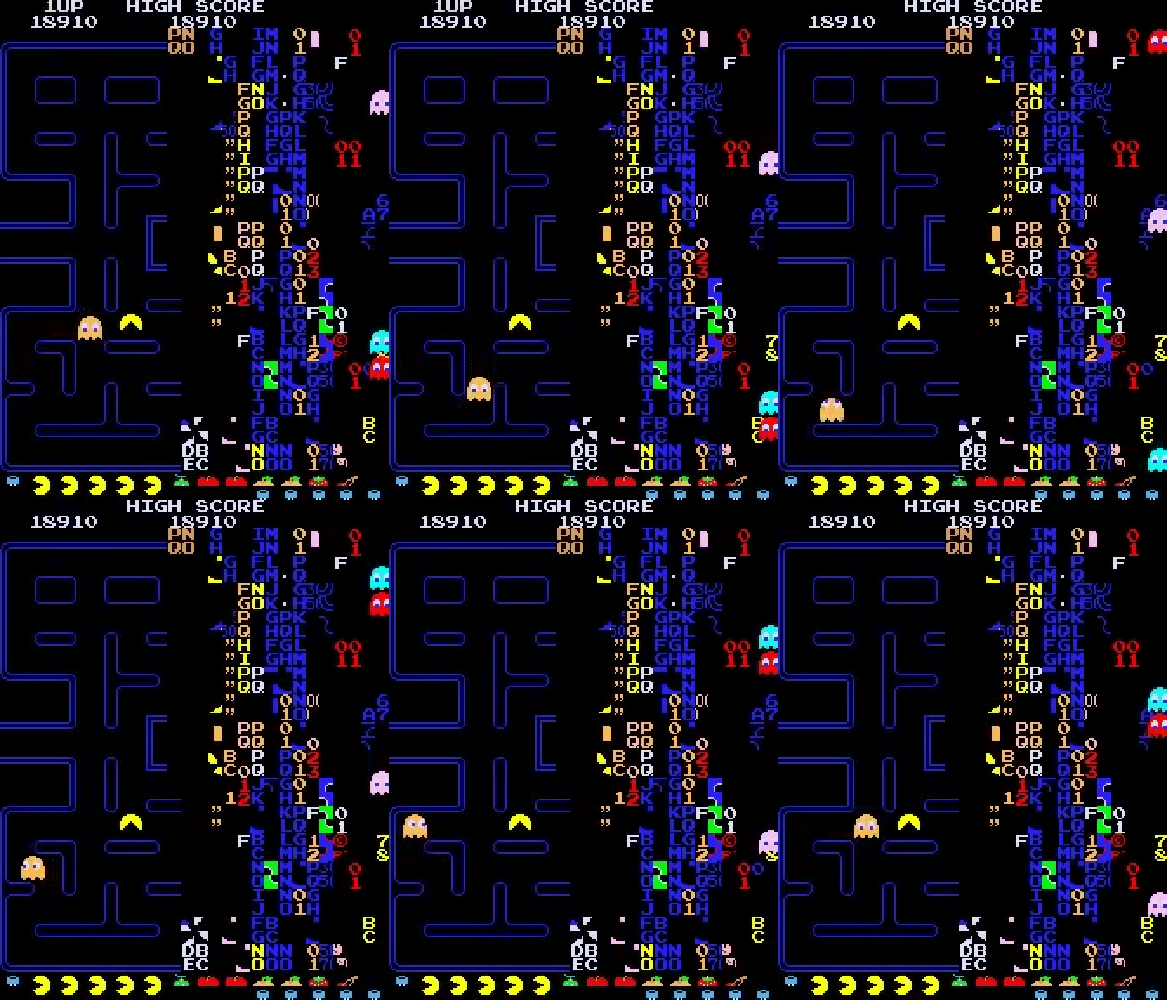
On Eliot’s fourth birthday, I started him with a Pac-Man plug-and-play TV game loaded with arcade classics — Galaxian (1979), Rally-X (1980), Bosconian (1981), Dig Dug (1982), and of course, Pac-Man (1980) and three sequels, Super Pac-Man (1982), Pac-Man Plus (1982), and Pac & Pal (1983).

Until the moment he picked up the joystick, part of me secretly dreaded he’d have no interest in it.

In the days leading up to his birth, I’d jolt awake in a cold sweat from nightmares of raising a six-year-old athlete, begging me to go outside to play football or baseball or some other dreaded physical activity.

Crisis averted.

He got better quickly. Six weeks later, he was beating my high scores in Dig Dug and regularly getting to higher stages of Pac-Man and its sequels.

I picked up another plug-and-play TV game — Ms. Pac-Man, Galaga, Mappy, Pole Position, and Xevious — and we played through the games together.

When we got bored of those, we hooked up my old Atari 2600, and we played through my collection of lo-fi gems like Asteroids, Kaboom!, Adventure, Combat, and (yes) E.T., but most didn’t hold up well.

It was time to move on to the next generation.


Four months into the experiment, with Eliot not even 4 1/2 years old, we’d jumped to the 8-bit era.

I loaded up an emulator and we started working our way through the NES canon.

At first, he sat on my lap and we took turns playing. Usually, he’d take the controls, but I’d step in for the tricky parts.

By age 5, he could beat some parts of moderately-difficult platformers like Super Mario 3.

By age 6, he was beating entire games on his own. He finished The Legend of Zelda on his own, and then finished the very difficult second quest with some mapping assistance.

We’d finished Super Mario Bros. 1-3, Mega Man 1–6, Castlevania 1–3, Rygar, Contra, and Duck Tales.

It was time to level up again.
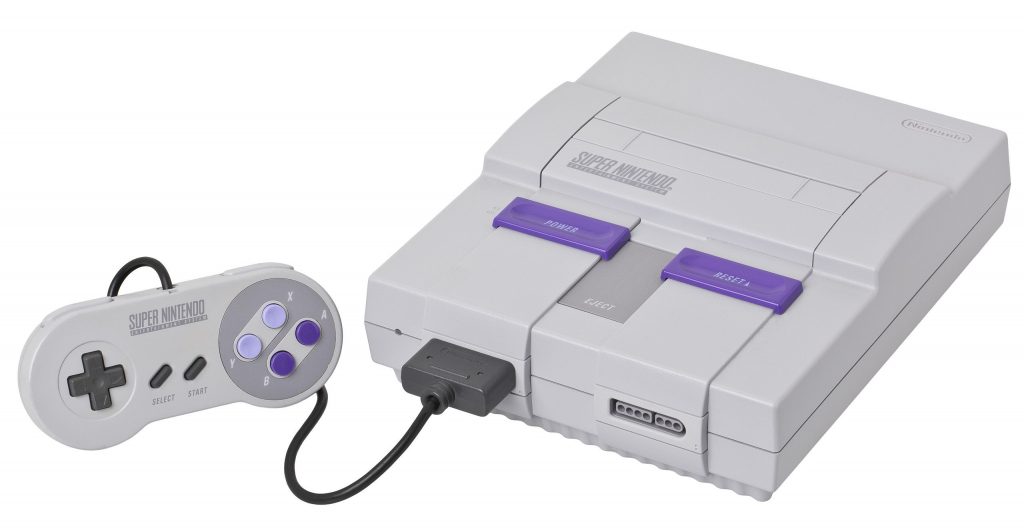

I never owned a Super Nintendo or Nintendo 64 — I’d moved on to PC gaming by then — so many of these games were new to me.

We played through Link to the Past and Super Mario World, and discovered some lesser-known gems together that became all-time favorites.

By the beginning of 2011, we’d moved on to the N64. The beginning of the 3D era on consoles didn’t age well in my eyes, but Eliot didn’t seem to mind. We beat the brilliant Ocarina of Time and Majora’s Mask, and fell in love with the criminally underrated Rocket: Robot on Wheels.

By the time he turned seven, Eliot had collected every star in Super Mario 64.

After that, we skipped straight to the 2000s. On the PlayStation 2, we played through ICO, Shadow of the Colossus, and the original Katamari Damacy, released the year he was born.

The experiment was complete.


This approach to widely surveying classic games clearly had an impact on him, and influenced the games that he likes now.

Like seemingly every kid his age, he loves Minecraft. No surprises there.

But he also loves brutally difficult games that challenge gamers 2–3 times his age, and he’s frighteningly good at them. His favorites usually borrow characteristics from roguelikes: procedurally-generated levels, permanent death, no save points.

One of his favorite games is Spelunky, easily one of the most difficult games I’ve ever played. Paste Magazine called it “a game with ‘hard’ carved into its very being.” I’ve never beaten it. I will probably never beat it.

A month after his eighth birthday, he beat Spelunky on his own.

But Spelunky isn’t like other games. Eliot may have beaten the game, but there’s a second, much harder ending — by going to Hell.

Tom Francis explains:

“To complete Spelunky, you just have to survive 15 randomly generated levels and then trick the final boss into killing itself. To get to hell, though, you have to perform a series of specific rituals in a specific order, using unique objects that crop up in different places each time, and then defeat the boss in a particularly audacious way to use his death as a stepping stone to the underworld.”

It’s one of the most difficult feats in gaming. I only know a couple people who have done it. For Tom Francis, it was “the hardest thing I’ve ever managed in a video game… It only took 41 minutes, but it took me hundreds of hours of play — and about 3,000 deaths — to learn how to do those 41 minutes.”

Three months ago, Eliot beat Spelunky the hard way. The game’s creator, Derek Yu, thinks he may be the youngest person to have done it.

After beating Spelunky, Eliot was ready for a new challenge. He asked me to buy him a new game he found through YouTube — Nuclear Throne, Vlambeer’s action roguelike-like known for its relentless difficulty. A week later:

Nuclear Throne, like many indie games developed by a tiny team, has a very old-school aesthetic.
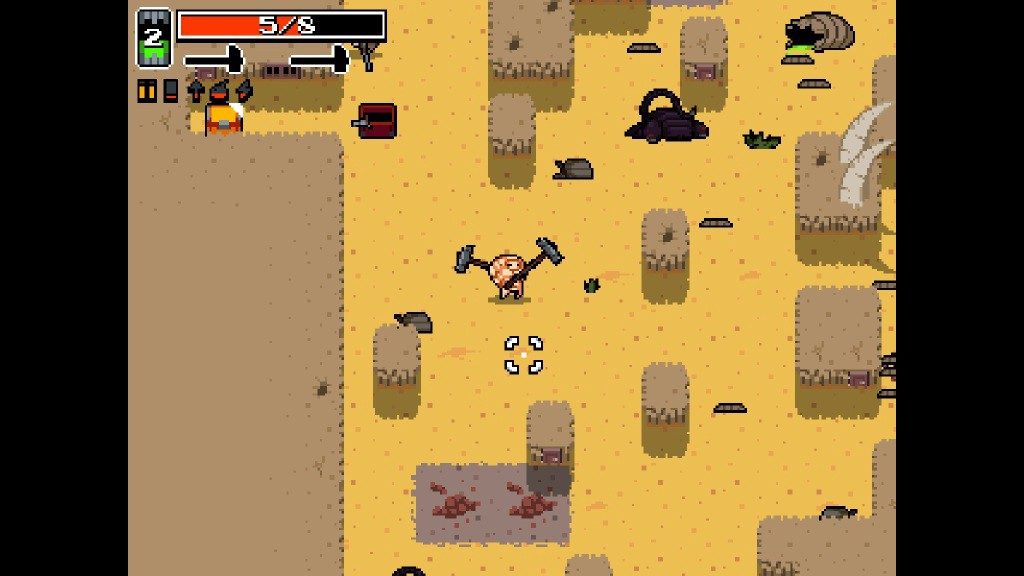
And this, for me, is the most interesting impact of the experiment.

Eliot’s early exposure to games with limited graphics inoculated him from the flashy, hyper-realistic graphics found in today’s AAA games. He can appreciate retro graphics on its own terms, and focus on the gameplay.

The lo-fi graphics in games like VVVVVV, FTL, or Cave Story might turn off other kids his age, but like me, he’s drawn to them.

My hope is that this experiment instilled a life-long appreciation for smaller, weirder, more intimate games in him.


So I gave my son a crash course in video game history, compressing 25 years of gaming history into about four years.

At this point, you’re probably either thinking I’m a monster or a pretty awesome dad. Maybe a little of both.

That’s okay with me. My son is amazing, he loves video games, and more than anything, he loves playing them with me.

Ready, player two?
It’s about ethics in video game parenting.

I first published this post in December 2014, as part of The Message, a publication on Medium.

Six months later, I spoke about it in front of an audience at GEL, a conference in New York City.
Black Lives Matter

Jay Smooth’s new The Illipsis video for Fusion on rioting in Ferguson was so powerful a debunking of a common racist trope, I felt compelled to transcribe it in the hopes more people would read it, quote it, and pass it on.

Take it away, Jay.

Jay Smooth:

So, I want to talk for a minute about human beings and about riots.

This past Monday night, while we were all sitting there waiting for that blow that we all knew was coming and hoping that we might be wrong just this one time, I said on Twitter that, “The fundamental danger of a non-indictment is not more riots, it is more Darren Wilsons.”

That thought struck a chord with a lot of people; it was linked to more than any tweet that I’ve ever made. But later on that night, we saw some things happen in Ferguson. We saw some unrest, we saw things you could call rioting.

And when that happened, a bunch of other people on Twitter were delighted by the idea that that heartache and grief and rage gave them a social media “gotcha” moment.

“So who’s the real danger now, Mr. Social Justice Warrior? You see all those thugs out there? You see how you people act? What do you have to say now?”

Well, here’s what I think now: I believe what I said. Now, more than ever.

And if you think what happened on Monday disproves what I said, you didn’t understand what I was talking about.

I wasn’t happy at all about what happened Monday night. I hate to see people pushed that far. I hate to see people’s community, family businesses destroyed. I hated seeing that.

But I’m also clear that if you ask me to weigh one against the other, we are weighing the destruction of property against the loss of a life. And if you value some people’s property more than the life of a black child, we’re not on the same team.

And regardless of that, for us to even discuss caring about one or the other is presenting a false choice because they’re not in opposition to each other. One is a byproduct of the other.

That unrest we saw Monday night was a byproduct of the injustice that preceded it.

This is not a choice, this is a cause-and-effect relationship. If you’re worried about the effects, you need to be thinking about the cause.

Riots are a thing that human beings do because human beings have limits.

We don’t all have the same limits. For some of us, our human limit is when our favorite team loses a game. For some of us, it’s when our favorite team wins a game.

The people of Ferguson had a different limit than that.

For the people of Ferguson, a lifetime of neglect and de facto segregation and incompetence and mistreatment by every level of government was not their limit.

When that maligned neglect set the stage for one of their children to be shot down and left in the street like a piece of trash, that was not their limit.

For the people of Ferguson, spending 100 days almost entirely peacefully protesting for some measure of justice for that child and having their desire for justice treated like a joke by every local authority was not their limit.

And then after those 100 days, when the so-called “prosecutor” waited until the dead of night to come out and twist that knife one last time, when he came out and confirmed once and for all that Michael Brown’s life didn’t matter, only then did the people of Ferguson reach their limit.

So when you look at what happened Monday night, the question you should be asking is how did these human beings last that long before they reached their human limit?

How do black people in America retain such a deep well of humanity that they can be pushed so far again and again without reaching their human limit?

How do we keep going through this same cycle? Because that’s the thing, it’s not just these 100 days. It’s the 100 times this cycle played out before Michael Brown.

The thing about that tweet I sent out Monday night? That tweet wasn’t really from Monday night.

I made the exact same tweet a year and a half ago about Trayvon Martin. The exact same tweet, word for word, all I did was switch out the name.

And that’s how sick, that’s how predictable and sick this white supremacy Groundhog Day is that we live in. You can literally, word for word, have the exact same conversation, year after year, and just switch out the name of the black child we lost.

There is nothing more exhausting or more inhumane than black America’s eternal cycle of being shocked but not surprised.

When you have to go through your whole life with all your muscles tensed, waiting for the same blow to come again and again, knowing it will hurt a bit more each time precisely because you always know it’s coming. And then you have to teach your children how to go through the same cycle.

That’s the definition of torture. Those are not fit living conditions for a human being.

So when I see President Obama say he has “no sympathy” for people who destroy a car? I’m sorry, but I do have sympathy for them.

I’m not happy to see them doing it, but human beings have limits.

When I watch that footage of Michael Brown’s mother out there crushed and heartbroken and I see her family talk about burning this thing down, I’m not happy to see that, but I don’t think we should be making excuses for that. I don’t think we should be explaining that away.

I don’t think there’s anything to be ashamed of. That is real life. That is what happens when you treat human beings this way.

So if you hated what you saw on Monday night, if you hated seeing those human beings pushed past their limit, you need to do something about the government, the justice system, and the institutions of policing that do not treat them like human beings.

If you watched the news Monday night and didn’t like the effects, you need to do something about the cause.

You, I, we need to go out there and make this country into a place where black lives matter.

Liked this? Go follow Jay Smooth on Twitter and go watch everything he’s ever made. It’s time well-spent.

3 Comments

Too Many Cooks

Tucked quietly into the 4am slot, Adult Swim occasionally broadcasts a segment listed simply as “Infomercials.” Most of these have been parodies of late-night infomercials, but for the last week, they’ve aired something a little different.

Have you ever watched something, and knew as it unfolded that you were witnessing the birth of a cult classic?

Please allow me to introduce you to everyone’s favorite late ’80s sitcom, Too Many Cooks:

Finished? Good.

Some things you might have missed (spoilers):

  • The credits appearing over each character are their real names. The IMDB page is suitably nuts.
  • If you slow the end credits, nearly every character’s last name is “Cook.” Also spotted: Cooke, Van Cook, O’Cook, McCook, Bake, Broil, and B6-12.
  • The stalker, credited as “Bill” on IMDB and “Featuring William Tokarsky” in the credits, appears in the background many, many, many times before he’s officially introduced. Watch it again.
  • Hardest to spot? The serial killer appears in a background oil painting.
  • Lars von Trier as “Pie,” who has his own badge.
  • The dad, Ken DeLozier, is the patient infected with “Intronitis.” His face is replaced by William Tokarsky’s as soon as the final photo’s taken.
  • Katelyn Nacon aka “Chloe Cook” is the teen daughter introduced third. She’s introduced again around the dinner table, and looks bored to tears.
  • The magazine read by both grandmas is called “Magazine: The Magazine.” The cover promises “Pages Inside” with words and paper.
  • The creator, Casper Kelly, also writes Your Pretty Face Is Going to Hell, a live-action workplace comedy set in Hell.
  • Vulture and EW both interviewed Kelly about the film, which was in post-production for over a year, and they did a Reddit AMA.

Like meta-TV intro credits humor? You may also enjoy this inferior One for the Road, a MadTV sketch with a similar starting premise, USB’s Hart and Home, and Adam Scott’s The Greatest Event in Television History series.

Rush Coil released a ridiculously great chiptune cover:

11 Comments

Analyzing 72 Hours of #Gamergate

Over the last week, I’ve been scraping every single #Gamergate tweet to do some network analysis. I ended up writing the whole thing up on Medium, I hope you like it.

One interesting bit: I discovered Newsweek made a major mistake reporting the sentiment analysis on their Gamergate feature, confirmed by the analytics company that collected it. I updated my post with the details.

2 Comments

72 Hours of #Gamergate

Two months ago today, actor Adam Baldwin was the first to use the #Gamergate hashtag on Twitter, solidifying a name for the movement that’s dominated all conversations in gaming since. Depending on where you sit on the issue, it’s either a widespread campaign of harassment against women or, actually, about ethics in videogames journalism.

Anyone who’s mentioned the #Gamergate hashtag in a critical light knows the feeling: a swarm of seemingly random, largely-anonymous people descending to comment and criticize.

I’ve been using Twitter for eight years, but I’ve never seen behavior quite like this. This swarming behavior is so prevalent, it got a new nickname — “sea lioning,” inspired by David Malki’s Wondermark comic.

I wanted to understand #Gamergate, how its proponents and critics behaved and the composition of both audiences.

So I wrote a little Python script with the Twython wrapper for the Twitter streaming API, and started capturing every single tweet that mentioned the #Gamergate and #NotYourShield hashtags from October 21–23.

Three days later, I was sitting on 316,669 tweets, along with a bunch of metadata for trying to understand the composition of both sides of the #Gamergate movement.

Why three days? It was a manageable and consistent slice of activity, taken at a time when the hashtag wasn’t trending and no major news was breaking, reducing the number of confused newcomers, bots, spammers, and other opportunists.

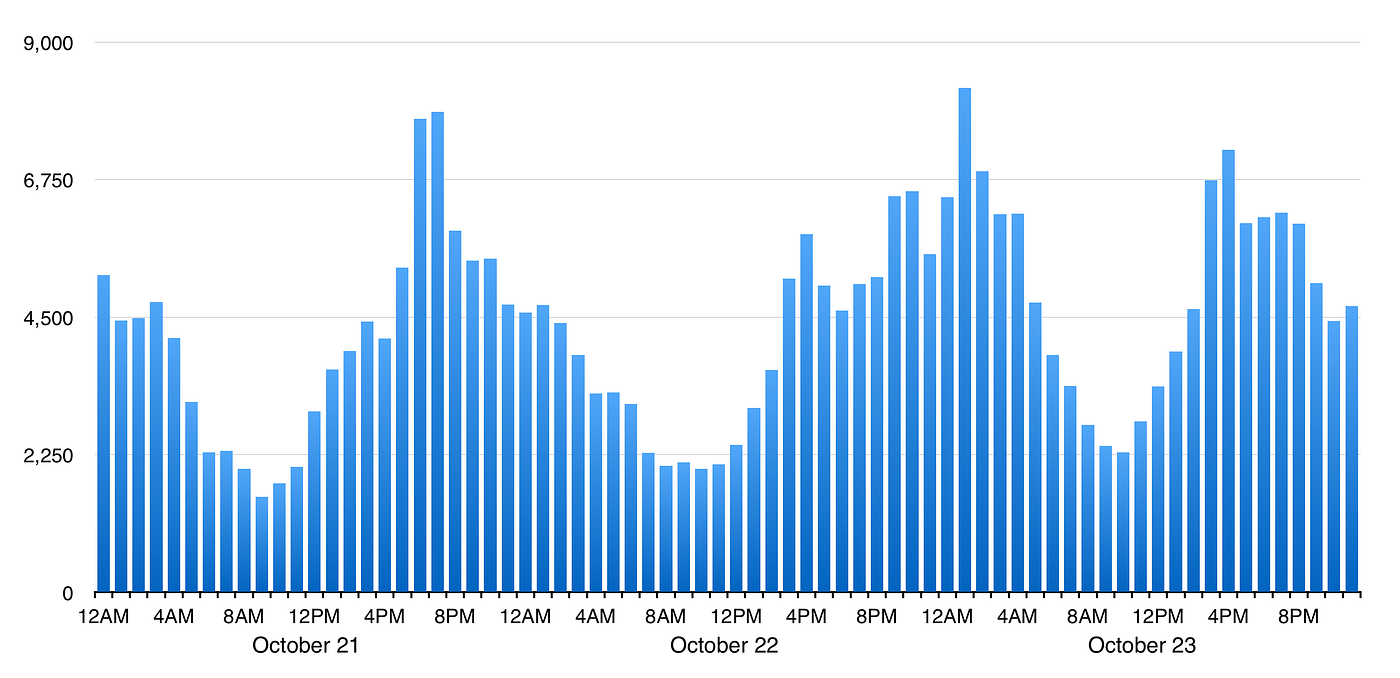
Hourly posting activity for #Gamergate/#NotYourShield. Times in UTC.


In the process of collecting the data, I posted a couple innocuous charts on Twitter and was predictably flooded with critical comments, many questioning my motives.

Without question, I have a strong anti-Gamergate bias. I co-organize a festival called XOXO that invited two frequent #Gamergate targets to speak, Anita Sarkeesian and Leigh Alexander. I backed Anita’s project, and I think they both do great work. I’m also friends or acquaintances with a few dozen independent game designers, developers, and journalists, most of whom have come out publicly against Gamergate. I think the whole thing’s pretty awful, and that it has critically wounded the public perception of videogames.

That said, I think the numbers below accurately and objectively reflect the data, and the analysis I’m doing is very straightforward. You could reproduce everything with a copy of Excel or Numbers.app. I included a dump of the complete dataset at the end of this post, and I encourage you to double-check my work.


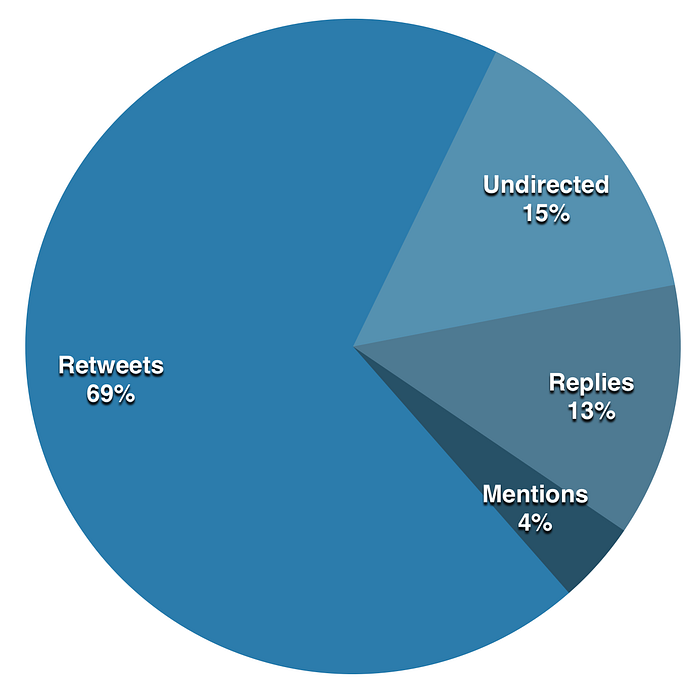
Most of the posting activity to #Gamergate and #NotYourShield is retweets. (From here on, I’ll refer to both hashtags as just “#Gamergate” for readability’s sake.)

Out of 316,669 total tweets, 217,384 of them (about 69%) were retweets.

The remaining 99,285 (31%) were original tweets— 46,826 weren’t directed to anyone, 39,622 replied directly to another user, and 12,837 publicly mentioned one or more users.

In total, 38,630 user accounts posted to the two hashtags in those three days. Excluding retweets, that number drops down to 17,410 users.

With that out of the way, let’s look at who’s posting to #Gamergate.

Account Age

Gamergate is unusual in one respect: many of its proponents are using newly-created, often pseudonymous, accounts.

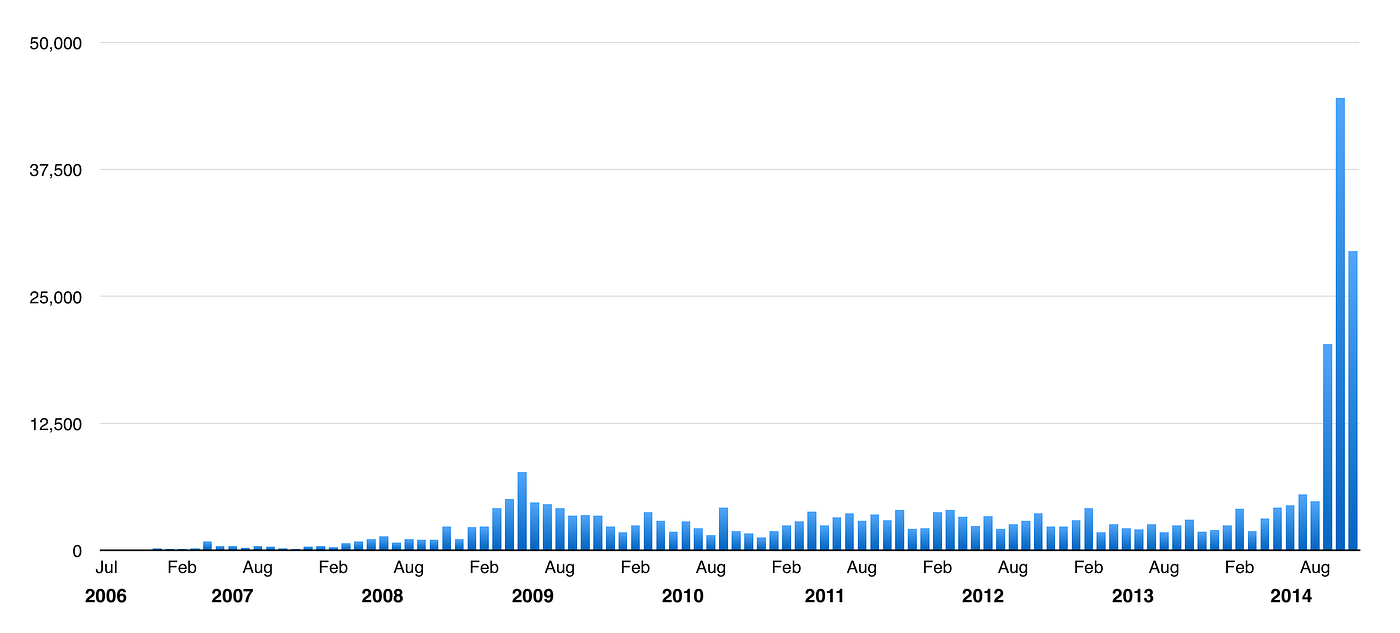
The chart below shows every tweet charted by the month that user signed up for Twitter.

#Gamergate tweets charted by month of account creation


Roughly 25% of all Gamergate activity is coming from accounts created in the last two months.

To be clear, I’m not suggesting these accounts are bots or sockpuppets — one person controlling multiple accounts — but simply that these accounts are new to Twitter.

As Gamergate supporters were quick to point out, many of them joined Twitter simply because that’s where the debate was. Some created anonymous accounts to avoid being tracked and identified, while others joined only after being turned away from other forums.

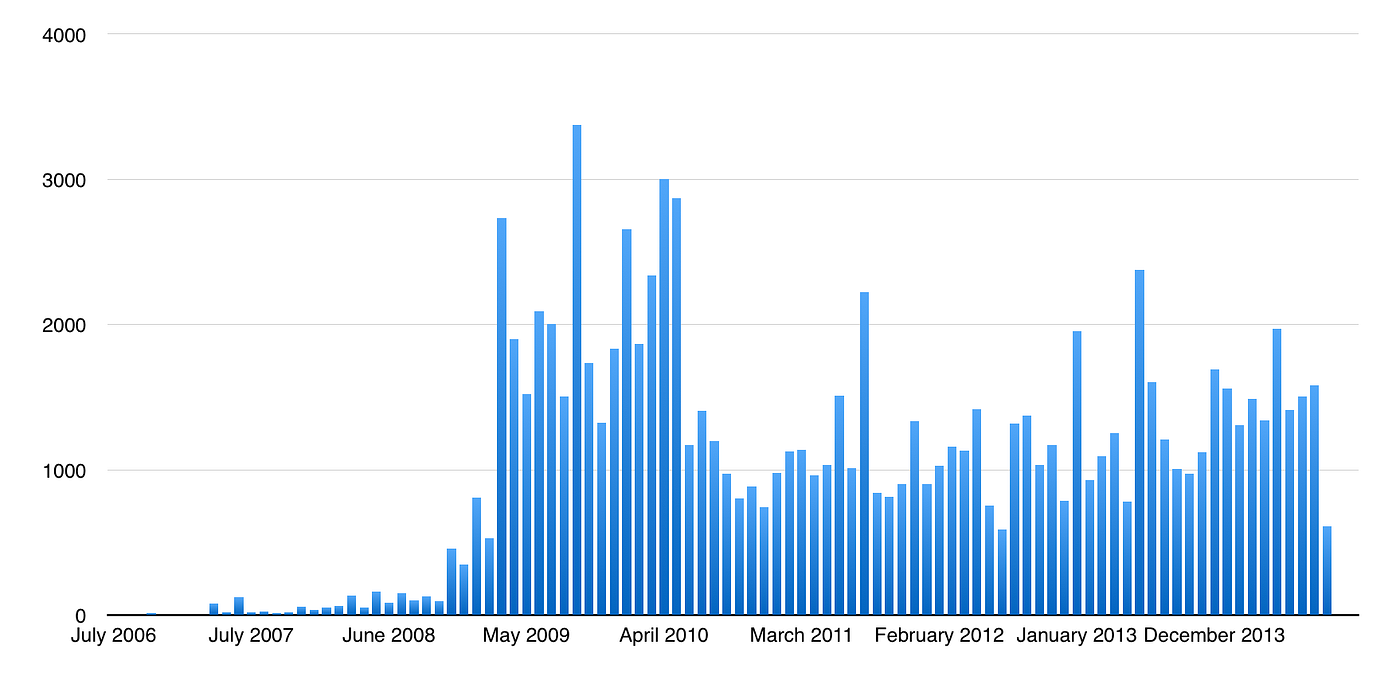
Is this distribution unusual, though? For contrast, I tried another hashtag for a similar length of time, the #kashmirfloods hashtag used during last month’s tragic floods that ravaged northern India. The distribution is much closer to what you’d expect: evenly distributed, roughly following Twitter’s rise in popularity.

The Retweet Network

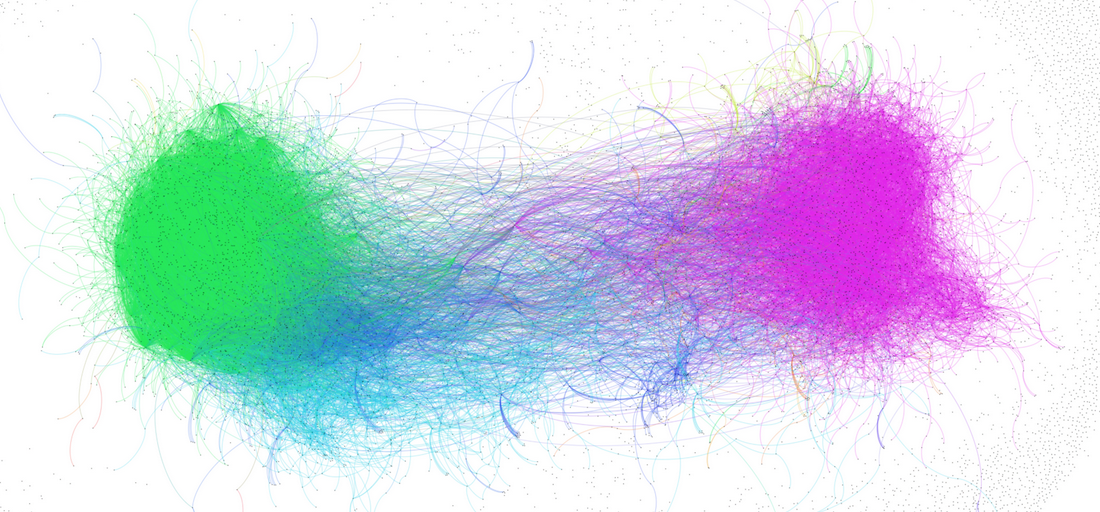
As you’d expect, there are two large communities contributing to the #Gamergate hashtag, and who they choose to follow and retweet are very, very different with little overlap.

There’s little overlap between communities.

For example, in this three day period, 1,673 users retweeted Anita Sarkeesian, while 2,240 users retweeted Blocker (aka Mr. Fart), one of the most prolific Gamergate tweeters. (Yes, the most retweeted person in #Gamergate is named “Mr. Fart.”) But only 79 users retweeted messages from both accounts.

Contrast that with the 1,138 users that retweeted messages from both Blocker and Gamergate proponent Milo Yiannopoulos in the same time period.

The top RTed users are pro-GG, the top RTed tweets are against.

The list of most retweeted users is dominated by Gamergate proponents, with only a couple critics in the top 20. Former NFL player and gamer Chris Kluwe pops up in #2 after a string of popular anti-Gamergate rants, but even Anita Sarkeesian only appears in 15th place.

The most retweeted tweets, however, look very different. The top 10 is entirely Gamergate critics and satire, with only five pro-Gamergate tweets in the top 20.

Why would that be? One obvious reason is the sheer number of #gamergate-tagged tweets being posted by supporters, while critics tend to post far fewer, possibly to avoid getting sea lioned.

Gamergate supporters use the #gamergate hashtag more often.

For example, the top five most-retweeted Gamergate critics collectively had 87 of their #gamergate-tagged tweets retweeted within the three day period. The top five Gamergate proponents had 811 tweets, nearly ten times as many.

Averaging Gamergate

We can use retweet behavior as a rough proxy to group like-minded individuals together. As we’ve established, those who retweet Anita Sarkeesian, Brianna Wu, and Zoe Quinn tend to fall in the opposing camp of those who retweet Milo Yiannopoulos, Internet Aristocrat, or Christina H. Sommers.

I grouped together the 3,022 accounts who retweeted Milo Yiannopoulos, Internet Aristocrat, or Christina H. Sommers, and the 1,694 who retweeted Anita Sarkeesian, Brianna Wu, and Zoe Quinn. With that, we can draw some rough demographics for Twitter usage.

The median Gamergate supporter has 67 followers, follows 134 accounts, has posted 1,194 tweets, and joined Twitter a little over two years ago.

The median Gamergate critic has 144 followers, follows 234 accounts, has posted 3,765 tweets, and joined Twitter four years and three months ago.

Naturally, this is skewed by the large population of relatively newly-created Gamergate accounts.

Gauging Sentiment

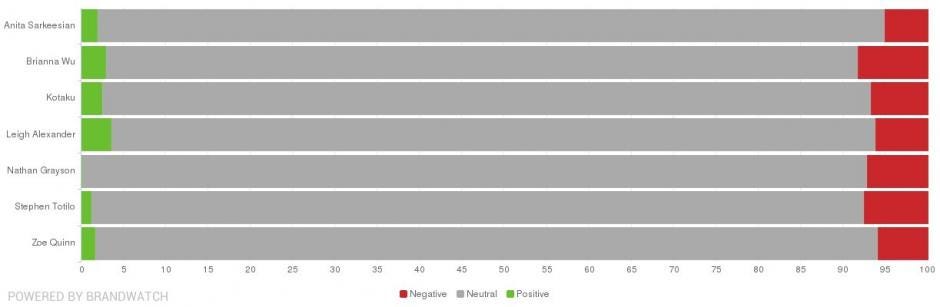
On Saturday, Newsweek partnered with a social media monitoring firm called Brandwatch to publish their own analysis of the Gamergate hashtag using half a million tweets sampled from September 1.

They ran sentiment analysis on tweets directed to several prominent Gamergate critics, and found across the board that around 90% of the tweets were “neutral.”

Newsweek interpreted this to mean the tweets were neither positive or negative, but I’m fairly sure Brandwatch simply meant they couldn’t make an automated determination for 90% of tweets — sentiment analysis using less than 140 characters can be challenging.

Digging into the actual text by hand, it’s clear that these tweets are anything but neutral.

In my three-day sample, there were 1,171 tweets that mentioned Anita Sarkeesian’s Twitter username, 485 for Brianna Wu, and 338 for Zoe Quinn. I put the text of all of those tweets, without user information, in this spreadsheet so you can see for yourself.

Roughly 90–95% take a clear side either in favor or against Gamergate.

A quick manual classification of a sample shows the numbers to be closer to 75% negative, 15% positive, and 10% neutral or undetermined, very far from Newsweek’s automated attempt. I’ve reached out to them to see if they’ll publish a clarification about renaming “neutral” to “undetermined.”

Update: Mike Williams, a data scientist at Brandwatch, confirmed that “neutral” should be “undetermined.” This morning, October 29, Newsweek published a clarification, but left the charts as they were, despite missing sentiment data for 90% of their tweets.

Worlds Apart

With the help of Gilad Lotan, chief data scientist at Betaworks, we grabbed the social graph for everyone in the dataset and visualized it using a fantastic open-source package called Gephi.

We used that information to map the universe of people who contributed to #Gamergate, clustering them into groups based on their relationships.

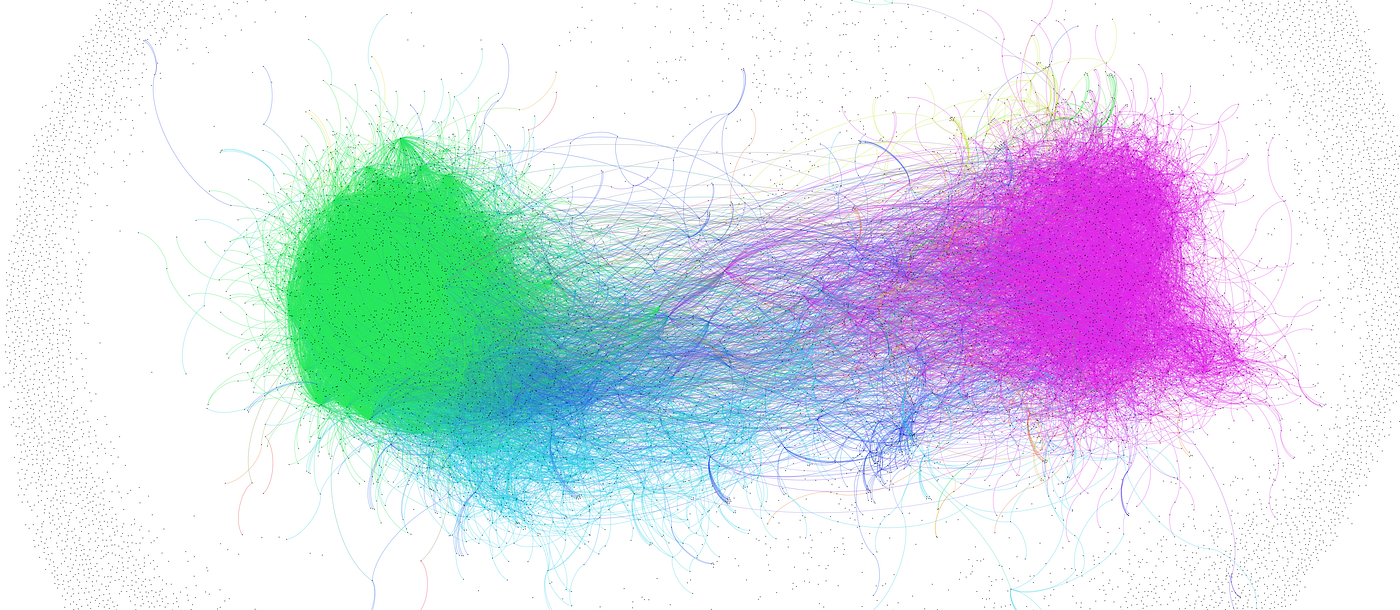
While there are hundreds of small communities represented by this visualization, it’s clear they group into two major groups: on the left, pro-Gamergate. On the right, anti-Gamergate. In the middle, a handful of controversial people engaging both sides. And on the margins, a constellation of isolated people unrelated and disengaged.

Each point is a single person in the #Gamergate universe, the lines connect who they follow. See a larger version with labels.


This network visualization is as good a metaphor as any for #Gamergate. Two massive, impenetrable hairballs of people that want little to do with one another, only listening to their side and firing volleys across the chasm.

Is it over yet?

The Data

Update: Originally, I was hosting complete downloads of the data here for anyone to play with, make their own visualizations, or simply fact-check my work.

Unfortunately, as it turns out, distributing the contents and metadata surrounding tweets is a violation of section 6b of Twitter’s Developer Policy. Twitter politely asked me to remove the downloads without sending lawyers, and I very much appreciate that approach.

My guess? This policy exists to protect the privacy of their users. Any downloadable dataset could include information that was subsequently deleted or made private by its owners, or removed by Twitter.

Pursuant to their guidelines, I’ve replaced the original dataset with a much more limited one, containing only the tweet ID and user ID. You can download it as a 9MB CSV or a 3MB ZIP.

I know this is far from ideal, but you can use this information to reconstruct the original dataset by using Twitter’s statuses/lookup API method, 100 tweets at a time. With their API rate limits, you should be able to grab up to 10,800 tweets an hour. Reconstructing the entire dataset would take around 29 hours.

Sorry, everyone.

(Note: This piece was originally published in The Message on Medium.)

Leave a comment

Justin Hall at XOXO

We’re posting every XOXO talk on YouTube, one every weekday in speaker order, and we’re a little over halfway through. There’s some really amazing stuff in there already, it’s hard for me to even pick favorites. Jonathan Mann and Gina Trapani are personal highlights.

The most popular talk we’ve ever had, by a decent margin, is Anita Sarkeesian talking about the tactics used by sexist jerks to discredit her and other women online. Go watch it. There’s an interesting behind-the-scenes story there, but maybe another time.

I just posted Justin Hall’s talk today, and it’s pretty great.

When he gets onstage, you can see he’s visibly shaken. That’s my fault. Before I introduced him to the stage, I told the audience that his site was the inspiration for teaching myself HTML in 1995. I told him I’d followed his life online for over 20 years, he opened my eyes to ways of using the web I’d never considered, and that he deeply influenced the way I thought about technology.

I made Justin Hall cry. And then we cut out my intro from the video, making him look like a big crybaby. Whoops!

There’s so much I love about Justin’s talk.

In 1995, starting at age 19, he started spilling the most intimate details of his life online, from his father’s suicide, the drugs he was taking, and the interactions he was having with friends, family, lovers, and long-time partners.

He wanted everyone to experience this, so spread the word in person and on TV and on roadtrips, an evangelist for the web as a personal communications medium. A Johnny Appleseed for HTML, trying to use technology to generate empathy.

It didn’t play out quite like he expected.

It takes a profound sense of self-awareness to realize the flaws in your deepest-held beliefs, talk about them publicly, and do the work to fix them.

“We’re all scientists of our own lives. We’re all constantly running experiments, every day. And what the web allows us to do is to share our data. What are we learning about our experiments, about what it means to be a good person and be connected?

We can use the web to share those truths with each other and evolve them, because we don’t know!

Let’s learn together until we’re dead.”

Sounds good to me.

Gamergate Is Running Out of Heroes

If you follow me on Twitter, you’ve probably gleaned how I feel about Gamergate. I’m not even going to attempt to summarize it—this covers it pretty well.

When 4chan started banning every Gamergate-related thread from its videogame forum, the infuriated gamers fled to 8chan (aka ∞chan), a year-old spinoff with its own unique origin story. Gamergate was welcomed with open arms. (I’m guessing Moot wasn’t heartbroken to lose their business.)

So, I know this is a cheap thrill, but I find it incredibly satisfying to read threads on 8chan from Gamergate supporters mourning all their fallen heroes.

We got a taste of this early on with the ultra-savvy geek icons like Joss Whedon and Tim Schafer coming out publicly in support of Anita Sarkeesian, followed by waves of rage and hand-wringing.

But as Gamergate continues to grow, and its accompanying campaign of harassment escalates, more and more artists, writers, and critics are publicly taking a stand against it.

That’s led to a lot of disappointment and frustration from pro-Gamergate supporters mourning the betrayal of their heroes, as they disappear one by one into their Social Justice blacklists.

For someone who’s sick of the abuse, these 8chan threads are pure schadenfreude:

One: https://archive.today/JASOw

Two: https://archive.today/xnFKy

Among the fallen heroes mentioned: Patton Oswalt, Seth Rogen, Felicia Day, William Gibson, Tim Schafer, cartoonist Mariel Cartwright, Joss Whedon, writer Greg Rucka, Wil Wheaton, writer Jim Sterling, John Scalzi, Adam Sessler, Jon Stewart, and the creators of Raspberry Pi, who came out forcefully against #gamergate.

When prompted for alternatives to their lost idols, a handful of names are mentioned, but only those who have remained silent on the issue. Their best hope is that the silent are secretly on their side, since nobody else creating stuff seems to be. They mention Giant Bomb’s Jeff Gerstmann, and the artists behind the Oglaf and Nedroid comics as possible supporters.

I wondered aloud on Twitter if their silence actually meant their support. Anthony from Nedroid immediately replied:

Oglaf’s Trudy Cooper replied later that night:

This morning, Jeff Gerstmann posted a strong statement against Gamergate in an editor’s letter on Giant Bomb:

So when “GamerGate” rose up to cover over a campaign of harassment with a veneer of concern for the ethics of games journalism, it more or less set off every single disgust alarm I have. Though I’m sure some good people have been roped into this mess under this guise, the ethical concern portion of all this is largely a farce, a fallacy.

Cross those three off the idols list, I guess.

Towards the end of the thread, one commenter summed it up, “We have to accept that pretty much the entirety of western society has turned against us and chugged kool-aid like crazy.”

I’ve said it before—creating something new and putting it online is an act of bravery, and it exposes you to a tremendous amount of criticism. At any level of popularity, you deal with kneejerk contrarians, self-entitled fans, and anonymous haters—the bread and butter of the Gamergate movement.

It’s not too surprising that they’re having a hard time winning their heroes over to their side.

Middling

Twitter’s for 140-character short-form writing and Medium’s for long-form. Weirdly, there really isn’t a great platform for everything in the middle — what previously would’ve just been called “blogging.” Mid-length blogging. Middling.

I think that’s partly why seeing Matt Haughey, Paul Ford, and Michael Sippey restart regular blogging on Paul’s delightfully retro tilde.club is so refreshing to me. I miss seeing people I admire post stuff longer than a tweet.

So I think I’ll try doing the same thing here. In the early days of Waxy.org, before I launched the linkblog, I used to blog short posts constantly. Multiple times a day. Twitter and Waxy Links cannibalized all the smaller posts, and as my reach grew, I started reserving blogging for more “serious” stuff — mostly longer-form research and investigative writing.

Well, fuck that. I miss the casual spontaneity of it all, and since I’m pretty sure hardly anybody’s reading my site again after the death of Google Reader, the pressure’s off.

What do I have to lose?

Update: Nice, Gina Trapani’s in too.

25 Comments

The Problem with Ello

Building something like Ello costs money. They have a team of at least seven people, and have worked on it for months. That doesn’t come cheap.

The About section makes it seem like Ello was built independently, a group of artists making something for themselves, presumably funded by volunteer effort and maybe a seed investment from Ello president and CEO Paul Budnitz, who also founded Kidrobot and Budnitz Bicycles.

But a little digging shows a much more predictable source: they took a $435,000 round of seed funding in January from FreshTracks Capital, a Vermont-based VC firm that announced the deal in March.

Why is this a problem?

The Ello founders are positioning it as an alternative to other social networks — they won’t sell your data or show you ads. “You are not the product.”

If they were independently-funded and run as some sort of co-op, bootstrapped until profitable, maybe that’s plausible. Hard, but possible.

But VCs don’t give money out of goodwill, and taking VC funding — even seed funding — creates outside pressures that shape the inevitable direction of a company.

Before they opened their doors, Ello became hooked on an unsustainable funding model — taking cash from VCs — and will almost certainly take a much larger Series A round once that $435,000 dries up. (Which, at their current burn rate, should be in a couple months.)

And they’ll have no trouble getting it. There’s a lot of money out there right now, and it will be extremely tempting to take it, especially if refusing it would mean closure or layoffs.

The problem, of course, is that VCs aren’t like Kickstarter backers, or even like angel investors. Kickstarter or Patreon backers just want the thing being made. Angel investors may have other reasons to invest beyond equity: fame, insider access, or maybe just the joy of helping something exist.

VCs may invest in things they think are interesting or want to exist, but they primarily invest money in startups to get a return on their investment, on behalf of their limited partners. That return usually takes the form of an exit: an acquisition or an IPO.

Unless they have a very unique relationship with their investors, Ello will inevitably be pushed towards profitability and an exit, even if it compromises their current values. Sometimes, this push comes subtly in the form of advice and questions in emails, phone calls, and chats over coffee. Sometimes, as more direct pressure from the board. (FreshTracks’ Managing Director sits on their board.) Or, if things go bad, by replacing the founders.

The Ello team knows that how a startup is funded shapes how it behaves. They spend a good chunk of their About pages talking about how they’re not going to make money (not ads or selling your data), and a little bit about how they hope to (paid premium features). I hope they’re right — it’d be great to have more startups that aren’t reliant on ads.

But they completely fail to disclose how Ello is being funded now, which matters just as much, if not more, as any future revenue plans.

I love seeing people build new stuff. More people trying to build crazy experimental communities on the Internet is a very good thing. And nothing’s more audacious than trying to build a new social network.

Social networks become the glue that connect people together — the foundation for friendships, relationships, and new works of creative expression.

Building a social network is like opening the doors to a huge party and inviting everyone in. Without a way to get your stuff out, shutting down a social network is like locking the door and burning the place down.

At the moment, Ello is a free, closed-source social network, with no export tools or an API, fueled by venture capital and a loose plan for paid premium features. I think it’s fair to be skeptical.

Like everyone else here, I hope Ello can stick to their principles, resist outside pressure, fight market forces, and find a unique and sustainable niche.

Let’s hope their investors feel the same way.

(Note: I originally posted this article on Ello shortly after its launch, along with a followup responding to the media interest.)

Leave a comment

How to Flawlessly Predict Anything on the Internet

On Saturday, a Twitter account appeared that perfectly predicted the outcome of the final World Cup game, down to who scored the winning goal for Germany. It was a con—and a classic one. (We’ll talk about how the con works in a moment.)

But it also felt like a missed opportunity, and immediately made me think of a much more serious con perfect for the 2016 election.

The Long Con

On November 9, 2016, the day after the presidential election, a YouTube video appears.

In the video, uploaded six months earlier, a member of Anonymous holds a leaked memo from the CEO of an electronic voting machine manufacturer. The memo states they’ve been contracted to manipulate the results of the upcoming presidential election, and clearly outlines what those results will be.

The memo goes on to say that the chosen presidential nominee will win by a small margin, and detailed state-by-state breakdowns are included in an attached spreadsheet.

To prove their claims, the Anonymous whistleblower points to Flickr and Instagram accounts with detailed scans of the memo, a Dropbox with 50 state-separated CSV files with election outcomes for each, and, finally, a Twitter account that details the electoral results for every state, the outcome of several key Senate and House races, and a final electoral tally.

Every single timestamp, across four different services, checks out—June 2016, shortly after the Democratic and Republican nominees were chosen.

And every single prediction is accurate. The Internet implodes in the biggest conspiracy theory ever.

How It’s Done

The scenario above is totally possible, easy to fake, and doesn’t require a nefarious conspiracy and Snowden-level leaker to pull off.

All it requires is a little programming knowledge, and six months of patience. Here’s how.

  1. Start by creating new private accounts for YouTube, Flickr, Dropbox, and Twitter.
  2. Create four fake memos representing four different scenarios—Republican and Democratic victories with either marginal or landslide results.
  3. Upload four videos to YouTube explaining the four different results, and show closeups of the respective memos you’ve created. Upload the scanned memos to Flickr and Instagram.
  4. Create comma-separated text files with your electoral results, two for every state. Since each state’s electoral votes are winner-take-all, list the nominee and electoral vote count in each. Upload the 100 CSV files to Dropbox. (Knowing a little code will make this much quicker.)
  5. Using the Twitter API, post tweets with every possible outcome. You should end up with two tweets for each state result or Congressional race. (Three if there’s a strong third-party contender.)
  6. Finally, for the electoral tally, write a script that uses the Twitter API to tweet every possible permutation of the final national electoral tally. With 538 electoral votes, you should end up with 1,076 tweets — from a 538-0 Republican washout to a 0-538 Democratic landslide, and every variation in between. (The variations could be easily narrowed by taking swing states into account, but why bother?)
  7. When all the results are in, delete every single incorrect prediction.
  8. Make the account public.

What’s left appears impossible: four social media accounts with six-month-old predictions, and 100% accuracy.

Selective Memory

This is a modern update to a classic confidence game—find a risky scenario with limited possibilities, bet on every single combination, and then hide your failures. The result is that you look like you’re either psychic or a goddamned genius.

Variations of this scam have been used for centuries in finance, magic, and gambling.

Mutual fund companies bring new funds to market by incubating new funds outside of the public eye for years, then actively market the strongest performers with the highest returns. Poof! You’re an overnight Warren Buffett!

Magician Derren Brown provided a perfect demonstration in the context of horse race betting, sending consecutive race predictions to 7,776 individuals divided into ever-shrinking groups, until he was left with one person who’d received five consecutive winning predictions. Convincing her to hand over her life savings was trivial.

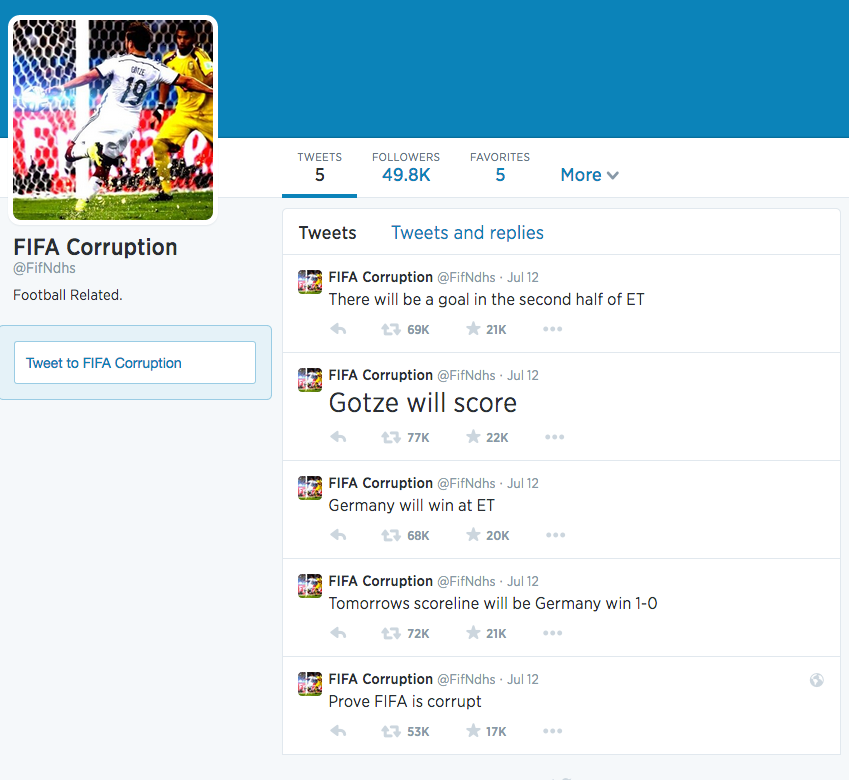
The FIFA hoax last weekend took a conspiracy bent, alleging that the governing body overseeing the World Cup was corrupt.

The account, @FifNdhs, posted four flawless predictions of the final World Cup match between Germany and Argentina, implying that Argentinian players took a dive.

The account went viral in minutes, with each prediction being retweeted tens of thousands of times.

But the would-be leaker made a fatal mistake: they forgot to make the account private before deleting their wrong predictions. Multiple people were able to grab screenshots, instantly debunking the hoax.

This hoax plays into our biases:

  1. Technological.We trust that timestamps on social media can’t be manipulated.
  2. Cognitive. We tend to attribute credibility to those things we can see that survived a process, and not those that are less visible. See: Survivorship bias.
  3. Emotional. Conspiracies can confirm our existing distrust in particular entities, whether it’s FIFA or the federal government.

The beauty of this hoax is that it works with any scenario limited to less than a few thousand permutations, and on any service that lets you mark posts or accounts private. Want to prove the Oscars are rigged? Your local school board election? Apple’s stock price? Go nuts!

But for everyone else: never trust a prediction revealed after its outcome.

Leave a comment

Chloe

For the second time in 18 months, I’ve lost a friend to depression—a unique, young talent with their greatest years ahead of them.

Chloe Weil tasted words. She was vulnerable to rich emotional experiences in the summertime. She hated her birthday, and she hated surprises. She had a cat named FACE that was famous on Reddit for a day. She helped us listen to songs traveling across the stars.

She was, in short, a badass.

Chloe was a person who made things. She made things with code, with fabric, with yarn, with charcoal, with sugar.

She poked fun at her depression, even as she was fighting it.

Chloe, I wish I’d told you in life how much I admire you, how incredibly talented I think you are. You continually made things, and like your synesthesia, they revealed someone who experiences the world unlike anyone else I know.

I wish I’d been able to say these words to you in person, instead of writing them to you in death, so that you could have tasted every one.

Friending the App Store

I love indie games, and follow the indie game scene pretty closely. I read gaming blogs, follow dozens of game devs, and keep a close eye on interesting new releases for the festival I run every year.

But I can’t catch everything. So, last month, I was boarding a flight to NYC and asked for some recent iPhone game recommendations:

Within minutes, I’d loaded my phone with obscure and interesting gems suggested by dozens of people.

I’d already played the critically-lauded Monument Valley, Blek and Hitman Go. But many others were completely new to me—15 Coins, Kiwanuka, Power Grounds, Hoplite and Oquonie were all wonderful.

All of these underrated game were all buried in the App Store, hidden in plain sight for months, but it took Twitter to find them.


Next month, the iOS App Store turns six years old. In that time, iPhone and iPad owners have downloaded its 1.2 million apps over 75 billion times.

But how we discover apps has stayed virtually the same since its launch: editorial picks, sales charts, and search. We’ve been using the same set of tools to navigate the App Store since 2008.

What worked for 500 apps in 2008 doesn’t work for 1.2 million in 2014.

Apple’s created a remarkable distribution platform for developers, big and small, but discovery suffered as the number of apps has exploded.

300 million people visit the App Store every week, but they all see the same handful of apps—a selection hand-picked by Apple staff, along with a stagnant list of bestsellers.

Apple’s sole attempt at personalized recommendations—the painfully inadequate “Genius,” which recommended clones of apps you already installed—was phased out last year for the even-worse “Near Me,” showing the same location-centric apps to everyone in your city.

iOS App Store: Then and Now

This one-size-fits-all model may have worked in the first year, but as the App Store has grown, it’s created an environment where discovering under-the-radar gems is impossible.

It’s especially frustrating to see developers compete with each other to win a zero-sum game—attempting to break into the sales leaderboards with exploitive free-to-play tactics, or hope that they win the App Store lottery with homepage placement.


Apple is hardly alone here.

Every major app store—the iOS App Store, Xbox Live Arcade, Nintendo eShop, PlayStation Network—serves the same set of editorial picks and charts to every member of their community.

Only two that I know of, Steam and Google Play, have experimented with personalized app discovery using the social graph. Google strictly relies on Google Plus for its recommendations, which is great if you’re an active Plus user. (Which you probably aren’t.)

Valve has dipped its toe into social recommendations for the Steam distribution network in the past, but they’re planning to expand the functionality this year, letting community members curate their own storefronts.


Getting Social

My hope is that Apple, and every other app store, can take a page from the last decade of the social web. Give its users a public identity, an incentive to share what they love, and the ability to find and follow others like them.

Find Friends

Mockup: Finding friends from Twitter. Apologies to Foursquare.

Like Twitter, these should be relationships where you can follow someone, without requiring approval the way friending people on Facebook does.

Bootstrap the social graph using iOS’s Twitter, Facebook, and address book integration, letting users find and follow users that recommend apps they like.

It’s not just about friends, but about following people, developers, or organizations that are finding and curating stuff you like.

Public Profiles

There’s an inherent expectation that app purchases are private, so automatically sharing that activity would be a massive privacy violation.

Instead, aggregate reviews and ratings on a public profile page. Add a simple, lightweight way to favorite apps, rather than requiring star reviews and purchases.

Each profile should have a “Follow” button and follower count, and apps you’ve favorited or reviewed appear on your profile, letting individuals or companies curate apps they love for their followers.

Likewise, every App Store developer should have a profile, listing the apps they’ve published and giving their fans a chance to be immediately notified when new apps are released.

Discovery

Mockup: Timeline of recent activity from people you follow


Finally, with the social graph in place, it would be possible to replace the “Near Me” section of the App Store with something relevant and personalized—a timeline view of shared apps, reviews, and ratings from people you follow.

Alternate views could show trending or popular apps from people you follow.

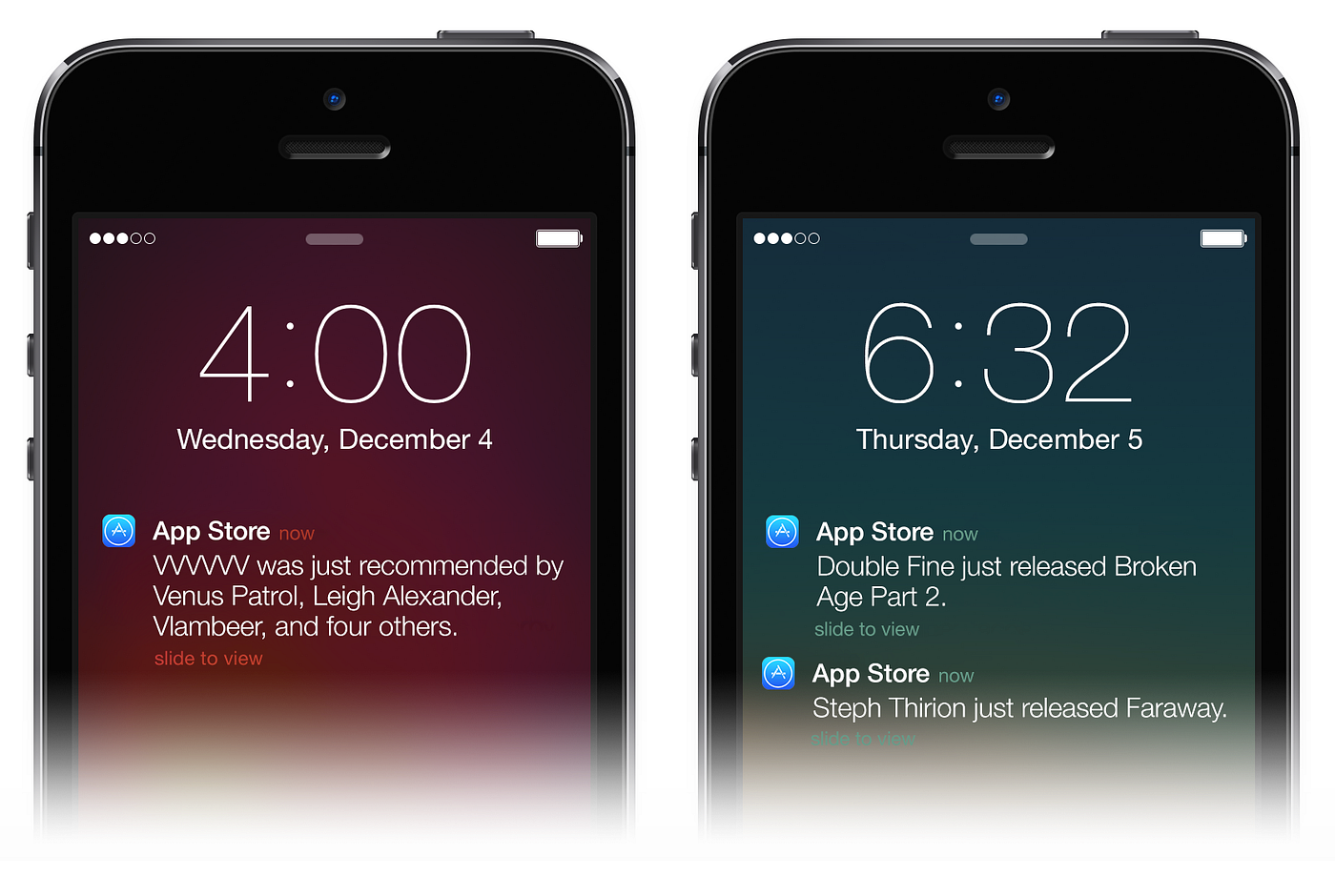
Push notifications could announce trending apps from people you follow, or alert you when a developer you follow has released a new app.


It’s upsetting to see the incredible work of so many independent developers get lost in the sea of apps, with so little assistance provided by Apple to find them.

Apple is using discovery methods from the age of brick-and-mortar bookstores and videogame shops—shelves of staff picks and bestseller lists are useful, but they’ll never be able to expose more than the very surface of what’s in the App Store.

Mockup: Trending recommendations and new app releases as iOS push notifications from Apple

The failure of Ping may have left Apple scared of taking this on, but that would be a mistake. Ping failed because of bad execution, and a failure to iterate, not because it was a bad idea.

Social discovery isn’t going away, and it’s the best chance of making sure every wonderfully underseen gem finds its audience.

Leave a comment

Diary of a Corporate Sellout

You haven’t made it until someone calls you a sellout.

My moment was October 5, 2005, the morning after we announced that Yahoo! acquired my side project, a collaborative events community called Upcoming.org.

“Pffft. Sellout.” — Billistic, 9:06am

Starting Up

I launched Upcoming two years earlier in 2003, after five months of working in my spare time while managing the website for an investment firm in Los Angeles.

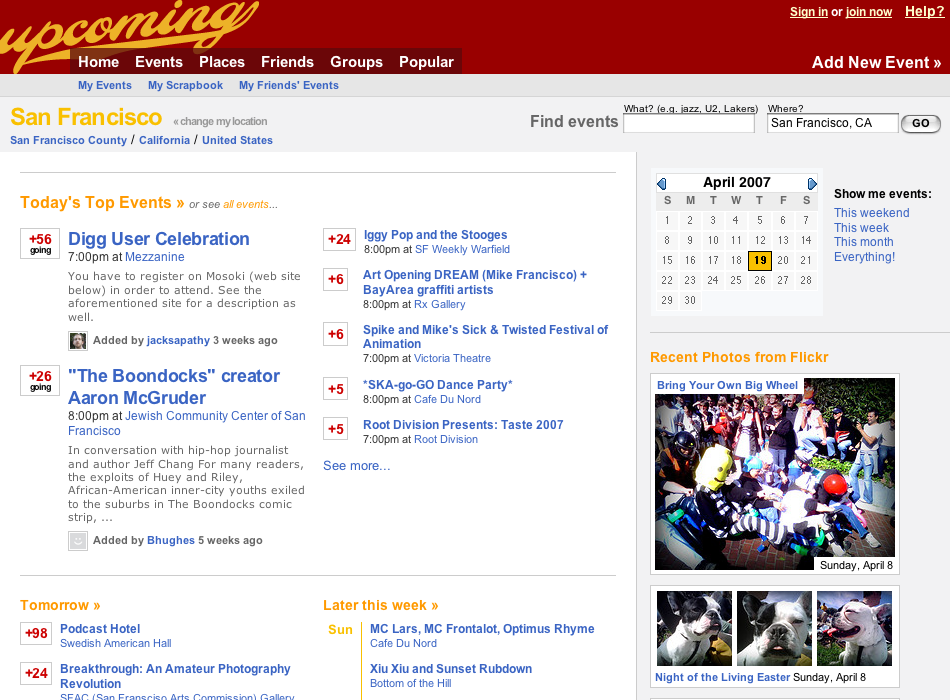
Upcoming was a community for discovering interesting events in a city and tracking what you and your friends wanted to do. Entirely curated by its members, every event was added by someone in the community, surfacing events that were often under the radar of local weeklies and newspaper listings.

It launched on Talk Like A Pirate Day, September 19, 2003, and I celebrated with a handful of friends at a nearby bar, passing out eye patches between rounds of beer.

Upcoming was among the first websites to use a social network for more than just meeting people. Friendster, and Six Degrees before it, let you connect to friends but limited the interaction to just browsing your friends’ friends and writing testimonials.

According to the New York Times, Jonathan Abrams built Friendster for surfing photos of cute girls, and it showed. It was probably great if you were single and trying to hook up. I’m married, so Friendster was kind of boring.

My hope was that I could use a social network to solve other first-world problems.

Upcoming was hardly alone in this line of thinking. The zeitgeist was in the air, the early days of what Tim O’Reilly would soon dub Web 2.0. Upcoming launched a month after Myspace and the same week as Del.ici.ous, and predated Facebook and Flickr by five months. Many more followed.

Each of these sites used the social graph to solve their respective problems— finding interesting links, photos, restaurants, bands, whatever. They used the network to connect people together in new ways.

It worked really, really well.

Upcoming wasn’t a blockbuster, by any means, but it found a cult audience of early adopters that were both geeky and social — the intersection of people who liked spending time on computers in 2003, but also spending time around other people.

A year after launching Upcoming, my son was born. What little spare time I had outside of my day job vanished even as Upcoming continued to grow.

I asked two close friends, Gordon Luk and Leonard Lin, to join as co-founders and help launch a redesign with a bunch of new features and other recent innovations, including private events, tagging, mobile integration, and an open API for developers.

The week we launched the redesign, in March 2005, Yahoo! bought Flickr and everything changed.

Selling Out

Even with two new co-founders, Upcoming.org was still firmly a side project. We never incorporated or took any investment, and none of us worked on it full-time. It made enough money in Google ads to cover the hosting bills and bubble tea.

Despite that, Upcoming continued to grow in popularity. The API led to a flood of new mashups and integrations, built into every major blogging platform of the day and powering the calendars of major sites.

Upcoming’s cultural footprint was larger than its traffic numbers would suggest, since it was heavily used by the geeks creating the next wave of social startups.

Among them were Stewart Butterfield and Caterina Fake, co-founders of Flickr and old friends from the proto-blogging scene.

After the Flickr acquisition, Caterina was tasked with bringing other interesting people and projects to Yahoo. She did it well. Throughout 2005, Yahoo hired many of the most creative people I’ve ever met. Yahoo was actually cool, in its own goofy way.

That July, Caterina emailed me to see if we’d ever be interested in joining Yahoo. Two meetings later, it was a done deal. We sold Upcoming and moved to Sunnyvale.

I kept my day job at the financial company until the day it was acquired. My resignation meeting with my boss was surreal:

“So… Yahoo bought my website.”
“I don’t think I can counteroffer that.”

For me, it felt like a dream. It was a tiny acquisition by any standard, but the money was secondary to the fact that I’d finally be able to work on my own project full-time. We’d be working next to some of our favorite people in the world at one of the most prestigious Internet companies, and Upcoming would get the resources it needed to grow and thrive.

In the back of my mind, there was a gnawing worry. I knew that once the deal was signed, Upcoming wouldn’t be my baby anymore. But it felt right. I crossed my fingers, we signed on the line, and hoped for the best.

Dropping Out

At the time we were negotiating, the only online communities I knew that had been acquired were Google’s purchases of Blogger and Dodgeball, LiveJournal’s sale to SixApart, and Flickr’s sale to Yahoo. Del.icio.us joined six weeks after us.

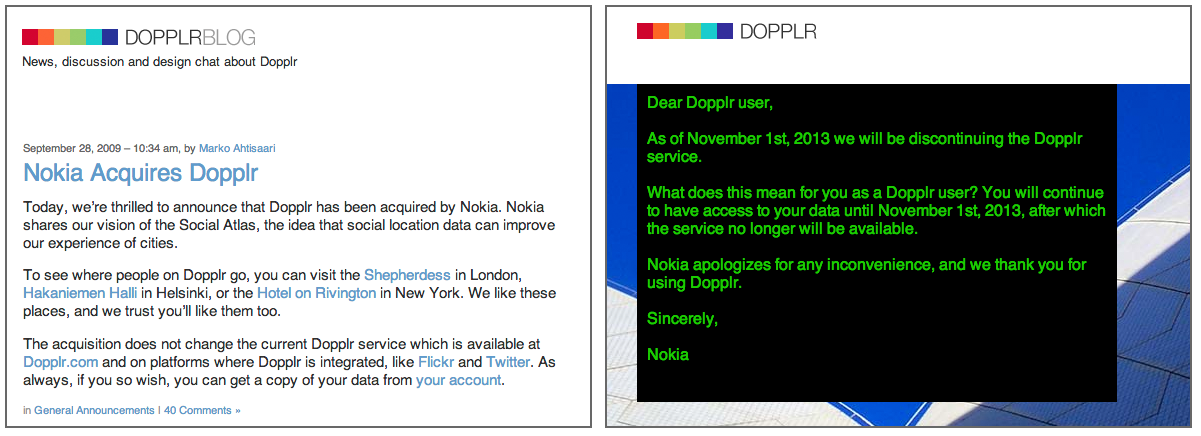
Each one posted a gushing blog post about how they were thrilled to announce their acquisition. Here’s mine.

Each acquisition seemed to be a success, with the teams apparently retaining autonomy and thriving under new ownership.

You know how this story ends. You know because you’ve experienced it yourself, usually two or three years after something you love was bought by a big company. The founders leave because of a culture clash, the site falls into disuse or changes focus under new management, and eventually you see a notice along these lines:

“Thank you for being a part of our incredible journey and thanks for all the support. P.S. Your data will be deleted in two weeks.”

I miss Dopplr.

These breathtaking acquisition announcements and their matching closure notices are so common that they’ve become a cliché. There’s even a Tumblr dedicated to them.


Our story was similar. To Yahoo’s credit, they mostly left our tiny three-person project alone. Culturally, it never made sense.

We spent a lot of time on integrations with the rest of the Yahoo network, integrating it into everything from Pets and Autos to Local, Maps, Mail, and Search itself. But Upcoming’s small, geeky base often clashed with the core Yahoo demographic.

(Imagine searching the Yahoo homepage for “san francisco events” and getting results for an MC Frontalot show, a microformats meetup, and a pillow fight flashmob and you can begin to see the problem.)

We launched a major redesign, migrated to Yahoo IDs and a Yahoo subdomain, and the site continued to grow quickly.


When we posted our acquisition announcement, we wrote up a little FAQ to put on Upcoming.org itself. It includes this deeply ironic, naïve gem:

You guys are big corporate sellouts!
That’s not really a question.

Fine… You guys are big corporate sellouts?
If getting paid for doing what you love is selling out, guilty as charged. But know that nothing has changed our ideals, and we won’t compromise ourselves because we’re working at a large company. We’ve always been focused on making something useful and used, and we think that working with Yahoo! will make that a zillion times easier.

All of that was true. We didn’t compromise our ideals, we focused on making something useful, and we certainly thought working with Yahoo would be beneficial to everyone.

What we didn’t anticipate was how giving up ownership sells the community instead.

Building an online community is like throwing a big party. You build the house, decorate it, and send out some invites. But it’s the people that show up that make it special.

When you sell the house, you’re not just selling a house. You’re selling everyone inside.

We now know that online communities have a very difficult time surviving that transition. For years, YouTube was the rare exception, but even they’ve had trouble in the last couple years as Google tried to cram Plus down everyone’s collective throats.


While it was great to work on something I’d created full time, I knew within the first couple months that working in a company as large as Yahoo wasn’t for me. It was no longer something we owned. We were taking care of someone else’s baby.

The site was healthy and growing, and we were all ready to try something new. I left Yahoo at the end of 2007 and my two cofounders followed shortly after.

After we left, the site fell into disrepair. Spam, always a problem, was left unchecked. Social features were downplayed or removed entirely. Updates trickled to a crawl and then stopped entirely.

In 2010, a leaked slide from an internal Yahoo meeting revealed a couple dozen products on the chopping block—including Del.icio.us, Fire Eagle, and Upcoming.

It took three more years before they pulled the plug, and Upcoming finally closed last April.

Starting Over

Yesterday, danah explained how “selling out” has lost its meaning.

For the most part, she’s right. Certainly among teens, the moral panic of over-commercialism coming from young die-hard fans is over.

As much as older generations may wince at YouTube celebrities pushing Taco Bell or Lorde pimping Samsung phones, nobody really cares anymore.

If anything, it’s a mark of success. You’ve built an audience that companies want to reach. You’ve made something people love, and they want those positive feelings to rub off on their products.

These brands provide independence and financial freedom in a way that publishers never could—without sacrificing ownership or creative control. Artists still make the music they want to make. Kids on YouTube are making a living making videos. The audience doesn’t care and everyone’s integrity remains intact.


Online communities are a different story.

If you start a social startup and give up ownership, whether through significant investment or an acquisition, you’re putting a community at risk.

It’s not just “data.” It’s the collective effort and history of everyone that breathed life into the thing you made.

There’s a huge amount of trust there, and we have every right to be angry when the services we use disappear. They tie to our identity, they forge new friendships, and they hold our collective history.

In the case of Upcoming, it was a decade of memories and experiences from real people. It was my responsibility not to fuck it up. People trusted me with those memories, and now they’re gone.

It’s the only time in my life that I felt like a sellout. It’s not a great feeling.


Through my work with Kickstarter and organizing XOXO, a festival entirely about independence, I’ve surrounded myself with people who make their living without sacrificing creative or financial control of their work.

When invited, I travel around the world to talk to people about why independence matters. I’ve always talked about my mistakes in public with the hope that others learn from them. Some of these lessons came at a high personal cost, but I’ve gone to great lengths to make sure I can talk about them.

I’ve never had the opportunity to fix one of them.

Last month, through a bizarre and surprising set of circumstances, Yahoo sold me back the Upcoming.org domain.

As far as I know, this is a first. Major corporations don’t give back the original domains they acquired back to their founders, and Yahoo should be commended for it. It’d be nice to see this right-of-first-refusal become part of standard shutdown procedures.

Ever since I left Upcoming, I kept waiting for someone to build something that scratched that itch, but it never happened.

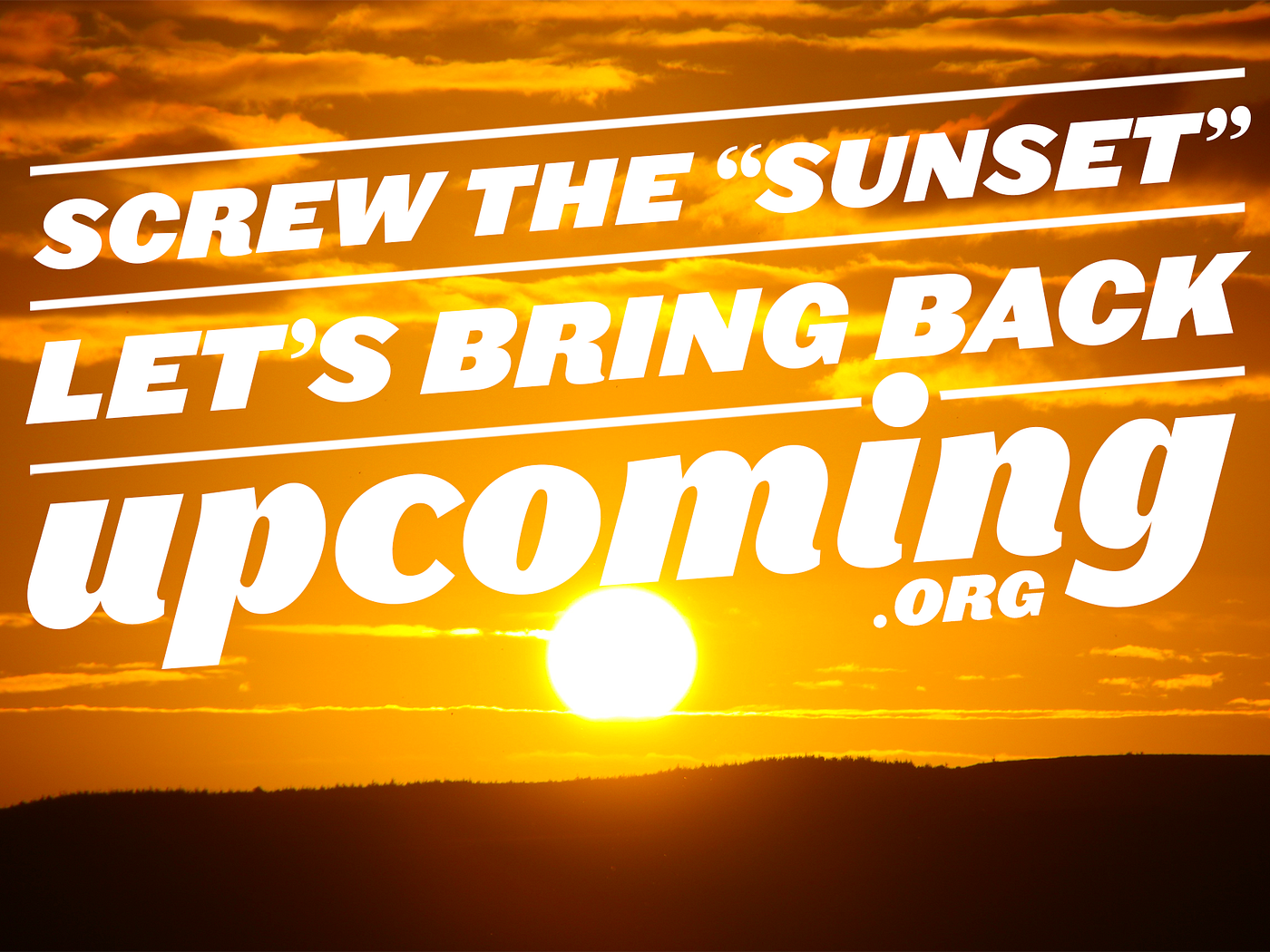
I had no idea if anyone else felt the same way, so earlier this month, I launched a Kickstarter project to fund rebuilding Upcoming and restoring the historical events.

It hit the goal in two hours. More than 1,500 people have pledged over $100,000 to bring Upcoming back.

It’s hard to articulate what that means to me.

To me, it represents a chance to make things right.

I miss Upcoming.

I miss the community that made it great.

And I won’t sell out again.

Leave a comment

Every Lonely Sandwich Video At The Same Time

Adam Lisagor’s pioneered a style of promotional video that’s changed how startups market themselves. They exude a nerdy cool, clearly showing the product or service, explaining why it matters and why you should use it with a deadpan sense of humor.

I never feel like they’re selling to me, and Adam seems to only make videos for stuff he loves, turning Sandwich Video into a stamp of approval for great new things.

For me, the best Sandwich Videos are the ones with Adam himself. They always make me want to give him a hug, and then hand him all my money.

As a tribute, here’s every single video featuring Lonely Sandwich as pitchman in chronological order. At the same time.

3 Comments

The Return of Upcoming.org

I don’t even know where to start, so I’ll just start with the news:

  1. In a surprising move, Yahoo sold the Upcoming.org domain back to me.
  2. I want to build a new Upcoming.
  3. I launched a Kickstarter project to make it happen.

I wrote much, much more on the project.

Yes, this is insane. More thoughts soon.

11 Comments

‘JIF’ Is the Format. ‘GIF’ Is the Culture

The animated GIF is the Internet’s native art form. But 25 years later, we still haven’t decided how to pronounce it.

We’ve spilled so many words over the pronunciation of a single letter, rivaled only by the debate over tabs vs. spaces, email vs. e-mail, and whether to capitalize “Internet.”

So, how do you pronounce GIF?

There are three main camps:

  1. Soft G—GIF is like “jif.” You think an inventor should be able to dictate how their invention is pronounced.
  2. Hard G—GIF is like “gift.” You believe that the creator’s wishes are largely irrelevant because language evolves, and prescriptive approaches to language are pointless.
  3. ↓

For the “soft G” crowd, this issue was settled in 1987 when CompuServe engineer Steve Wilhite first designed the GIF format. He’s always been adamant about the pronunciation, as in this interview with the New York Times last year:

“The Oxford English Dictionary accepts both pronunciations,” Mr. Wilhite said. “They are wrong. It is a soft ‘G,’ pronounced ‘jif.’ End of story.”

There’s something to this argument.

One of the great things about inventing something is that you get to name it, and by extension, how it’s pronounced. Honoring an inventor’s wishes may not be required, but it’s the nice thing to do.

There’s only one problem: Steve Wilhite and CompuServe did not invent the animated GIF as we know it.


The creators of the GIF format didn’t anticipate this kind of usage for their format, and the proof is in the spec itself — they never specified a way to loop animations.

When CompuServe added animation to the GIF89a spec in 1989, animations would only play once. For six years, every animated GIF ended on the final frame.

It was Netscape, not CompuServe, that added the ability to repeat animations, starting with Navigator 2.0 beta 4 in December 1995. Netscape defined an extension to the GIF format that specified how many times an animation should loop or if it should play infinitely.

Today, every animated GIF contains the “NETSCAPE2.0” string inside it, a digital thumbprint that firmly places the modern animated GIF as a Web-era invention.


So, does this mean that Netscape should get to dictate how it’s pronounced? No, not really.

Because when we talk about GIFs these days, we’re not really talking about the file format. We’re talking about the art form and culture that surrounds it, and that was created and popularized by the Internet.

The modern GIF was invented by the Internet, and like the Internet, its applications sprawl beyond comprehension. Early memes, reaction GIFs, glitch animations, wigglegrams, Blingee, cinemagraphs, and countless variations spread on Tumblr, Twitter, Reddit, 4chan, and dedicated net art communities like dump.fm.

GIF isn’t just a file format, it’s an art form and a culture. And, despite Wilhite’s efforts, most of the people in that culture pronounce it with a “hard G.”

via N6JLV

Since I downloaded my first GIF off a BBS in the late 1980s, I’ve pronounced GIF with a hard “g” like “gift.” It looked natural to me, and like many others, it was an on-screen acronym that I didn’t hear out loud until years later. I stuck with that pronunciation for years, even after I knew the “official” pronunciation.

But I’m not entirely comfortable disregarding the wishes of Steve Wilhite or the culture of animated GIF art, so I started taking a new approach last year:

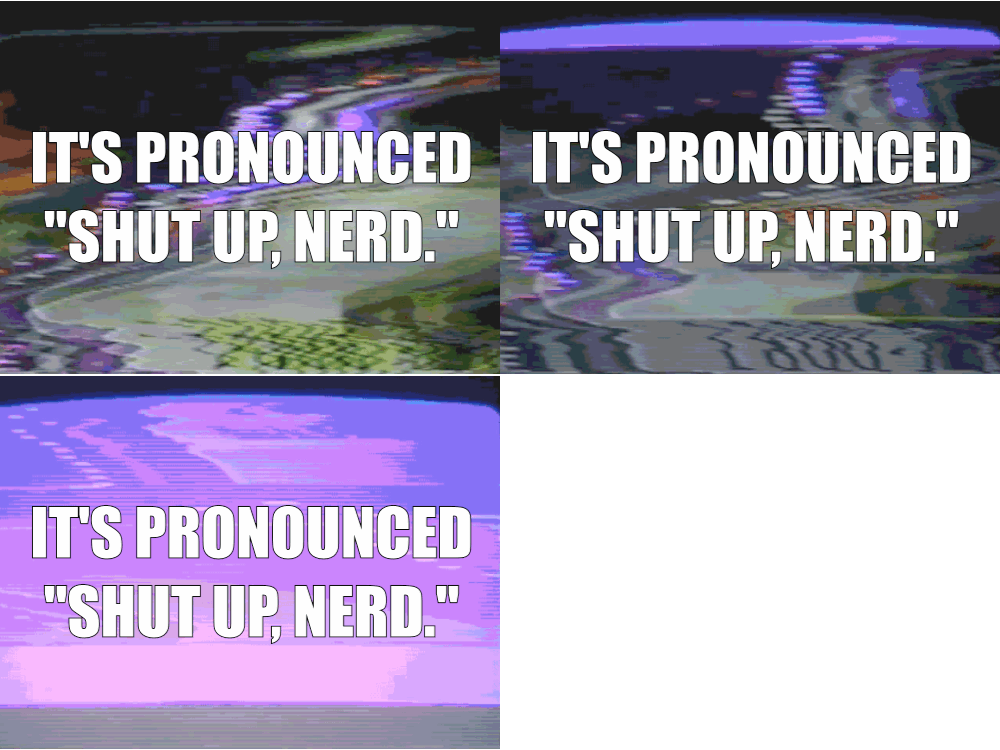
“JIF” is the format. “GIF” is the culture.

To honor Wilhite’s pioneering work, I pronounce every static or non-looping GIF with a soft-G. Every discussion of the file format, transparency, interlacing, and static GIFs are “jifs.” These are all “jifs.” So are these.

But the animated GIF, as we know it, was created by Netscape and popularized by the Internet, so I pronounce it with a hard-G.

There! That oughta settle it, once and for all.

Note: I originally published this post on Medium, as part of The Message, on April 29, 2014.

Medium Is The Message

This month, I joined The Message, a new collaborative writing experiment on Medium with an all-star list of some of my favorite writers—danah boyd, Anil Dash, Craig Mod, Rex Sorgatz, Paul Ford, Joanne McNeil, Virginia Heffernan, Clive Thompson, Quinn Norton, Robin Sloan, and Zeynep Tufekci.

Medium’s Kate Lee wrote an introductory post introducing The Message and how we came up with its name. It’s a playful nod to McLuhan, but an appropriate one.

The Message may sound like a simple group blog, but I’m using it as an opportunity to play with Medium as a new medium for writing, pushing its publishing and communication tools to try new things that I can’t really do here on Waxy. I’ll still republish most of my posts here for permanent archiving, but inevitably, they’ll lose something in the translation.

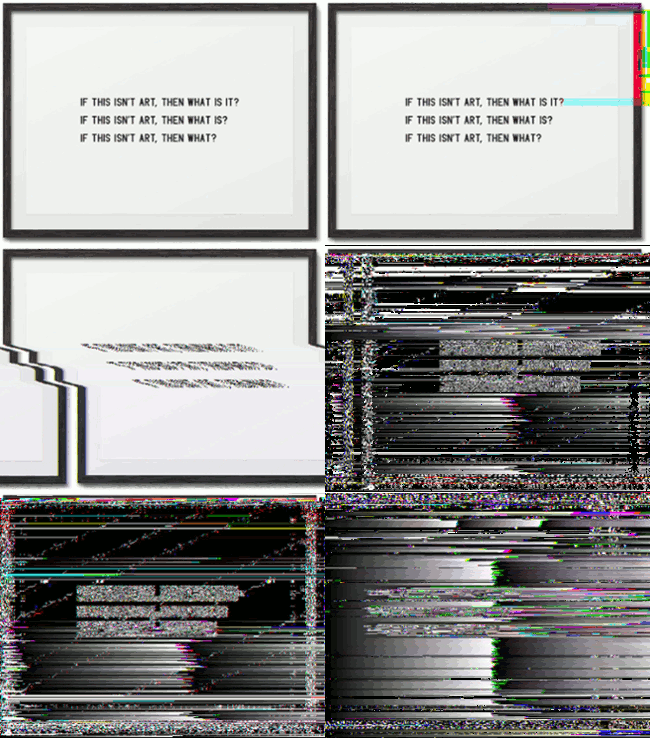
Before publishing anything on The Message, I wanted to know what Medium was capable of, so I published this.

It broke Medium, turning their recommendation emails and user interface into glitch art, crashing computers, and stressing out the support staff.

I followed it up by glitching LinkedIn. That was fun.

This morning, I published my first official post on The Message, my take on the GIF pronunciation war. Short version: CompuServe didn’t actually invent the animated GIF, as we know it, so doesn’t get to dictate how it’s pronounced. It’s a product of the web era, invented by Netscape and popularized by an entire culture.

I hope you like it.

2 Comments

The Indiepocalypse at Webstock 2014

Last February, I was honored to be invited to speak at Webstock in New Zealand, along with Maciej Ceglowski, Erika Hall, Charlie Todd, Clive Thompson, and a bunch of other neat people.

My talk, like New Zealand itself, was a bit of a whirlwind. I roused the hungover crowd on Friday morning with a look back at my childhood on the Sunset Strip and how it shaped my later views on creative and financial independence. The talk’s now online, and you can watch it here. I’m pretty happy with how it came out, hope you like it.

4 Comments

Dirty, Fast, and Free Audio Transcription with YouTube

Five years ago, I wrote about how I transcribe audio with Amazon’s Mechanical Turk, splitting interviews into small segments and distributing the work among dozens of anonymous people. It ended up as one of my most popular posts ever, continuing to draw traffic and comments every day.

Lately, I’ve been toying with a free, fast way to generate machine transcriptions: repurposing YouTube’s automatic captions feature.

How It Works

Every time you upload a video, YouTube tries to generate a caption file. If there’s audible text, you can grab a subtitle file within a few minutes of uploading the video.

But how’s the quality? Pretty mediocre! It’s about as good as you’d expect from a free machine-generated transcript. The caption files have no punctuation between sentences, speakers aren’t broken out separately, and errors are very common.

But if you’re transcribing interviews, it’s often easier to edit a flawed transcript than starting from scratch. And YouTube provides a solid interface for editing your transcript audio and getting the results in plaintext.

I used TunesToTube, a free service for uploading MP3s to YouTube, to upload the first 15 minutes of our New Disruptors interview, with permission from Glenn Fleishman.

It took about 30 seconds for TunesToTube to generate the 15-minute-long video, three seconds to upload it, and about a minute for the video to be viewable on my account.

It takes a bit more time for YouTube to generate the audio transcriptions. Testing in the middle of a weekday, it took about six minutes to transcribe a two-minute video, and around 30 minutes for the 15-minute video. Fortunately, there’s nothing you need to do while it processes. Just upload and wait.

I ran a number of familiar film monologues through the YouTube’s transcription engine, and the results vary from solid to laughably bad. I’ve posted the videos below with the automatic transcription and their actual text.

As you’d expect, it works best with clear enunciation and spoken word. Soft words over background music, like in the Breakfast Club clip, falls apart pretty quick. But some, like Independence Day, aren’t terrible.

Continue reading (1,600 words) ⇢ 39 Comments

Ellen DeGeneres' "Walter Mitty" Screener Leaks Online

It’s Oscar piracy season, that time of the year where screeners of newly-released critical darlings are leaked online as DVD and Blu-Ray screeners are sent out around the world to Academy voters and secretly loaned to their friends and relatives.

Yesterday was a busy day with screener copies of Frozen, Her, and The Wolf of Wall Street all appearing online.

Today, I got a tip that there was a very unusual watermark in the screener of The Secret Life of Walter Mitty that leaked online today. I dug it up, and sure enough, a very familiar name pops up in the first scene of the screener. I made a GIF of it:

Oh, Ellen! If the watermark’s accurate, this screener belonged to Ellen DeGeneres. But was it actually an Oscar screener? Probably not.

The watermark shows that the screener was created on November 26, 2013. According to Ken Rudolph’s Academy screener list, he received the Walter Mitty DVD screener via UPS on December 19.

That’s a pretty huge gap, indicating that Ellen’s screener wasn’t for Oscar consideration, but instead given to her for review in advance of Ben Stiller’s December 4 appearance on her show.

Of course, there’s a chance, albeit small, that this watermark was added by someone besides 20th Century Fox — by someone trying to hide the identity of the actual source, maybe.

More likely, the watermark is accurate and Ellen’s screener simply ended up in the wrong hands. A postal worker, one of her employees, friend, family member, or countless others in the production and distribution chain could be responsible for ripping the DVD and putting it online.

It’s very common for screeners to leak, but rare for a celebrity’s name to be identified as the source. In 2011, a screener copy of Super 8 leaked online with Howard Stern’s name clearly watermarked on it. Stern vehemently denied leaking the film on air.

Curious to see if Ellen responds the same way.

As usual, I’ll update my spreadsheet of Oscar screener piracy statistics as soon as the nominees are announced on the morning of January 16.

7 Comments