
Visualizing the most popular TV series from 1986-2019
— I love this series from Data Is Beautiful, covering websites, social networks, programming languages, and more #Xfinity ruins E.T. for the holidays
— Comcast owns E.T.’s owner, Universal Pictures, as well as NBC, the network this expertly-made schlock aired on #Adam Koford’s Bootleg Peanuts Reboot
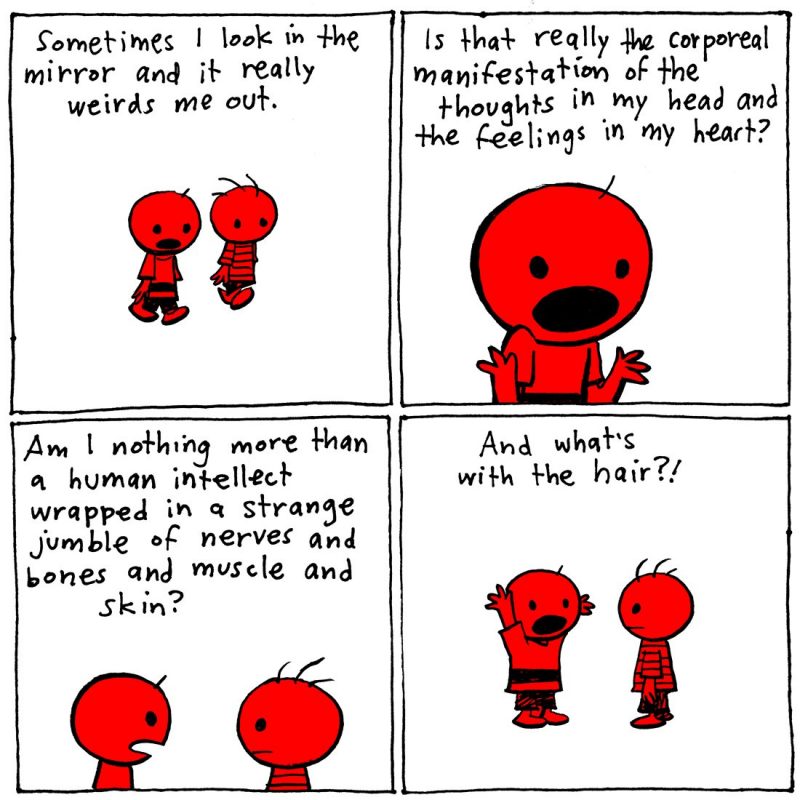
Starting earlier this month, the very talented Adam Koford, the creator of Laugh-Out-Loud Cats webcomic, started posting these wonderful bootleg Peanuts comics to his Twitter account, and continued almost every day since.
Loose and sketchy, they capture the essence of Charles Schultz’ Peanuts so well: sweet and sad, combining childlike wonder and existential dread. As he went on, they started evolving a unique style of their own, distinct from the Peanuts characters but still recognizable.
None of Adam’s comic tweets are threaded, making it hard to link to or catch up on, so I created this Twitter Moment aggregating them all in one place with Adam’s blessing. I embedded the whole thing below.
Needless to say, you should follow Adam on Twitter and Instagram. Just don’t tell the Peanuts estate.
Runway Palette
— stunning desktop-only color visualization of 144,000 outfits from 3,800 runway shows; how it was made via Web Curios #Jamie Brew on How to Write With an Artificial Intelligence
— try it out, just start typing and hit Tab any time for generated text from GPT-2 #The voxel art of Dima K
— one of many talented artists using MagicaVoxel, the free voxel art editor/renderer; see also: Niklas Mäckle, Sir Carma #Former Go champion beaten by DeepMind retires after declaring AI invincible
— “Even if I become the number one, there is an entity that cannot be defeated.” #Twitter will start removing inactive accounts in December
— this immediately raised the issue of memorializing accounts, with no clear answers #Oops! Predicting Unintentional Action in Video
— Columbia University students trained a machine to understand fail videos via @jonathanfly #RIPE ran out of IPv4 addresses
— the final registry allocated the last available IPv4 blocks via Nelson Minar #Leaked Chinese operation manuals reveal new details of mass internment and AI-driven “predictive policing”
— mass surveillance, large-scale data collection, and machine learning employed for social control and state-run terror via @bethanyallenebr #Christian Weiske’s replacement OUYA server goes live
— the games were saved by volunteer archivists, and stored at the Internet Archive via @textfiles #Vanity Fair interviews Billie Eilish for the third year with the same questions
— they should keep it going for 55 years like the Up series via @fimoculous #Unraveling the Mystery of “Visit Eroda,” The Tourism Campaign For An Island That Doesn’t Exist

Late last week, people on Twitter started noticing sponsored tweets promoting the island of Eroda, linking to a website advertising its picturesque views, marine life, and seaside cuisine.
The only catch? Eroda doesn’t exist. It’s completely fictional. Musician/photographer Austin Strifler was the first to notice, bringing attention to it in a long thread that unraveled over the last few days.
The Visit Eroda website is full of strange details:
- It’s dated copyright 2004, but the domain was registered on October 28 of this year.
- Rotating banner ads on the site are served locally, and just point back to the Eroda homepage.
- Some mysterious copy. In the description of the Eroda Ferry, “Our recommendation? Avoid leaving Eroda on odd numbered days…” For the fishing charter, “For extra good luck, make sure you wear one gold earring…” And for the Fisherman’s Pub, “The only rule of the bar? Don’t mention a pig in the pub.”
- A map of the island was apparently generated in Inkarnate, an online fantasy map maker.
Two key facts indicated this was more than just one prankster’s internet goof, and that it was a well-funded viral campaign.
- The Eroda site is actively running a large number of ads across Twitter, Facebook, Instagram, YouTube, and Spotify.
- The visiteroda.com domain is managed by MarkMonitor, a relatively expensive service primarily used by large companies to manage and protect their domains.
Digging Deeper
Over the weekend, fans of Alternate-Reality Games (ARGs) raced to learn more, sharing information in a newly-created Eroda subreddit, dedicated Discord server, and crowdsourced docs.
The Eroda campaign continued to feed the mystery with a new YouTube video, and mysterious new posts on Twitter, Facebook, and Instagram.
The Daily Dot’s Nashwa Bawab was the first to write about the campaign, with an article on Saturday afternoon about the conspiracy theories.
Personally, I tried every trick I know to identify the owners, with no useful information. I looked at the HTML/CSS source, EXIF metadata for photos on the site, text strings in the map PDF file, IP addresses and server host, current and historical WHOIS and DNS records, reverse IP/WHOIS lookups, robots.txt, XML sitemaps, brute-forcing filenames, Google Analytics IDs, server architecture, ad tracker codes, and social network forensics.
Whoever was behind it covered their tracks well—but not well enough.
Solving the Mystery
One theory emerged from the large and obsessive Harry Styles fandom: Eroda was a promotion for Harry Styles’ upcoming album, Fine Line, due out next month on December 13.
The evidence seemed thin at first, but kept mounting. Among the clues:
- Many of the photos and video from the Visit Eroda site and social media campaigns appear to have been shot in St. Abbs, a small fishing village on the southeastern coast of Scotland, the same location where Harry Styles was filming an as-yet-unreleased music video last August.
- One of the cast members in the video sports a very unusual hairdo, elaborate pretzelesque braids. The About Eroda page says, “In particular, Erodean hairstyles have become a rather bold expression of self amongst the island’s youth.”
- Some of the place names on Eroda may reference the song titles on the album. The Fisherman’s Pub is located “on the corner of Cherry Street and Golden Way,” while the first tracks on Sides A and B of Fine Line are called “Golden” and “Cherry.” The island’s name itself, Eroda, may be a reference to the third song, “Adore You.”
- Another site launched for the new album, Do You Know Who You Are, was similarly managed by MarkMonitor, with similar coding styles for the CSS.
Any of these could be written off as coincidence.
Until last night, when Ryan J, executive producer of music magazine Down In The Pit, received a Visit Eroda ad on Facebook, and noticed that Facebook reported the ad was served to him because he’d visited Harry Styles’ official website.
This not only confirms the Eroda team is targeting Harry Styles fans, but also a clear ownership link: advertisers can only target Facebook ads to sites they’ve installed the Facebook Pixel tracker on.
In other words, Harry Styles’ official homepage and Visit Eroda are managed by the same people.
Despite all of their efforts at secrecy, the marketing agency behind this viral campaign was exposed by an unexpected source, Facebook’s ad transparency tools.
But Why?
For non-fans, this may be anti-climactic or even confusing. Why would a musician launch a viral campaign like this just to promote a new album?
ARGs and other forms of transmedia storytelling are a creative way to build a world around a piece of art, whether it’s a videogame, TV show, or album, while teasing out details for dedicated fans.
Though more common in games and TV/film, bands like Twenty One Pilots, Nine Inch Nails, and AFI have all used ARGs to promote the launch of concept albums.
For Nine Inch Nails’ Year Zero (2007), clues were hidden in concert t-shirts, USB drives left at shows, and encoded in the audio waveforms in tracks on the album itself, fleshing out Trent Reznor’s vision of the dystopian world of the concept album. The clues led to an exclusive, underground Nine Inch Nails concert for his most dedicated fans.
It’s a way for an artist to express themselves beyond the work itself, and a way to involve a community of fans, joining them together to collectively solve a mystery.
It’s too early to say where this campaign is going, but I expect we’ll know on December 13. Until then, it’s a perfect example of how impossibly hard it can be to keep a secret from a global community of dedicated fans on the internet in 2019.
Updates
December 2. Today, the Visit Eroda account tweeted the teaser trailer for Harry Styles’ “Adore You” music video, resolving the mystery for any lingering skeptics.
Since this started, I’ve participated in the Discord channel and followed each new clue and development. For me, the most interesting part was watching the cultural divide between two fandoms: ARG enthusiasts and Harry Styles stans.
The Discord team was started by ARG fans, but as Harry Styles fans joined looking for new information, it became a constant source of conflict. Admins required nearly all Harry Styles-related discussion to move out of general channels, even as evidence mounted that the campaign was promotion for his album.
Many of the ARG fans, desperate for any explanation beyond Harry Styles, constantly tried to debunk solid proof like the Facebook Pixel connection.
This morning, once the video was released and all doubt removed, it triggered a wave of frustrated farewells as dozens of members quit the Discord, while the Harry Styles fans were more excited than ever.
If the goal was to energize his fan base for the release of new material, the Eroda campaign was an unmitigated success.
I know many ARG enthusiasts were hoping for something deeper, but as someone with no interest in his music, I’m still grateful to the creative team behind the island of Eroda for making the internet just a bit more mysterious, if only for a week or two.
December 6. The full “Adore You” music video premiered this morning, telling the full story of Eroda. Great song, great video.
Billboard interviewed some of the digital team at Columbia Records behind the campaign.
Save .ORG
— EFF, Internet Archive, Creative Commons, and many more are trying to stop the sale and protect .ORG #Sunday Afternoon at Denny’s
— a mini-documentary following a MAGA meetup that gets protested by neo-Nazis via MetaFilter #The Register digs into the disturbing sale of the .ORG domain registry to a private equity firm
— everything about this stinks via Nick Heer #The Verge’s Mia Sato on the Hmong diaspora’s use of free conference calling as pirate radio
— accessible without internet, and largely run/DJed by women, some lines have over 1,000 simultaneous callers via Nelson Minar #Sacha Baron Cohen blasts Facebook, Google, and Twitter for allowing hate and propaganda to thrive
— “their entire business model relies on generating more engagement, and nothing generates more engagement than lies, fear and outrage” #List of Lists: The Best of the 2010s
— Rex Sorgatz is compiling a growing meta-list of every decade retrospective via Web Curios #The Jungle Prince of Delhi
— Ellen Barry’s remarkable story of a deposed royal family living in a ruined Indian palace, hiding a secret they took to their graves via @shaunwalker7 #Guess My Word
— simple, clever web game to compete with others to guess a word that changes daily via Web Curios #Janelle Shane teaches an AI to begin a novel
— she trained GPT-2 on over 10k opening lines with incredible results via Web Curios #The Digital Antiquarian looks back at Graham Nelson’s “Curses”
— the final article in his fascinating series on the roots of the post-Infocom interactive fiction renaissance #Descript adds um detection, full-text search
— the powerful podcast/video editor continues to evolve in interesting ways #The Verge on Syniverse, the company responsible for the Valentine’s Day SMS debacle
— the missing 168,000 texts were roughly 0.5 seconds of activity #The Final Days of Japan’s Most Incredible Arcade
— Anata no Warehouse was inspired by the Kowloon Walled City via MetaFilter #Hit the High Notes
— sing into your browser to test your vocal range against 27 famous voices via MetaFilter #Typologies of New York City: A Crowdsourced Hyperlapse
— cw: seizure warning; 1,272 photos from Instagram, 200+ hours of work via @hankgreen #LegraJS, JS library to draw with LEGO-like brick shapes
— for example, render any image in LEGO-like bricks via @preetster #Typora, a minimalist Markdown editor
— glowing recommendation from Darius Kazemi, who has good taste in software via @tinysubversions #Half-Life: Alyx trailer
— surprisingly, supports the Oculus Rift/Windows Mixed Reality in addition to Valve VR headsets #Turning Photos into 2.5 Parallax Animations with Machine Learning
For years, filmmakers have used 2.5D parallax to make static photos feel more dynamic, as in The Kid Stays In The Picture, the 2002 documentary about film producer Robert Evans that popularized the technique.
Traditionally, a video editor would use Photoshop to isolate the photo elements on separate layers, fill in the removed objects to complete the background, and animate the layers in a tool like After Effects. Here’s a typical tutorial, showing the time-consuming and tedious process.
Last September, a team at Adobe Research released a paper and video demonstrating a new technique for animating a still image with a virtual camera and zoom, adding parallax to create what they call “the 3D Ken Burns effect.”
This new technique uses deep learning and computer vision to turn a static photo into a 2.5D parallax animation in seconds, using a neural network to estimate depths, render a virtual camera through space, and fill in the missing areas.
On Monday night, researcher Simon Niklaus finally got permission to release the code, posting it to Github with a CC-NC license, allowing anyone to experiment with it for themselves.
Sample Animations
It’s incredibly fun to play with. I ran some famous images through it, and then put a call out to Twitter for more ideas. Here are the results. Click anywhere on the video to play it.
Surprisingly, it even works on illustrations and paintings.
Try It Yourself
Unlike the Spleeter library, the Ken Burns 3D library requires using PyTorch with an Nvidia GPU with CUDA drivers. Sadly, Apple phased out CUDA support in Mojave, but there’s an even easier way to play around with it.
I created a Google Colab notebook here, which will let you process images on Google’s GPUs entirely in your browser.
If you’re unfamiliar with Colab, it can be a bit intimidating. Try this, and let me know if you get stuck.
- Open the Google Colab notebook.
- Click File->Open In Playground Mode to run it yourself.
- Click “Connect” to connect to a hosted runtime, a temporary Google server where the commands will run.
- From the “Runtime” menu, click “Run All.” A warning will pop up, you can click “Run Anyway.”
- On the left-hand side of the window, click the tab to open the Files sidebar.
- The final command processes the “doublestrike.jpg” sample image, and generates a new file in the /images directory called “autozoom.mp4.”
- Upload your own images by right-clicking the “images” folder and clicking Upload. Change the input/output filenames, and click the play button to run the final command again.
Good luck!
Update: This Google Colab notebook by Manuel Romero is much faster and easier to use, with a handy widget to upload files, process images in bulk, and download all the finished animations.