YouTube expands anti-harassment policies
— a clear reaction to their failure to act in the Carlos Maza/Steven Crowder incident #Twitter announces Bluesky project to develop (another) decentralized open standard for social media
— ActivityPub was tailor-made for this use, but they seem committed to reinventing it on the blockchain #Vulfpeck Live at Madison Square Garden
— I watched them play for a small crowd at XOXO, and four years later, they’re selling out MSG with no label, manager, or advertising #XOXO’s Worldbuilders fundraiser for Heifer International
— we’re giving away prizes from our own collection of XOXO history, and would love your help hitting the goal by December 17 #Wired Magazine’s cover story on Simone Giertz
— after surviving her brain tumor, she hopes to move on from shitty robots to space exploration via @SimoneGiertz #Twin Peaks VR
— I still wonder what the cancelled Twin Peaks for the NES would’ve been like via It's Nice That #“Link In Bio” is a subtle undermining of the web
— Anil Dash on how links represent a threat to closed systems #Bbbreaking News: Discovering Amateur News Videos by Monitoring Journalists on Twitter
If you’ve ever looked at the replies on any newsworthy amateur video posted to Twitter, you’ll see an inevitable chorus of news organizations and broadcast journalists in the replies, usually asking two questions:
- Did you shoot this video?
- Can we use it on all our platforms, affiliates, etc with credit?
That gave me an idea, which I posted to Twitter.
Within two days, a talented developer named Corey Johnson made it real by launching Bbbreaking News.
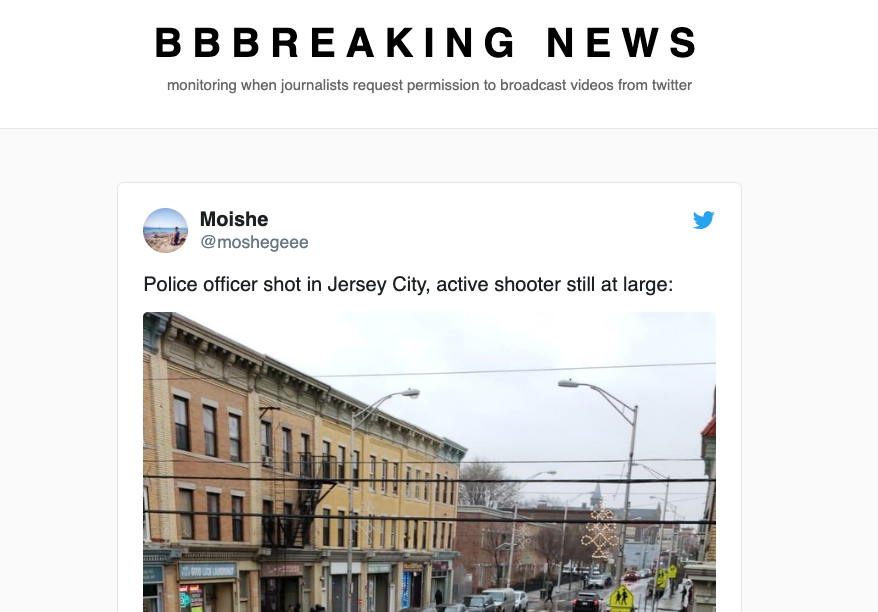
I’ve returned regularly since Corey launched it and, as expected, it’s a powerful way of tracking a particular type of breaking news: visual stories with footage captured by normal people at the right place and right time.
Much of it is of interest only to local news channels: traffic accidents, subway mishaps, a wild animal on the loose, the occasional building fire.
But frequently, Bbbreaking News shows the impact of gun violence and climate change: a near-constant stream of active shooter scenarios, interspersed with massive brush fires, catastrophic flooding, and extreme weather events.
It’s a fascinating way to see the stories that broadcast media is currently tracking and viewing their sources before they can even report on it, captured by the people stuck in the middle.
I recommend checking it out. Thanks to Corey for running with the idea and saving me the effort of building it myself!
Bloomberg Businessweek’s Jealousy List
— this year’s articles their editorial staff most wish they’d written #The Tools I Use: My Setup, 11 Years Later
On January 22, 2009, I linked to Daniel Bogan’s newly-launched Uses This (then called “The Setup”), an interview series where he asks interesting people about “the tools and techniques they use to get things done.”
Three days later, Daniel asked me on AOL Instant Messenger if I’d be open to doing an interview myself.
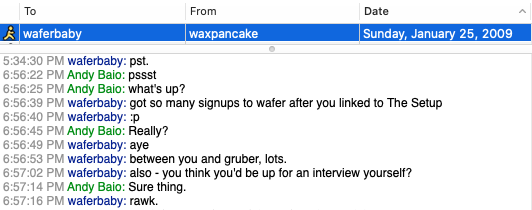
I happily agreed—and then waited nearly 11 years to get around to it, despite his occasional prodding.
Since he first asked me, Daniel’s published over 1,000 interviews with an incredibly interesting group of people spanning dozens of fields and professions.
So I finally sat down and wrote my answers, and the interview is now live.
I can’t say it’s particularly interesting or meaningful, but it might give you a glimpse into how I think about the tools I use to make things.
And Daniel? Thanks for your patience.
Choose Your Own Adventure publishers try to get phrase banned from Itch.io
— Chooseco has only owned the trademark since 1999, after Random House let it lapse #The Universal LEGO Sorting Machine
— made from 10,000 LEGOs, the AI-powered sorting machine can recognize and sort every LEGO part ever made #Verizon blocks Archive Team from preserving 20 years of Yahoo Groups history
— days before mass deletion, they banned Archive Team’s volunteer email addresses via @textfiles #TikTok’s Top 100 of 2019
— related: Taylor Lorenz interviewed Vanessa Pappas, TikTok’s most accessible executive in the West #
Natural History Museum
— delightfully weird short from Kirsten Lepore, who’s currently directing an indie feature film #Recovering hidden video from lighting changes
— reconstructing the shadows in Plato’s cave with deep matrix factorization via @xsteenbrugge #AI Dungeon 2
— an AI-driven text adventure that responds realistically to any input, one of the most profoundly amazing projects I’ve ever seen #YouTube Rewind 2019
— taking the safe route with a purely stats-focused roundup after last year’s cringefest #Teaching AI Feminism and Making Art
— Arwa Michelle Mboya is training a neural network on iconic feminist texts via twitter.com #Nintendo took down Super Mario ROM hack video that likely inspired Mario Maker 2 feature
— as Patrick explains, the ultra-hard Kaizo Mario fan-made games almost certainly inspired the original Mario Maker #The Hungry Terminator
— next-level deepfake from the creator of the Bill Hader/Arnold Schwarzenegger swap #Motherboard on Ring’s evolution into Amazon’s private surveillance network
— the first of a three-part series, here’s part two via Belong.io #Craigslist finally gets an official iOS app
— I truly never thought this would ever happen via @mikebodge #Lost Code
— “a graphic design project exploring the fiction in translation” from Hilda Wong and Ellen Lo via It's Nice That #Matthias Eberl’s research on TikTok’s privacy issues
— they fingerprint individuals with both Canvas images and internal audio generation #How Artists on Twitter Tricked Spammy T-Shirt Stores Into Admitting Their Automated Art Theft
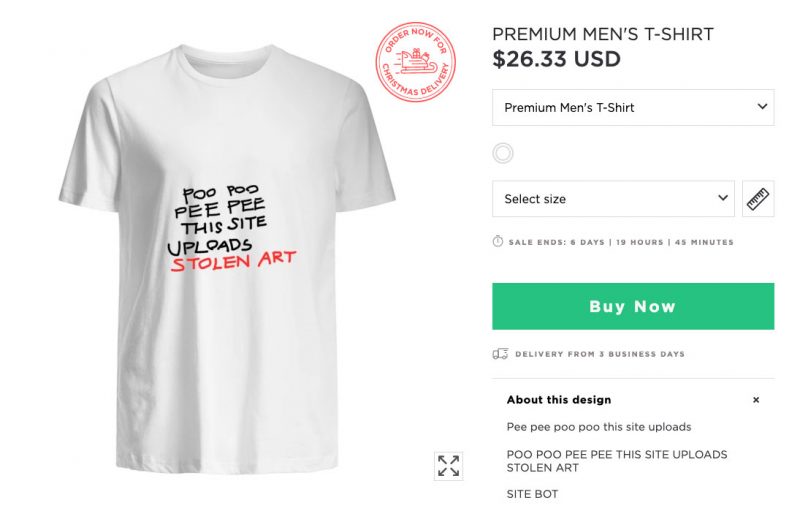
Yesterday, an artist on Twitter named Nana ran an experiment to test a theory.
Their suspicion was that bots were actively looking on Twitter for phrases like “I want this on a shirt” or “This needs to be a t-shirt,” automatically scraping the quoted images, and instantly selling them without permission as print-on-demand t-shirts.
Dozens of Nana’s followers replied, and a few hours later, a Twitter bot replied with a link to the newly-created t-shirt listing on Moteefe, a print-on-demand t-shirt service.
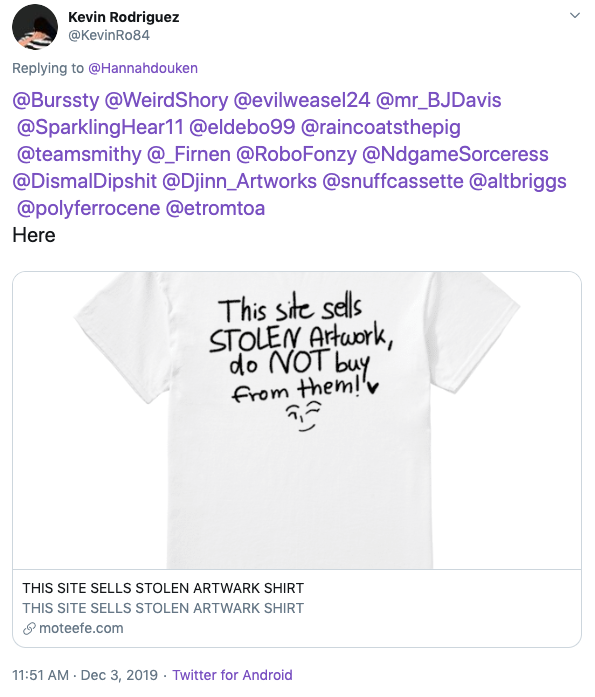
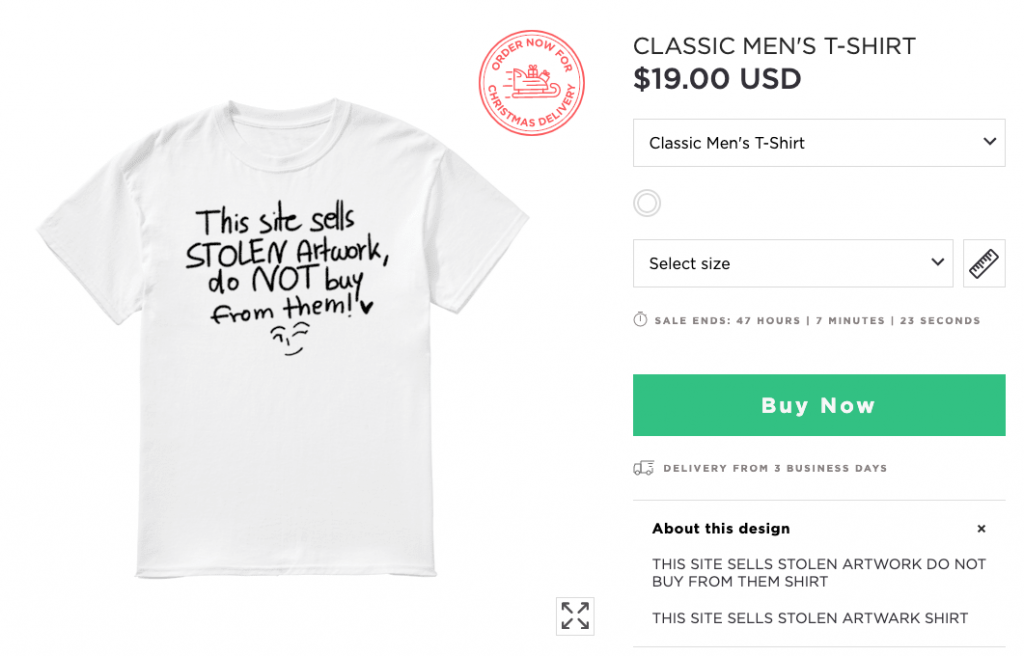
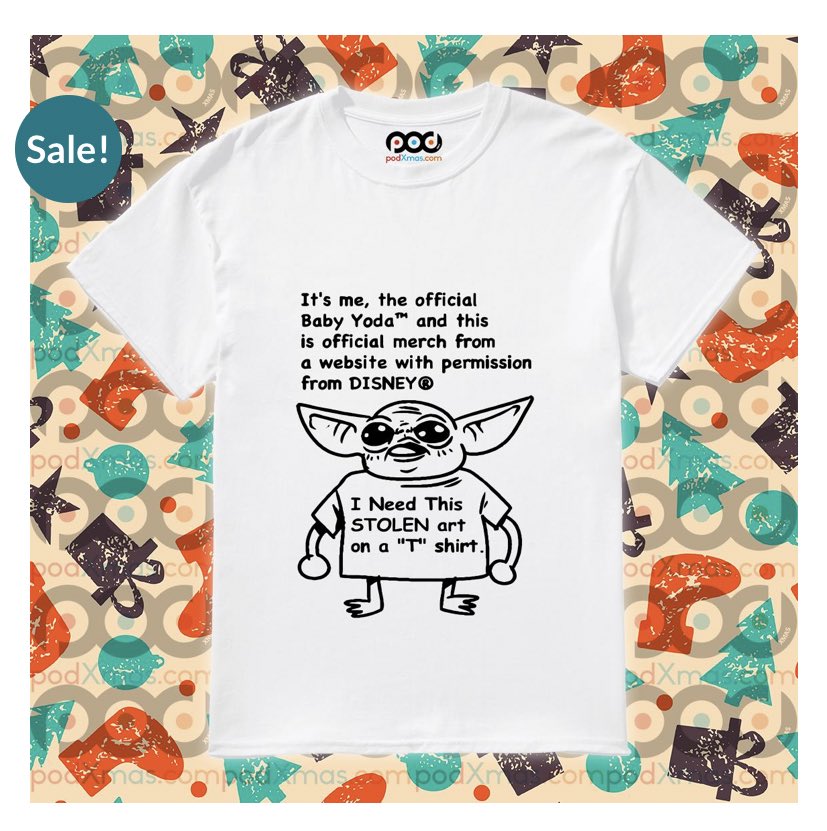
Several other t-shirt listings followed shortly after, with listings on questionable sites like Toucan Style, CopThis, and many more.
Spinning up a print-on-demand stores is dead simple with platforms like GearBubble, Printly, Printful, GearLaunch (who power Toucan Style), and many more — creating a storefront with thousands of theoretical product listings, but with merchandise only manufactured on demand through third-party printers who handles shipping and fulfillment with no inventory.
Many of them integrate with other providers, allowing these non-existent products to immediately appear on eBay, Amazon, Etsy, and other stores, but only manufactured when someone actually buys them.
The ease of listing products without manufacturing them is how we end up with bizarre algorithmic t-shirts and entire stock photo libraries on phone cases. Even if they only generate one sale daily per 1,000 listings, that can still be a profitable business if you’re listing hundreds of thousands of items.
But whoever’s running these art theft bots found a much more profitable way of generating leads: by scanning Twitter for people specifically telling artists they’d buy a shirt with an illustration on it. The t-shirt scammers don’t have the rights to sell other people’s artwork, but they clearly don’t care.
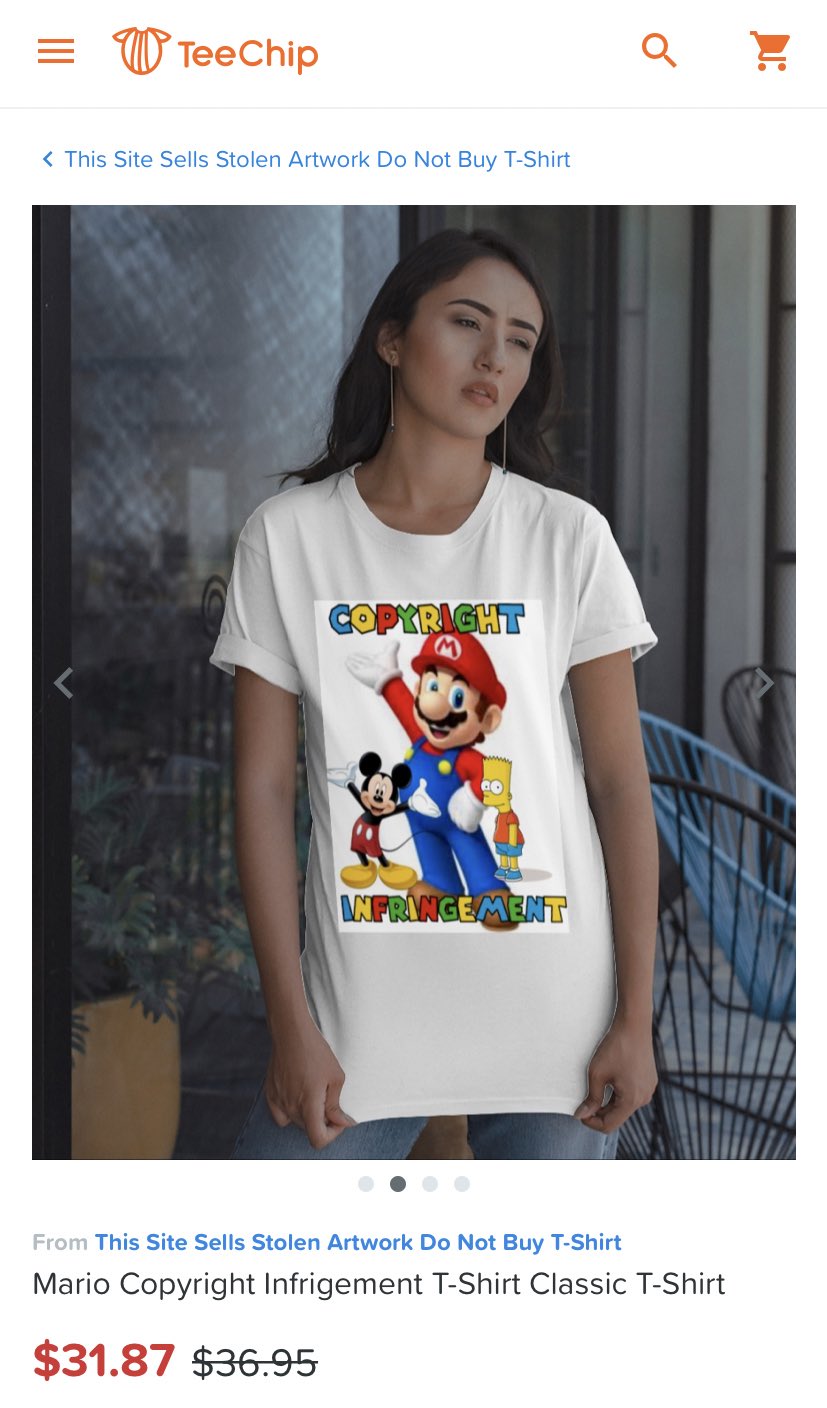
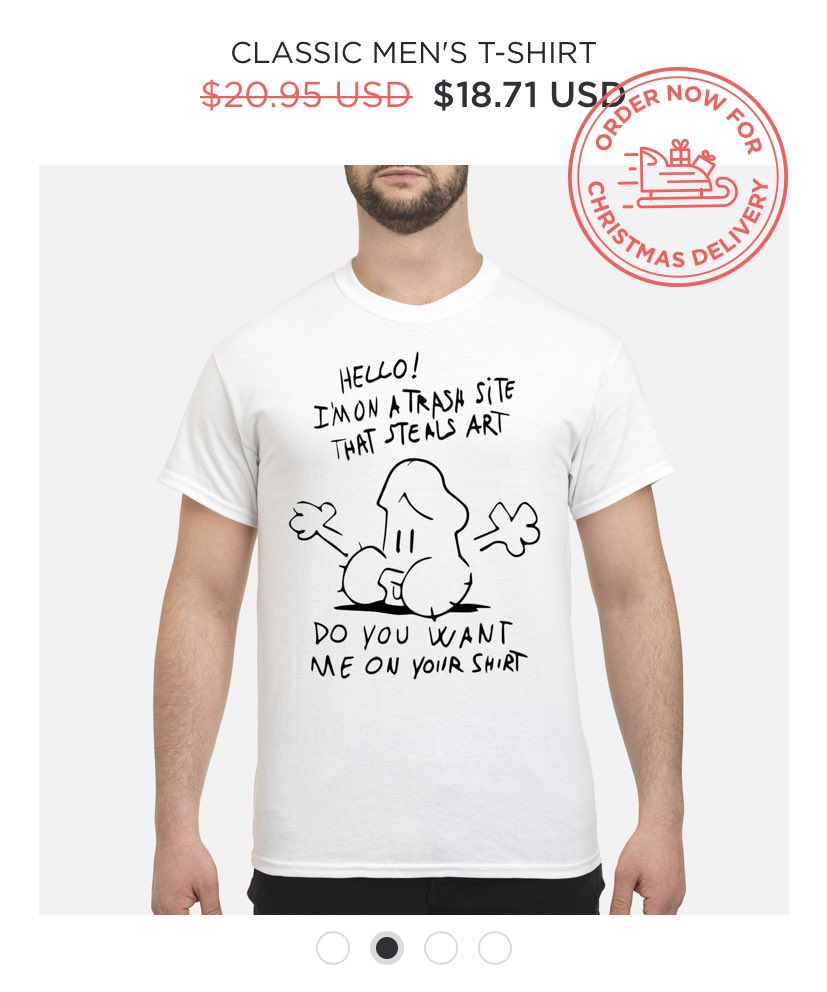
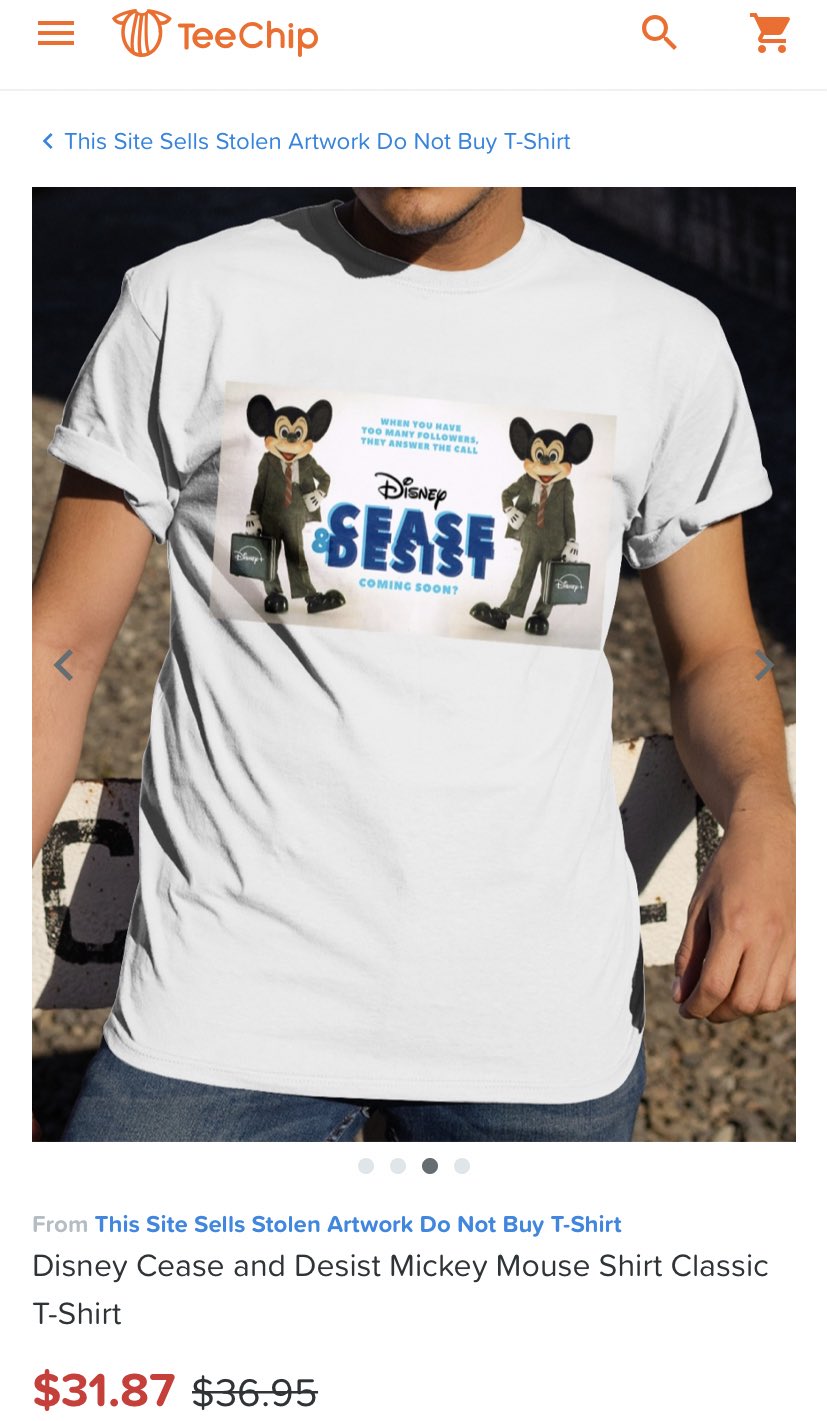
Once Nana proved that this was the methodology these t-shirt sellers were using, others jumped in to subvert them.
Of course, it worked. Bots will be bots.
For me, this all raises two questions:
- Who’s responsible for this infringement?
- What responsibility do print-on-demand providers have to prevent infringement on their platforms?
The first question is the hardest: we don’t know. These scammers are happy to continue printing shirts because their identities are well-protected, shielded by the platforms they’re working with.
I reached out to Moteefe, who seems to be the worst offender for this particular strain of art theft. Countless Twitter bots are continually spamming users with newly-created Moteefe listings, as you can see in this search.
Unlike most print-on-demand platforms like RedBubble, Moteefe doesn’t reveal any information about the user who created the shirt listings. They’re a well-funded startup in London, and have an obligation not to allow their platform to be exploited in this way. I’ll update if I hear back from them.
Until then, be careful telling artists that you want to see their work on a shirt, unless you want dozens of scammers to use it without permission.
Or feel free to use this image, courtesy of Nakanoart.
So since these art-stealing bots are tracking your text and not reply images, I made this for you guys!
— nakanoart (@nakanodrawing) December 4, 2019
If you want something from ANY creative made into a shirt, you can use this image to tell the artist you want to buy it. So you don’t need to type it out ❤️ pic.twitter.com/E9Mn2GILcb
Update
Nearly every reply to the official @Disney account on Twitter right now is someone asking for a shirt. I wonder if their social media team has figured out what’s going on yet.
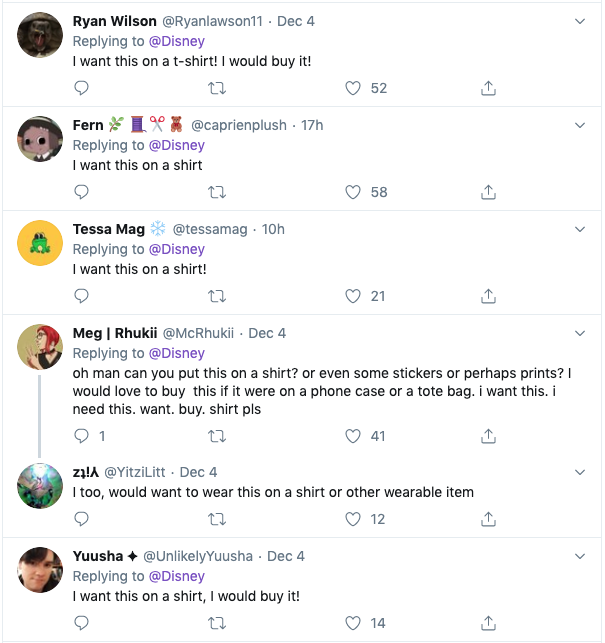
I know I shouldn’t buy them, but some of these copyright troll bait shirts are just amazing.