The Jonathan Coultons of Gaming

I’m mostly a casual spectator of the gaming industry, with my experience limited to being a fan, so it’s been a delight to meet the people behind the games I love at GDC. At the same time, I’ve felt a kinship with these indie developers, having worked as a developer (and accidental entrepreneur) in the web industry for the last ten years.

One of the most jarring and frustrating differences I’ve seen between the web and gaming worlds is the dominance of middle-men: publishers and platforms trying to control the distribution of games. In the web industry, there’s nobody controlling distribution and I don’t need anyone’s authorization to launch a new project. But the gaming industry is dominated by gatekeepers. For consoles, you can pay through the nose for the privilege to be on Xbox Live Arcade, Playstation Network or the upcoming WiiWare, and then wait months to be released into the pipeline. On PCs, there’s no clear monopoly, with distribution fragmented between a handful of game download portals and distribution frameworks like Steam.

Or you can go it alone and sell directly to your fans through your own web presence but, for the moment, this is very rare. Why? There’s no clear answer.

The gaming industry today feels like the music industry of the recent past. Bands were desperate to get signed to a label, and financial success was elusive without a record deal. Record labels provide the funding to record an album, the marketing to promote it, and access into the well-established distribution pipeline of record stores and other retail outlets. In the last five years, these gatekeepers have lost relevance as musicians like Jonathan Coulton, Radiohead, and Trent Reznor have started selling directly to their fans through their own sites, or adding them directly to iTunes or Amazon.

Small indies like Bit Blot (Aquaria), 2D Boy (World of Goo) and Invisible Handlebar’s Audiosurf are like the Jonathan Coultons of gaming — bootstrapping their game development, doing their own promotion, and cutting out every middleman to deliver games directly to their fans. And it seems to be working, at least well enough for them to grow and keep doing what they love.

Clearly, this route doesn’t work for everyone. I talked to Jonatan Söderström of Cactus Soft, one of the most creative and prolific game designers working today. He releases an interesting freeware PC game nearly every month, but is struggling to survive at home in Sweden. In desperation and “on the brink of extinction,” he recently added ads to his site and asked his audience for $1 donations so he could eat. Talking to him, he reminded me of many other brilliant programmers I’ve worked with — motivated and talented, but almost pathologically uninterested (or incapable?) in self-promotion or business.

Bit Blot and 2D Boy both understand that while game design comes first, marketing can’t be ignored. They work with the media, speak at conferences, keep visible blogs, and connect directly to their community online. For example, Bit Blot’s “Seven Days of Aquaria” campaign offered new information and gameplay videos each day until its release. The result? So much anticipation and demand that their servers died on release day. It was a brilliant campaign that cost them nothing but their time.

As an outsider, it seems obvious that the costs (monetary and otherwise) of going down the publisher/platform route are too high. Like a record label, the publishers take a cut and try to own your intellectual property and distribution options. Developing for Xbox Live Arcade, WiiWare, and Playstation Network all have their associated costs and royalties too. Between 30-50% of revenue goes to the platform and the development costs for localization and testing are much higher. Even if your overall sales are 20% lower by skipping the distribution channels, it seems like you’d still make just as much money, with the benefit of more control and more time to focus on actual game development. (If you’re interested in the topic, Simon Carless wrote an interesting editorial earlier this month that ran some of the numbers.)

Whether you work in music, gaming or web development, the ultimate goal should be to do what you love without compromise, get recognized for your work, and not starve to death in the process. If your primary motivator is fame and getting your game in front of as many people as possible, regardless of the cost, it seems the only option for game developers is going to a major publisher and working with the big platforms. But if you’re happy making a healthy living with a more modest audience, the DIY route is more viable every day.

4 Comments

GDC: First Impressions

I’m already overwhelmed at my first GDC, and from what I’ve heard, things don’t even really get moving until tomorrow! The first two days are dominated by a number of excellent summits and tutorials, but apparently, the real action doesn’t start until tomorrow when the game competitions, expo floor, major announcements, and big keynotes all begin in the morning.

I’m very interested in the parallels between gaming and web, and how the lines have blurred between game-like social software and social games. With that in mind, several people told me Worlds in Motion summit would be most relevant to my interests with sessions that “delve into online worlds, social gaming and media and player created activity, providing insight for developers of all backgrounds into how the game industry is collectively building socialization into games and integrating personalization and player-generated content into gameplay.”

Instead, I’ve found the most inspiring and innovative talks have been in the Independent Games Summit. Unlike the companies in World in Motion, these tiny two-person startups and student projects are operating on a shoestring budget and exploring territory that the big guys aren’t.

It seems like most of the interesting new projects are happening on the web or as PC/Mac downloads, partly because they don’t have the funding or support to acquire dev kits for the consoles and partly because it gives them more control over their own fate. (For example, Xbox Live Arcade costs a minimum of $125,000 to create a game. The overhead for a Flash game, like starting a website, is mostly your own time.)

And because they have so many resource constraints, they’re developing gameplay that’s often experimental and completely unique. The IGF finalists are a laundry list of intriguing gameplay ideas (many of which I’ve mentioned on Waxy before):

  • Audiosurf, a rhythm/racing/puzzle game that analyzes and visualizes your MP3 collection to create a dynamic 3D racetrack with characteristics pulled from tone, tempo, and volume.
  • The Path, a horror game based on Little Red Riding Hood, with ambient music by Jarboe. If you follow the path before you, you lose the game.
  • World of Goo, a construction game using physics to lift blobs to great heights
  • Crayon Physics Deluxe, an adorable game that instantiates anything you sketch to solve puzzles.
  • Poesysteme, breeding words with Darwinian evolution.
  • Goo, like Go with liquid dynamics.
  • Fret Nice, a platformer that uses the Guitar Hero guitar to control the character in time to the music
  • Fez, the 2D character stuck in a 3D world

Several speakers have discussed how the art and design are more important than the technology, that games are more about conjuring emotion than showing off graphical effects. Aquaria co-creator Alec Holowka described game development as a Zelda Triforce, with three parts of Art/Design, Business/Marketing, and Technology. Some games, like movie-licensed games, are led by business but have poor technology and design. Others, like many big-budget games, are led by technology. Indie games need to support their work with honest marketing and solid technology, but it’s the creator’s voice, vision, and passion that ultimately make the game resonate with an audience.

Anyway, I’m looking forward to playing and meeting this year’s finalists tomorrow when the IGF Pavilion opens tomorrow.

Some notable quotes from the first couple of days of the show:

Gabe Zichermann on Facebook and eBay as MMOs: “I think we need to acknowledge there are things in life that are fun that game designers didn’t make… People are engaged in playing all the time — they’re not fake worlds a game designer made… Everybody plays games all the time, whether we as game designers make them or not.”

Raph Koster on virtual worlds: “We’re building theme parks instead of parks.”

Tracy Fullerton from USC Game Innovation Lab: “Indie’s not about finding a backdoor into the industry or building games on a shoestring budget. It’s about tearing down walls to create a new culture.”

3 Comments

Game Developer's Conference 2008

This week, thanks to Simon Carless at GameSetWatch, I’m going to the Game Developer’s Conference in San Francisco this week. I’ll be writing about the conference daily and guest-publishing over at GSW.

If you’re going, let me know. I’ll be updating my current location on Twitter intermittently if you want to get together.

Also, if anyone out there works at Valve or can otherwise get me into the Valve party on Wednesday night, get in touch! You’ll be my new best friend. Thank you, kind anonymous insider. I owe you cake.

The Online Life of NIU Killer Stephen Kazmierczak

It didn’t take long for online sleuths to identify the man behind the shootings at Northern Illinois University yesterday. Early this morning, before the police or the Associated Press released his name, online sleuths identified the 27-year-old man as Stephen P. Kazmierczak. Online, he went by “Steve Kaz,” “Kazmier,” and “StatisticsGrad.”

Working from there, a few blogs went to work at discovering his online accounts and other trails he’s left online. Here’s what we know so far, and I’ll be updating this entry throughout the day as I find more.

Academic

As mentioned in several news articles, he was the vice-president of the school’s Academic Criminal Justice Association. Their executive officers page lists one of his email addresses, [email protected]. Searching for that email address shows some discussion list activity from 2004 related to his work, but nothing recent.

Here’s his biography for his Vice-President position. (Via Steve Huff from True Crime Weblog.)

Steve served as an undergrad teaching aid for Sociology 388 (corrections) and 488 (juvenile delinquency) in spring, 2004. He has strong interests in justice reform and, as an older sociology/criminal justice major, he brings experience and ideas to the group.

My name is Steve Kazmierczak, and I’m a 3rd year student here at NIU. During my sophomore year I served as an aid for the SOCI170 web-board and last semester, I was fortunate to have the opportunity to be a team leader for SOCI488-Juvenile Delinquency. Since attending NIU, I’ve worked very hard as a student, and I know that I would be able to forth the same effort as an officer of the ACA. I feel that I’m committed to social justice, and if elected as treasurer I promise to serve the NIU chapter of the ACA to the

best of my ability.

The following information was retrieved from the University of Illinois – Urbana-Champaign’s student database before it was removed. (Found on Odd Culture.)

alias: skazmie2

name: Kazmierczak Steven Phillip

pretty_name: Steven Phillip Kazmierczak

email: [email protected]

sudent_department_name: School of Social Work

student_program_name: MSW:Social Work -UIUC

student_level_description: Graduate – Urbana-Champaign

student_major_name: Social Work

phone: (815) 508-2416

office_address: 1207 W. Oregon, M/C 140, Urbana, IL 61801

title: ACADEMIC HOURLY

department: School of Social Work

type: person phone student staff

The NIU staff is removing pages where he was mentioned, but you can see in the Google cache that he won the 2006 Dean’s Award and the Sociology Honors Society.

Here’s a very short video of Stephen in class, taken by a professor in January 2004.

Personal

True Crime Weblog also discovered that he had problems with Paypal in this PaypalSucks thread from March 2007. He wrote, “Somebody please help me out, as I am desperate. I need this money to survive, as I am a poor graduate student just trying to make it by, which is why I started using Ebay in the first place, (to supplement the income I made through an assistantship).”

Testimonials

On a few sites, anonymous commenters that reportedly knew Kazmierczak have stepped forward to tell their stories. These are mostly anonymous, so it’s impossible to verify their accuracy.

From Odd Culture, posted today:

I knew this kid, friend of a friend type deal. He was odd, quiet always gave me a creepy vibe, but then a lot of people give me that so I didn’t think anything of it. Last I remember seeing him was in early jan. he showed me his tattoo’s. They were all graphic an gory, but thats what guys like as tattoos. One was the doll from the Saw movies. I found that a little weird, why would a guy this age have a tattoo of some terrifying doll that signified nothing but a crazy serial killer. It scared me. But whatever floats your boat I thought. Then they started talking about his guns, he didn’t bring it up, but just sat there and said a few things here and there jokingly, but quiet. I immediately thought why in the hell does this kid have a gun? He doesn’t look like a hunter and didn’t live anywhere I would consider dangerous enough for a gun, let alone two. The only thing I could think of is that he needed to prove something to himself or to someone else, since he was tall and gangly, and didn’t look like he was mr popular. It’s scary knowing that I hung out with that kid, that I sat there and discussed these things with him. He is one of those guys that you just know something is wrong with him the first time you meet him, but he’s nice so you figure he is just a little odd. As for a motive goes, I do know that he had some issues with his sexuality, maybe it has something to do with that.

Also posted today on Odd Culture, by someone named “William”:

I can’t believe some of you, I grew up with Steve. I don’t know what happened after we graduated high school to put him down this path but the kid I grew up with was a decent kid. I sat and ate lunch with him from grade school on up, we were in the same classes.

No matter how terrible his last acts I can’t reconcile this with the adult I knew graduating high school, and the kid I grew up with.

In April 2006, Jim Schaffer posted a very long rant mentioning Kazmierczak on an Aphex Twin fan forum. Radar Online confirmed that Kazmierczak worked at the Elks Grove Pirates Cove children’s theme park in 1995, so this one’s definitely real.

steve motherfucking kazmierczak. yes thats exactly the problem here.

i was working at pirates cove in late 1995 and i was you know $4.50/hr child labor laws be damned and like i remember steve kazmierczak, the kind of kid who engaged in odd acts of fellatio with his dog, the kind of kid who’d go and masturbate in the bathroom while you were over at his house, the kind of person who injured kids on the train ride cuz he was mental and he shouldn’t be given domain over kids on little faux-traincars with an aluminum baseball bat… when steve fucking kazmierczak ran up to me in late 95 early 96 proudly boasting his brand new copy of “i care because you do” like he was finally in with the cool kids.

both me and my friend joe died a little bit that day.

This morning, an anonymous commenter on The Copycat Effect wrote:

I attended just about every position with Steve at NIU. My senior year he was my Teachers Assistant for a quantitative research methods course. I would have never expected Steve to become involved in such a massive tragedy. He was always very nice, helpful, and a scholar. It is really a shame that he went and did something like this.

Updates

February 16: Some excellent digging by the commenters at True Crime Weblog revealed Kazmierczak’s Photobucket account. Inside, there’s a Get Well Soon card sent to “Jessica.”

According to this Chicago Tribune article, “[Kazmierczak] moved to Champaign with his girlfriend, also a graduate of NIU’s sociology program. The couple had both been officers in the school’s student chapter of the American Corrections Association.” The only other female member of the Academic Criminal Justice Association is Jessica Baty, the group’s Secretary.

So, Jessica Baty is almost certainly Kazmierczak’s girlfriend. The commenters also found this Myspace page belonging to Jessica, with an unpublished photo of the couple together. (I cached it, just in case.) Her profile is private, but currently has this status message: “Jessica is missing SK.”

February 17: An anonymous commenter below discovered this weblog from someone who lived next door to Kazmierczak while he was growing up. This entry and this entry are both fascinating reading.

47 Comments

Geek Valentines

Looks like Digg found a copy of the Tetris valentine I’ve been hosting on my server since February 2006. The original was created by Mitch at the wonderful 4 Color Rebellion gaming blog, but when I tried to redirect the requests to their original entry, the traffic shut down their server in a few minutes.

So if you’re looking for the valentine, here it is. Click it to see a full-size, print-quality version on 4 Color Rebellion’s site, and see their other 2006 Geek Valentines.

And if you like those, don’t miss 4 Color Rebellion’s geek valentines for last year and this year! In 2007, they made adorable Phoenix Wright, Nintendo DS, Wii, and Metroid Prime valentines. This year, it’s a set of valentines for Dr. Mario, Mario Galaxy, and Wii.

In case you’re 14 years old, relatively new to the Internet, and/or coming from Digg, here are a bunch of other two-year-old links you might have missed: Halo Babies, Ze Frank’s On Valentine’s Day, A Very Star Wars Valentines, All Your Heart Candy Are Belong To Us, a set of vintage 1980s Valentines including Mario, Zelda, and TMNT, vector art of Ralph Wiggum’s valentines, more original Nintendo valentines, and nothing woos a lady like romantic Perl poetry. Want something more fresh? New this year are the Team Fortress 2 valentines, Ironic Sans’ Scientist Valentines, Jacks of Science’s Science Valentines, Diesel Sweeties’ E-Cards 2.0, a DIY pulsating LED heart card, interlocking Moebius strip hearts, and Woot’s superhero comic anti-valentines.

12 Comments

WIRED and The WELL

Reading Rex Sorgatz’s commemoration of Wired Magazine’s first issue for its 15th birthday, I was reminded of the very first mentions of Wired online. Not on the web, which was only just getting started with the release of Mosaic 0.5 the month before, but on the uber-hip Northern California BBS, The WELL.

I love deep-diving the WELL archives for research. It’s an amazing glimpse at the tech and media scene of the late ’80s and early ’90s, but especially for anyone interested in Wired. Many of Wired’s founding staff and contributors were active on the WELL, and executive editor Kevin Kelly was a WELL co-founder, so it was natural that the BBS hosted the official Wired forum.

Below, for the first time on the public web, I’ve reprinted some of Wired’s early history on the WELL, including the first call-for-feedback from May 1992 (9 months before the first issue), the first press release, and some of the more interesting responses.

Continue reading (2,550 words) ⇢ 3 Comments

Highlights from the British MovieTone Darkweb

While researching oscilloscope art — more on that tomorrow — I stumbled on the MovieTone Digital Archive, an incredible and underrated online resource for vintage British newsreel footage from the 1930s to the late 1970s.

Amazingly, it seems virtually unknown on the web, linked seven times on Del.icio.us and only 33 links in Google’s index. It’s almost certainly because of the registration wall, with no clear insight into what’s hiding behind the curtain. But once you register (for free), you get access to full access to the entire video archive in high-quality Quicktime or Windows Media.

Funny enough, I noticed that their Quicktime previews are viewable outside of their site. So, as long as it lasts, here’s a small sampling of my favorites from the 48,500+ reels in the British MovieTone News archive.

Continue reading (600 words) ⇢ 10 Comments

CNET to Shut Down Consumating

Just received word moments ago that Consumating, the niche dating community acquired by CNET in December 2005, will be shutting down next month. In the wake of the sale of Webshots to American Greetings, it appears that CNET couldn’t find a buyer for the site and is no longer interested in maintaining it.

Founders Ben Brown and Adam Mathes are no longer affiliated with Consumating, but they were the first to break the news two hours ago. “Just got word of the plan to turn off Consumating,” Ben wrote on Twitter. Adam replied, “Beginning my long mourning period over the end of Consumating.”

After Ben Brown left CNET in Spring 2007, Jesse Keyes took over managing the site. This morning, he posted a revealing Question of the Week on Consumating: “What will you do when it all comes grinding to a halt?” Jesse’s own response was, “Pack it up and call it a day…”

Rumors of its demise have been swirling for the last two weeks, so most of the community didn’t seem surprised in the active discussions. A week ago, Consumating users set up an off-site message board to ease the transition and keep friendships alive, in the event of a closure.

Though there hasn’t been an official statement from CNET on the matter, sources close to the company confirmed that the shutdown date will be March 15. Users will be able to download a data dump of their questions, answers, and other social activity as a comma-separated file.

Even though Consumating never found a huge audience or revenue, it’s worth noting that it still has a dedicated following that loves the site, uses it every day, and formed offline relationships because of it. It’s unfortunate that CNET couldn’t find a way to keep the site online, even if that meant handing it back to the users that made it special. Since online communities are built on top of user’s contributions and social interactions, it raises the question: are companies responsible for keeping community website alive, even after they cease to be strategically desirable?

Well, maybe the Consumating founders did find a way to preserve it after shutdown. Shortly before Ben Brown left, he pushed CNET to open source the Consumating code base. That project, Clonesumating, is available on Google Code. After it’s burned to the ground, maybe an open version of Consumating will rise from the ashes.

February 14 Update: Yesterday, Jesse Keyes gave the official announcement. “We know you want and deserve a site that is vibrant and fresh, and we don’t think it’s fair to you to keep an unsupported site live. And so, we’ll be shutting Consumating.com down on March 15th,” he wrote. “In a couple weeks we’ll have a way available for you to download a file with most of your profile data, which could theoretically be imported into a similar site. Details will come when we’re ready to release the exporter.”

According to this thread, the private messaging feature recently stopped working and nobody’s around to fix it. How depressing.

16 Comments

An Assortment of Random Updates, Volume 1

I’m working on redesigning Waxy today, so no huge article. Instead, a roundup of brand new updates to posts from my first week of full-time blogging.

Colin’s Bear Animation

Colin emailed to let me know that his inadequate former professor no longer works at the school. “They’ve hired a new professor this semester and he actually works at Alias,” he wrote. “In only two weeks it has become very clear that we now have someone worth our parents’ hard-earned cash.”

Also, by request, I found a full-length copy of the song from the video. Here’s an MP3 of Funky Monkey Dance from the Mother 3 soundtrack. (The good part starts at 1:20.)

Personal Ads of the Digerati

Surprisingly, the only people that seemed to care about Dave’s personal ad were Valleywag, Eye on Winer (the newest in a long line of obsessive Dave Winer watchdog sites), and Dave Winer himself. He commented on it a few times on his Twitter account, but that was about it. (Related, Eye on Winer posted this Knight-Ridder article from 1986 about American bachelors, with Dave Winer in the lead story.)

Many more people took note of the bit about Richard Stallman’s extremely unusual web browsing habits, culled from this post I dug up from a discussion list late last year. That link ended up on Zawodny’s blog and, later, the top of Reddit. I emailed RMS some questions, to ask him more about this, leading to the shortest interview ever:

I’m fascinated with a message I read about how you read the web with a wget demon. Could you elaborate on it?

It is a program that runs wget and mails me back the result.

Do you then convert the HTML to plain text and read it by email, or do you load the retrieved file in a browser? (If so, which browser?)

I can do either one.

Finally, is it free software, or something that you’d be willing to release?

I did not write it, but our sysadmins say it is kludgy.

Thanks for that elaborate explanation, Richard! As Philipp told me, “He answers like a programmer. If you stopped him on the street to ask, ‘Do you know the time?’ he’d say ‘Yes’ and leave.”

The Times (UK) Spamming Social Sites

As I noted last week, The Times and Sitelynx both absolved themselves of responsibility. The Times claimed they weren’t aware that social media spamming was going on, which I tend to believe, and Sitelynx blamed Piotr completely for promoting articles on social sites — not because that’s a practice Sitelynx opposes, but because he wasn’t “properly trained” to do it and that’s not what he wasn’t hired to do. He was removed from The Times account.

Another Sitelynx employee, Sibylle Bernardakis, modified her StumbleUpon profile the day after the story broke to disclose her affiliation with The Sun, another Sitelynx client. I asked Graham Hansell, founder of Sitelynx, about this last week:

Graham responded, “She has followed our policy for submissions — Disclaimers where possible, latest news only, direct linking (no redirect) to valuable content, no hidden links or promotional content.” I pointed out that it appeared Sibylle never disclosed her affiliations before she modified her profiles earlier today. Graham replied, “That I am not aware of and will investigate. I don’t believe that to be true and we are obviously reviewing our internal policy for greater transparency.”

Some commenters noted that Chris Deary and Ilana Fox at The Sun also use Delicious extensively for promoting their articles. This doesn’t seem problematic because their affiliation with The Sun is transparent and disclosed, while Piotr and Sybille were not.

Brent Spiner’s Ol’ Yellow Eyes is Back

I just found out that a couple days before my post, Brent Spiner launched his new personal site and released a video on YouTube about his long-awaited concept album, Dreamland. Inspired by Broadway musicals and old-fashioned radio shows, the album is available for pre-order on Brent’s site. Did I mention it features the voice acting of Mark Hamill?

2 Comments

Origins of the "Plane on a Treadmill" Meme

By request of Waxy reader Logan Ingalls, I spent most of the day tracking down the origins of the Plane On A Treadmill physics puzzle/meme. I figured this would be simple, but six hours later, I’ve combed through archives of the web, Usenet, magazines, academic journal, physics websites, and hundreds of discussion forums looking for the source.

There have been a couple thought experiments that came close, but still different enough that they can’t be considered the source. Jason Scott found this Usenet post from September 1990, which sounded promising:

There is nothing special about the ground as a reference plane! Consider a large flatbed truck moving at 80 mph from east to west. Does the truck’s velocity have ANY effect on the airplane’s ability to fly? Now try to land on the truck….the velocity of the truck becomes *real* important!

O.K., I’ll carry my reductio-ad-absurdum one step more. I mount the entire state of california on a conveyor belt. Initially my conveyor belt is at rest. I take off, climb to some high altitude, and then key my mike 4 times which sets the ground into motion. Does my plane suddenly stop flying?

Very similar, but key differences in the question (and a five-year-gap before it caught on) suggest that this didn’t inspire the puzzle.

So, where did it come from? The earliest reference to it that I can find is this post to the PhysOrg Forums, dated July 19, 2005. It seems unlikely that some random poster on a physics message board would have invented it, but as far as I can tell, this is the case. Update: Its appearance online goes back to a Russian discussion forum in 2003. Read the updates at the bottom of the post for more.

I’ve tried to contact “dirak” through the PhysOrg site to get a decisive answer, but since he hasn’t posted a new message since July 2006, I think I’m out of luck. Looking for his username turns up some Slashdot submissions, all anonymous, and that’s about it. I’d even tried to contact the PhysOrg forum creators, but they’re extremely protective about their own privacy, too. As a desperate measure to locate the PhysOrg folks, I then tried to track down the freelance writers that wrote for PhysOrg (through Myspace and Facebook), and am waiting for those leads to respond. Update: Dirak responded! Read the updates below.

There’s no reference to the puzzle anywhere before July 2005, and no reference to it again until October 2005, suggesting that the rapidly-expanding PhysOrg thread led to users cross-posting it to other forums to get advice.

One of the earliest references is from November 15, 2005 on this discussion thread from Flightinfo.com, a popular aviation forum for serious pilots. Often cited in other messages from 2005, the Flightinfo thread was eventually removed from the site entirely in late 2006. On November 27, it spread further when an AVWeb columnist wrote a long article (also now offline) about how the controversy was spreading in the pilot community.

At this point, it was appearing on several message boards, inspiring heated debate everywhere it went. In December 2005, the question was posed to the Straight Dope discussion forum with no clear answers. A few weeks later, Cecil Adams himself addressed the question in his February 3, 2006 column. Cecil’s syndicated column broke the question into the mainstream. A few days later, Jason Kottke started his obsession with the question and the rest is history. Mythbusters’ elaborate tests were intended to answer the question for good, but it seems to have only strengthened the resolve of its detractors.

So until I hear back from “dirak,” or manage to contact PhysOrg, I’m going to consider this case closed. (Needless to say, if you can find an earlier reference or have any other information, please let me know.)

Updated February 7: Unbelievably, “Dirak” (his real name’s Andrew) responded to my private message through the PhysOrg forums! He says, “Yes, I’m sure I was the first who brought this topic to the English-speaking internet. However, I wasn’t the one who invented this question. I’m half-Russian and I read about it on one of Russian forums back in 2005.”

He continues, “I looked for that thread for you, here it is (it’s in Russian). The first guy (shipwreck) wrote about it in 2003 and in his first post he says that they were arguing about it in his college. shipwreck is an unregistered user on that board, so I’m not sure if it’s possible to contact him at all. Hope this helps you.”

Incredible. So, this brings its appearance online back to August 4, 2003. Any Russians out there want to carry on the search? Trying to contact “Shipwreck” would be the next step.

Also: Want me to research another meme? Email or IM me and I’ll give it a shot. Whee!

24 Comments

Pirating the 2008 Oscars, Part 2

Yesterday, I released six years of piracy data for your bemusement and data munging. But what does it all mean? Well, let’s start with a couple questions.

1. Is the MPAA doing a better job at preventing screeners from leaking online?

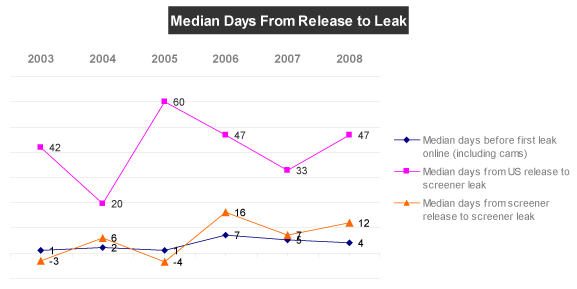
It’s hard to say. There are a couple weeks left, but so far, less than half of the 32 Academy screeners have leaked online. But yet, all but four three of the 34 nominated films are available in DVD quality right now, either as a screener or retail DVD. (Lars and the Real Girl, The Diving Bell and the Butterfly, and The Savages are the only films that haven’t leaked online in any form.)

If you look at the chart, it doesn’t seem like much has changed in the time it takes for films to leak online.

So what’s really going on here?

2. Is the MPAA preventing overall piracy of Oscar films?

No. 148 out of 151 of Oscar-nominated films from 2003 to 2007 were available in DVD quality (either leaked retail or screener DVDs) by Oscar night. The films are getting leaked just as quickly as ever, but apparently not through Academy screeners. This could be because watermarks and recent court cases are acting as an effective deterrent, but I think it’s attributable to two other reasons, which I mentioned in my post yesterday.

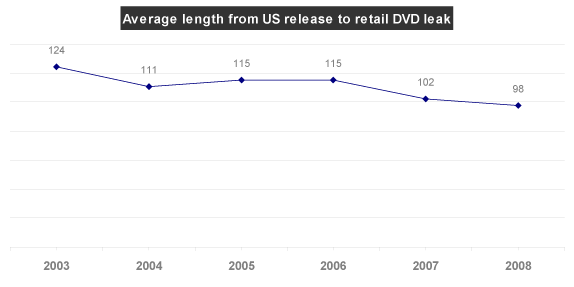
First, the gap between theatrical releases to retail DVD is getting shorter. (Note: I’m going to use the date the retail DVD was leaked as an approximation of the official DVD release date.) In the last five years, it’s gone from an average of about four months to about three months, and continuing to shrink.

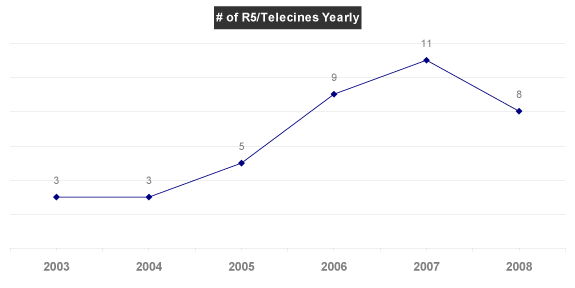
Second, the rise of Region 5 DVD transfers from overseas. These DVDs transferred directly from the film source were intended to help them compete with pirates by providing high-quality retail copies of films at the time of the film’s release. Instead, it’s created a huge new method of acquiring films before screeners are even released. (Read more about R5s at Afterdawn.)

Screeners aren’t leaking as often, not because the MPAA’s protecting them better, but because they’ve made the whole process moot by providing higher-quality, easier-to-acquire copies before screeners are released, in the form of R5 and retail DVDs.

Find anything else interesting in the data? Please, comment or send it to me and I’ll add it to this entry.

February 11 Update: The Lars and the Real Girl screener was released. I updated the data.

10 Comments

Pirating the 2008 Oscars (Now with 6 Years of Data)

Every year, the Academy tries to stop Oscar films from leaking online. And every year, they leak all the same. I’ve been tracking Oscar piracy since 2004, but I’ve decided to up the ante, releasing all the underlying data and extending it to 2003. Six years of Oscar piracy data on all 186 nominated films from 2003 to 2008 — including US release dates for Academy screeners, cams, telesyncs, R5/telecines, screener leaks and retail DVD rips — can all be viewed or downloaded below.

See Part 2, with my analysis of the data and some pretty charts.

View: Google Spreadsheets

Download: Excel (with formulas)

Download: CSV

This year, all but six of the 34 nominated films were available in DVD quality by the last week of January. This is about consistent with past years, but we’re seeing a shift towards studios releasing DVDs closer to their theatrical date. This trend, combined with the new availability of high-quality Region 5 rips from overseas, is making the screener leak less meaningful. After all, why bother releasing the screener if the retail DVD or a direct-from-film transfer is already out?

Collecting this data took me all day, so I’m going to publish my analysis and pretty charts tomorrow. Update: Here’s Part 2, with my analysis and charts.

Continue reading ⇢ 22 Comments

My First Week

This was my first week of daily blogging, so I thought I’d spend a moment to explain what I’m doing and why.

Very few weblogs do any kind of original research on a daily basis. Most either spend their time repurposing (or just linking to) original research from mainstream media or other sources, or they do commentary and analysis. Their most important role is as information filters, distilling everything going on in the world relevant to their audience and presenting only the good stuff. Finding a great filter is insanely valuable, but at the end of the day, does Waxy Links add anything new to the conversation?

So I’m going to try an experiment this year: publish something original on Waxy.org, every weekday. Not my opinions about news (opinions are cheap) and not just glorified linkblogging, but something new: original research, investigative journalism, information visualization, digitizing dead media, live reporting, or interviews. I’ll also be releasing new applications, interactive web toys, and social software throughout the year, because as much as I love journalism, I love coding just as much.

I don’t know exactly what I’ll do yet, and I don’t have many expectations. I also don’t expect it’ll drive a huge amount of traffic (or money), but I’m pretty sure it’ll be more fun than the alternatives.

This week, I wrote five stories. On Monday, I tracked a silly meme to its source and interviewed the creator, revealing some information that’s never been mentioned online before. Tuesday, I debunked one net legend’s personal ad with solid (and bizarre) evidence that I searched for, and published another that’s never been seen on the web. Wednesday, I exposed a deceptive campaign to lift a respected newspaper’s search engine rankings using social media websites. Thursday, I updated the developing story by interviewing representatives from the newspaper and its consulting firm, and interviewed several community founders about their policies regarding the practice. And today, I posted the MP3s of a rare, geeky album to the web for the first time.

So, a mix of hard and (extremely) soft news. But each story, I hope, added something completely new to the web that wasn’t there before.

That’s it. I hope you stick around. Feel free to ask any questions in the comments.

24 Comments

Brent Spiner's Ol' Yellow Eyes is Back

I was writing a long, interesting article about the Microsoft and Yahoo! merger, with several interviews from insiders at both companies, but I’m already sick to death of hearing about it. So I quit! Instead, here’s Brent “Data” Spiner’s rare 1991 album, “Ol’ Yellow Eyes Is Back.”

Don’t miss “It’s a Sin (To Tell A Lie),” with background vocals by The Sunspots — Jonathan “Riker” Frakes, Michael “Worf” Dorn, LeVar “Reading Rainbow” Burton, and Patrick “I’ve Seen Everything” Stewart.

Brent Spiner – Ol’ Yellow Eyes Is Back (1991)

1. Time After Time

2. The Very Thought of You

3. More Than You Know

4. Toot Toot Tootsie

5. Embraceable You

6. It’s a Sin (To Tell a Lie)

7. Long, Long Time

8. Carolina in the Morning

9. Marie (Randy Newman cover)

10. Zing! Went the Strings of My Heart

11. When I Fall in Love

12. Goodnight, Sweetheart

This album is extremely rare, and I believe this is the first time the MP3s have ever been publicly available on the Web. (I don’t even see it on the torrent trackers.) The cheapest copy of the CD on Amazon is $89.99, but you can generally find it on eBay in the $40-50 range. Since the album’s out of print, I hope Brent won’t mind that I’m releasing it here.

February 7 Update: Less than a week ago, a couple days before this post, Brent Spiner launched his new personal site and released a video on YouTube about his long-awaited concept album, Dreamland. Inspired by Broadway musicals and old-fashioned radio shows, the album is available for pre-order on Brent’s site. Did I mention it features the voice acting of Mark Hamill?

58 Comments

Social Media Founders on Undisclosed Mass Promotion

As I was writing up yesterday’s article on The Times, I realized that there’s a wide range of opinions from social media founders about undisclosed mass promotion on their communities. (Mahalo’s Jason Calacanis doesn’t mind, while Matt Haughey drops the banhammer on any Metafilter user who tries it.)

I contacted several founders affected by Sitelynx’s activity to see their official (and personal) stance on this questionable practice.

Continue reading (800 words) ⇢ 13 Comments

The Times (UK) Spamming Social Media Sites

Yesterday, I discovered that The Times (UK), a well-respected newspaper owned by News Corp., is involved in an extensive campaign to spam social media websites with links to Timesonline.co.uk articles.

Since 2004, The Times retained the established SEO consulting firm Sitelynx to handle their search engine marketing. Working on behalf of The Times, a Sitelynx employee posted thousands of links to community and social news websites, including Mahalo, Del.icio.us, StumbleUpon, Metafilter, Yahoo! Answers, Ma.gnolia, and Netscape’s Propeller. His actions were done without any disclosure of his affiliation to Sitelynx or The Times and were, in some cases, posted under the assumed identity of his wife. Update: The Times didn’t know what Sitelynx was doing, the Sitelynx employee was fired suspended, and The Sun is also involved. See the updates at the bottom of this entry.

What do the creators of Del.icio.us, Metafilter, and Mahalo think of this? I asked them!

The accounts were all created by Piotr (or Peter) Wyspianski, an SEO Manager at Sitelynx since June 2007. (Though his LinkedIn resume says “Executive.”)

Before coming to Sitelynx, Piotr had a history of promoting his own business, an online jewelry store called Signature Gems, by using his profiles on sites like Myspace, Flickr, and Yahoo 360 to manipulate his search engine rankings. After coming to Sitelynx, he continued to use this technique to promote The Times. (A full breakdown of his accounts on each site is below.)

For me, it’s disappointing to see a well regarded, legitimate newspaper using these tactics to gain headway against their online competitors. Founded in 1785, The Times is one of the world’s longest-running papers, the namesake for the New York Times and the paper that originally commissioned Times New Roman. I’m sincerely hoping that The Times didn’t authorize undisclosed, deceptive spamming in their partnership with Sitelynx. It’s even possible that Wyspianski is a rogue SEO working autonomously, and Sitelynx isn’t even aware of his actions.

To find out, I contacted Graham Hansell yesterday, the founder of Sitelynx and head of strategy, but he didn’t respond. I’m not having any luck finding an appropriate contact at The Times either, but if you know someone there who can help address these questions, please get in contact with me immediately by email or IM. (Update: The Times contacted me, see more in the updates below.) This quote from a 2004 article, which seems to be The Times’ only public statement on working with Sitelynx:

Simon Christy, marketing manager at Times Online, which has just signed up Sitelynx to improve its search visibility, agrees. “In the past it has been down to the techies to get their heads around SEO, but it’s now moved into the remit of marketers,” he says. “I see it as the fundamental building block or starting point for any search marketing strategy. Once you have the natural side sorted, then you can start spending money on the PPC side.”

Each of the accounts below is used exclusively for posting links to Timesonline.co.uk, his jewelry business, or a combination of both. (In case the accounts get removed, I’ve included the date he began posting and a rough count of the number of Times links.)

Continue reading (850 words) ⇢ 53 Comments

Personal Ads of the Digerati

Yesterday, I saw the Richard Stallman personal ad on Craigslist for the first time. While the text is authentic, the free software activist almost certainly didn’t post it to Craigslist himself, since he doesn’t really use the web. (Instead, he reads web pages by sending an email to a daemon, which retrieves the URL with wget and emails it back to him. Yes, this is not a joke.)

Stallman’s ad immediately reminded me of Dave Winer and his very first post on The WELL, a personal ad from 1994 that shows another side of the tech pioneer.

From: Dave Winer (dwiner)

Date: 1994-08-17 17:52:00

Conference: singles

Topic: Personal Ad experiences

Well, here goes -- my first message on The Well. I've just been lurking for the last few days, trying to figure out what's going on. It's pretty daunting, but maybe I'm getting the hang of it... You all seem like VERY nice people.

Photo by Kris Krüg on Flickr

Anyway, I wrote a personal ad last week, and sent it via email to a bunch of friends, most of them women, for their reaction. Here's the ad:

SWM 39, 6'2", athletic build, Bay Area, software entrepreneur turned massage therapist, gentle hands, romantic, emotionally developed, born-again hippie. Loves gardening, road trips, walking, skiing, writing. Looking for a great gal who's ready to create a safe space for love and lots and lots of play. Send email to: [email protected].

One of my friends had a pretty animated response:

"You're going to find a nurse or a chiropractor. Why? The self-description sounds too needy, as if you're looking for succor. Anyway, i never describe you that way to anyone i know. Your description entirely omits your shining INTELLIGENCE -- you're a genius; you assimilate new ideas like most people consume their morning cereal. You see shapes when there are only nebulae. You're also kinetic, always soul-searching. grounded and yet ready to leap. You're body's pretty irrelevant, but obviously you want to be of athletic build (for what sport, exactly, would your body be considered athletic? no offense, but REALLY). As long as you've got some hair left and your sexual organs, your body's functioning, or do you really want to be a combination of Yogi Berra and Albert Einstein? -- Love, Sylvia"

Of course I liked Sylvia's version of the ad better. ;->

Dave

PS: I'm a great skier. Definitely athletic.

I finally understand why John Brockman dubbed him The Lover in Digerati! Even in the age of Netscape 1.0, Dave was using technology to connect with people. I emailed him to find out the story behind his WELL posting and follow up on his current relationship status. No response yet, but his Facebook profile says he’s still single and looking for a relationship.

I find the personal side of these technology giants to be fascinating. In just a few words, it shows a warmer, more human side to an often-controversial man. If you can think of any other examples, leave them in the comments!

February 7 Update: Surprisingly, the only people that seemed to care about Dave’s personal ad were Valleywag, Eye on Winer (the newest in a long line of Dave Winer watchdog sites), and Dave Winer himself. He commented on it a few times on his Twitter account, but that was about it. (Related, Eye on Winer posted this Knight-Ridder article from 1986 about American bachelors, with Dave Winer in the lead story.)

Many more people took note of the bit about Richard Stallman’s extremely unusual web browsing habits, culled from this post I dug up from a discussion list late last year. That link ended up on Zawodny’s blog and, later, the top of Reddit. I emailed RMS some questions, to ask him more about this, leading to the shortest interview ever:

I’m fascinated with a message I read about how you read the web with a wget demon. Could you elaborate on it?

It is a program that runs wget and mails me back the result.

Do you then convert the HTML to plain text and read it by email, or do you load the retrieved file in a browser? (If so, which browser?)

I can do either one.

Finally, is it free software, or something that you’d be willing to release?

I did not write it, but our sysadmins say it is kludgy.

Thanks for that elaborate explanation, Richard! As Philipp told me, “He answers like a programmer. If you stopped him on the street to ask, ‘Do you know the time?’ he’d say ‘Yes’ and leave.”

8 Comments

Colin's Bear Animation

Remember Colin’s Bear Animation, the disgruntled demo reel I linked to a few weeks ago? First, watch it again. (It’s only 15 seconds long.)

In the spirit of investigating things nobody cares about but me, I decided to track down and interview Colin Sanders to find out the story behind the demo reel.

Continue reading (650 words) ⇢ 37 Comments