The Faces of Mechanical Turk

When you experiment with Amazon’s Mechanical Turk, it feels like magic. You toss 500 questions into the ether, and the answers instantly start rolling in from anonymous workers around the world. It was great for getting work done, but who are these people? I’ve seen the demographics, but that was too abstract for me.

Last week, I started a new Turk experiment to answer two questions: what do these people look like, and how much does it cost for someone to reveal their face?

Answer #1. This is what Mechanical Turk looks like (click for full-size):

Answer #2. About $0.50.

Results

Here’s my original request:

Upload a photo of yourself holding a handwritten sign that says “I Turk for …”, filling out why you turk. For example, “I Turk for Cash,” “I Turk for My Kids,” “I Turk to Kill Time,” or whatever else you like. Be honest, be funny, be whatever you like.

As a good faith gesture, here’s my photo.

If you have a webcam, you can simply go to Cameroid to snap a photo from your web browser, download the JPG, and upload it below. (Don’t worry if the text is backwards, I can fix that myself.) DON’T provide any identifiable information, like your name or email, since that’s a violation of MTurk policy.

The result will be used in a collage that can be found on my personal weblog, http://waxy.org. By uploading your image and accepting payment for the image, you give permission to me, Andy Baio, to use your image in all forms and media for any lawful purposes. (That’s just cover-my-ass language. I’m almost certainly only going to restrict it to this one project.) The collage will show up there shortly after the HIT is complete. Thanks, everybody!

I started the task at $.05, but only two people responded in the first 24 hours. (And one of those was Joshua Schachter, who I’d told about the project.) Clearly, that was too low, so I increased it to $.25, receiving only eight submissions in 48 hours. (For reference, all 500 of my Girl Talk tasks were done in about an hour.) Increasing it to $.50 got me 20 more submissions in about 48 hours, after which it started to drop off quickly. I wasn’t about to give dollar bills to random people for their photos, so I ended the experiment there. People aren’t willing to give up their anonymity for cheap.

The final results: 30 people total — 10 women, 20 men. Almost all were white, mostly in their 20s and 30s. 21 said they turked for money, 9 for fun or boredom.

Thanks for pulling back the curtain, Turkers.

41 Comments

Musicians Get Meta in Guitar Hero and Rock Band

There’s something satisfyingly self-referential about watching talented musicians try to play their own music in Rock Band and Guitar Hero. Especially when they’re worse than you.

Here’s a list of every video I could find. Let me know if I missed any.

Anthrax’s Scott Ian, “Madhouse” at Best Buy

“You suck. You’re going to have to write easier songs… 20 years ago.”

Continue reading (150 words) ⇢ 11 Comments

Deconstructing Google Mobile's Voice Search on the iPhone

I’ve experimented with audio transcription lately, but always with big, clumsy humans. I’d happily use cyborgs speech recognition software, but even today, automatic conversion of voice-to-text is still flawed. Naturally, I was intrigued when Google announced they were adding voice searching to their Google Mobile iPhone app.

Google’s flirted with voice-to-text conversion in the past, with GOOG-411 and their Audio Indexing of political videos on YouTube. But this is the first time they’re offering a web-accessible interface for speech conversion, albeit completely undocumented, so I decided to poke around a bit to see what I could find.

Over the last few hours, I’ve been analyzing the traffic proxied through my network, trying to reverse-engineer it to get to something usable, but I’ve hit my limits. I’m posting this with the hopes that someone out there can run with it and find out more.

Behind the Scenes

Here’s what we know so far: When you first start speaking into the microphone, the app opens a connection to Google’s server and starts sending over chunks of audio, almost certainly encoded with the open-source Speex codec.

The waveform image is generated on the phone and displayed along with a “Working” indicator and the adorable “beep-boop” sounds. In the background, a tiny file is being sent as a POST request to http://www.google.com/m/appreq/gmiphone. Here’s what the headers look like:

POST /m/appreq/gmiphone HTTP/1.1

User-Agent: Google/0.3.142.951 CFNetwork/339.3 Darwin/9.4.1

Content-Type: application/binary

Content-Length: 271

Accept: */*

Accept-Language: en-us

Accept-Encoding: gzip, deflate

Pragma: no-cache

Connection: keep-alive

Connection: keep-alive

Host: www.google.com

The response from Google is an even smaller attachment. These two files are the same for every query, so don’t contain any meaningful information.

HTTP/1.1 200 OK

Content-Type: application/binary

Content-Disposition: attachment

Date: Tue, 18 Nov 2008 13:06:53 GMT

X-Content-Type-Options: nosniff

Expires: Tue, 18 Nov 2008 13:06:53 GMT

Cache-Control: private, max-age=0

Content-Length: 114

Server: GFE/1.3

After the audio’s sent to Google, they return an HTML page with the results and a second request is triggered, this time a GET request to clients1.google.com with the converted voice-to-text string.

GET /complete/search?client=iphoneapp&hjson=t&types=t

&spell=t&nav=2&hl=en&q=chicken%20soup HTTP/1.1

User-Agent: Google/0.3.142.951 CFNetwork/339.3 Darwin/9.4.1

Accept: */*

Accept-Language: en-us

Accept-Encoding: gzip, deflate

Pragma: no-cache

Connection: keep-alive

Connection: keep-alive

Host: clients1.google.com

The response is an array of search terms in JSON format, for use in search autocompletion.

["chicken soup",[["http://www.chickensoup.com/","Chicken Soup for the Soul",5,""],["http://www.chickensoupforthepetloverssoul.com/","Chicken Soup for the Pet Lover's Soul",5,""],["chicken soup recipe","489,000 results",0,"2"],["chicken soup for the soul","1,470,000 results",0,"3"],["chicken soup dog food","462,000 results",0,"4"],["chicken soup with rice","467,000 results",0,"5"],["chicken soup diet","453,000 results",0,"6"],["chicken soup from scratch","364,000 results",0,"7"],["chicken soup for the soul quotes","398,000 results",0,"8"],["chicken soup crock pot","604,000 results",0,"9"]]]

Help!

Unfortunately, until we can isolate and decode the audio stream, playing with the voice recognition features is out of reach.

Any ideas on cracking this mystery would be hugely appreciated. Anonymity for Google insiders is guaranteed!

Updates

As several commenters figured out, and confirmed to me by Google, the audio is being sent to Google’s servers for voice recognition. The two binaries I posted above aren’t the actual transmission, and are actually identical for every query, so can be disregarded. Sorry about the red herring.

Gummi Hafsteinsson, product manager for Google’s Voice Search, says, “I can confirm that we split the audio down to a smaller byte stream, which is then sent to Google for recognition, but we can’t really provide any details beyond that.” Responding to my request for a public API, he added, “I appreciate the suggestion to provide voice recognition as a service. Right now we have nothing to announce, but we’ll take this feedback as we look at future product ideas.”

Also, Chris Messina discovered some secret settings in the application’s preferences file, including alternate color schemes and sound sets for “Monkey” and “Chicken.” Beep-boop!

Next step: As Paul discovered in the comments, the Legal Notices page says clearly that the app uses the open-source Speex codec for voice encoding. Can anyone capture and decode the audio being sent to Google?

November 19: I rewrote most of this entry to reflect the new information, since it was confusing new readers.

33 Comments

Girl Talk's Feed the Animals: The Official Sample List

Last month, I dissected Girl Talk’s Feed the Animals using the list of samples lovingly collected by hundreds of Wikipedia users. But that was totally unofficial, a crowdsourced attempt to find musical needles in a giant mashup haystack.

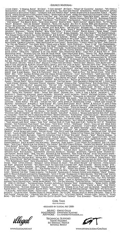
Well, the official CDs were shipped out last week to everyone who donated more than $10. Inside, as promised, was the official sample list — a one-page insert with every single sample on the album. Steve Heil was the first to scan it and contact me.

Unfortunately, a huge block of printed small-caps text isn’t very useful for my kind of fun, so I tried throwing into several OCR engines on WeOCR to turn the image into text. Tesseract gave the best results, but it was still a mess that needed quite a bit of cleanup.

Anyway, here it is. The complete list of all 322 samples in Girl Talk’s Feed the Animals, available as a CSV, Excel, or Google Spreadsheets document.

Continue reading (200 words) ⇢ 29 Comments

Memeorandum Colors: Visualizing Political Bias with Greasemonkey

Like the rest of the world, I’ve been completely obsessed with the presidential election and nonstop news coverage. My drug of choice? Gabe Rivera’s Memeorandum, the political sister site of Techmeme, which constantly surfaces the most controversial stories being discussed by political bloggers.

While most political blogs are extremely partisan, their biases aren’t immediately obvious to outsiders like me. I wanted to see, at a glance, how conservative or liberal the blogs were without clicking through to every article.

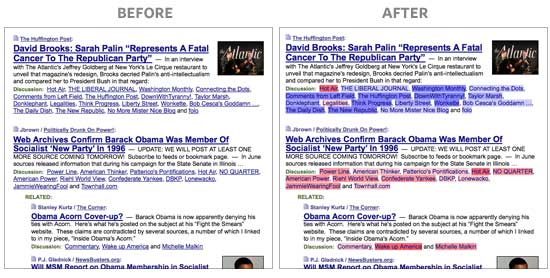
With the help of del.icio.us founder Joshua Schachter, we used a recommendation algorithm to score every blog on Memeorandum based on their linking activity in the last three months. Then I wrote a Greasemonkey script to pull that information out of Google Spreadsheets, and colorize Memeorandum on-the-fly. Left-leaning blogs are blue and right-leaning blogs are red, with darker colors representing strong biases. Check out the screenshot below, and install the Greasemonkey script or standalone Firefox extension to try it yourself.

Note: The colors don’t necessarily represent each blogger’s personal views or biases. It’s a reflection of their linking activity. The algorithm looks at the stories that bloggers linked to before, relative to all other bloggers, and groups them accordingly. People that link to things that only conservatives find interesting will be classified as bright red, even if they are personally moderate or liberal, and vice-versa. The algorithm can’t read minds, so don’t be offended if you feel misrepresented. It’s only looking at the data.

For example, while Nate Silver of FiveThirtyEight may be a Democrat, he has a tendency to link to stories conservative bloggers are discussing slightly more often than liberal bloggers, so he’s shaded very slightly red. (Geeks can read on for more details about how this works.)

Continue reading (950 words) ⇢ 101 Comments

Found Footage: Sarah Palin's 1984 Miss Alaska Pageant Video, Swimsuit Competition

Somehow, a 22-year-old University of Alaska student named Richard Millay got his hands on a videotape that’s eluded the media since John McCain asked Sarah Palin to be his running-mate — original footage of her 1984 Miss Alaska Pageant.

Of course, this is all very frivolous and has nothing to do with the current campaign. But like Barack Obama’s high school basketball footage, it’s a little glimpse into the early life of a highly-visible national figure.

In the first part added to YouTube, he posted the portion from the swimsuit competition, prefaced by a brief introduction mentioning the demand for the “88 minutes of Alaska Gold.”

Update: The original video was removed, but I managed to save a copy of the relevant footage without Richard’s original intro. YouTube’s removing every copy of this video, so I’m streaming the clip below from my own server. It won’t be removed.

Continue reading (300 words) ⇢ 54 Comments

Kickstarter

I wanted to take a moment to announce that I’ve joined the board of directors for Kickstarter, a brand-new startup based out of Brooklyn and Chicago.

April 28, 2009: Kickstarter is live! I wrote more about the launch here.

Kickstarter aims to let creative people of all kinds — journalists, artists, musicians, game developers, entrepreneurs, bloggers — raise money for their projects by connecting directly with fans, who receive exclusive access and rewards in exchange for their patronage. More than just a fundraising app, Kickstarter’s a publishing platform where project creators can communicate with the people that are supporting them. (Think Jill Sobule, A Swarm of Angels, or Sean Tevis.)

I was introduced to founders Charles Adler, Perry Chen, and Yancey Strickler by Caterina Fake back in June, and sealed the deal after a trip to NYC to meet the team. They’re a great group of guys with a strong vision, and I feel lucky to be involved.

Ultimately, everybody should be able to support themselves doing what they love using the web, and I think Kickstarter will be a great way to get there. Expect to hear more on Waxy.org as launch day gets closer.

To help them on their way, they’re currently looking for a CTO to join the founding team. I’ve been helping guide some of the technology decisions and building the development team, but we’re looking for a passionate and talented person to devote themselves to the project full-time.

If you’re interested, drop me an email or IM and I’ll introduce you!

3 Comments

Cheap, Easy Audio Transcription with Mechanical Turk

After recording last week’s interview, I was left with a 36-minute MP3 and a profound feeling of dread. You see, I hate transcribing audio. I used to transcribe interviews in high school, and it’s always tedious, taking upwards of eight times the length of the clip itself.

Bracing for a good four or five hours of rewinding and writing and rewinding, I remembered that this is The Future! So, instead, I tossed the job over to the global anonymous workforce at Amazon Mechanical Turk instead.

The result: my 36-minute recording was transcribed while I slept, in less than three hours, for a grand total of $15.40.

This is a fraction of the cost/time of any other transcription service online, including the Turk-driven Casting Words, though you potentially sacrifice some quality. In my experience, though, there were virtually no errors.

Here’s how to do it yourself, with no programming knowledge required. The instructions below are verbose, but using my template, it shouldn’t take you more than five minutes of setup per job.

Continue reading (1,050 words) ⇢ 135 Comments

Interview with David Winton, Director of "Code Rush" Mozilla Documentary

First, the bad news. Two days ago, I received a polite email from David Winton, the director of Code Rush, asking me to take the out-of-print documentary off of Waxy.org. As promised, I immediately complied.

Now, the good news — In my reply, I asked David if he’d mind being interviewed, and he agreed! He’s an accomplished director and producer, the creator of the Big Thinkers series for TechTV, and the cofounder of Winton/duPont Films, located in San Francisco’s Presidio.

We had a wonderful conversation about the film, which revealed for the first time that he’s planning on not only re-releasing Code Rush digitally, but considering releasing the original outtakes (100 hours of footage) to the public domain on Archive.org.

I wish all my takedown notices were like this! Read on for the full interview, with selected clips from Code Rush, used by permission.

Continue reading (2,750 words) ⇢ 8 Comments

Oddpost Co-Founder Launches Bandcamp, Publishing Platform for Musicians

Ethan Diamond, co-founder of the pioneering webmail service that became Yahoo! Mail, today lifted the veil on his new startup and gave me an exclusive first look.

Bandcamp is a free hosted publishing platform for musicians, taking the technical challenge out of setting up a site — transcoding music into different formats, streaming audio, analytics, payment processing, and so on.

Band websites are often pretty bad, hacked together by a friend of the band with Flash and Dreamweaver, or worse, by the record label. There are exceptions, but mostly, it’s a sea of Flash intros, popup windows, mystery navigation, and 30-second sound clips.

Bandcamp is trying to change that, giving every album and track its own page with clean URLs and semantic markup, with the accompanying SEO benefits. Even before launch, they’re topping Google results for many searches for song titles of participating bands.

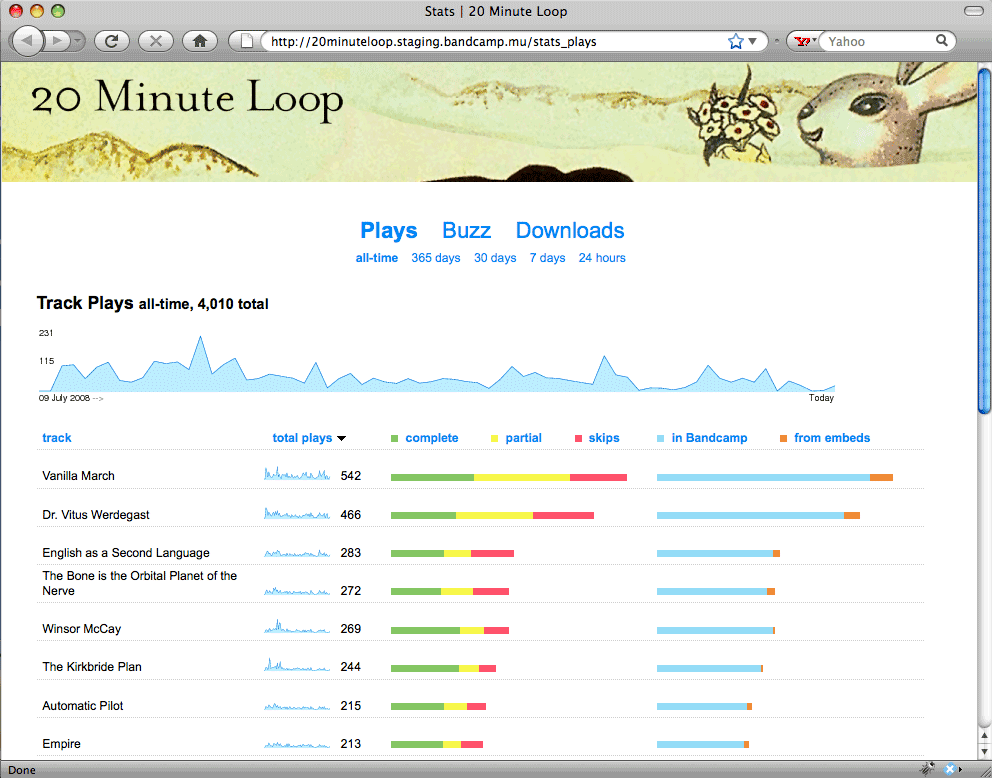
As an infoviz geek, I’m particular fond of their analytics and audio visualizations. Detailed stats let bands track recent activity on their songs and albums, including where people are coming from, trend tracking, and which songs were skipped, played partially, or played in full. A number of real-time audio visualizations in Flash are available on each song’s page, which can be shared and embedded on other websites.

Like Oddpost, the team’s small and nimble — only four people, all splitting engineering and design duties. Co-founder/CTO Shawn Grunberger (also formerly with Oddpost and Yahoo! Mail) and two engineers working from Seattle and Vermont round out the distributed team.

Ethan was kind enough to sit down with me on launch day to talk about their inspiration and process developing Bandcamp.

Continue reading (1,500 words) ⇢ 15 Comments

Computability: Steve Allen and Jayne Meadows' Computer Video from 1984

Election coverage, natural disasters, and Wall Street meltdown got you down? Let’s go back to a simpler time — 1984! It’s morning in America again, and the dawn of a new information age.

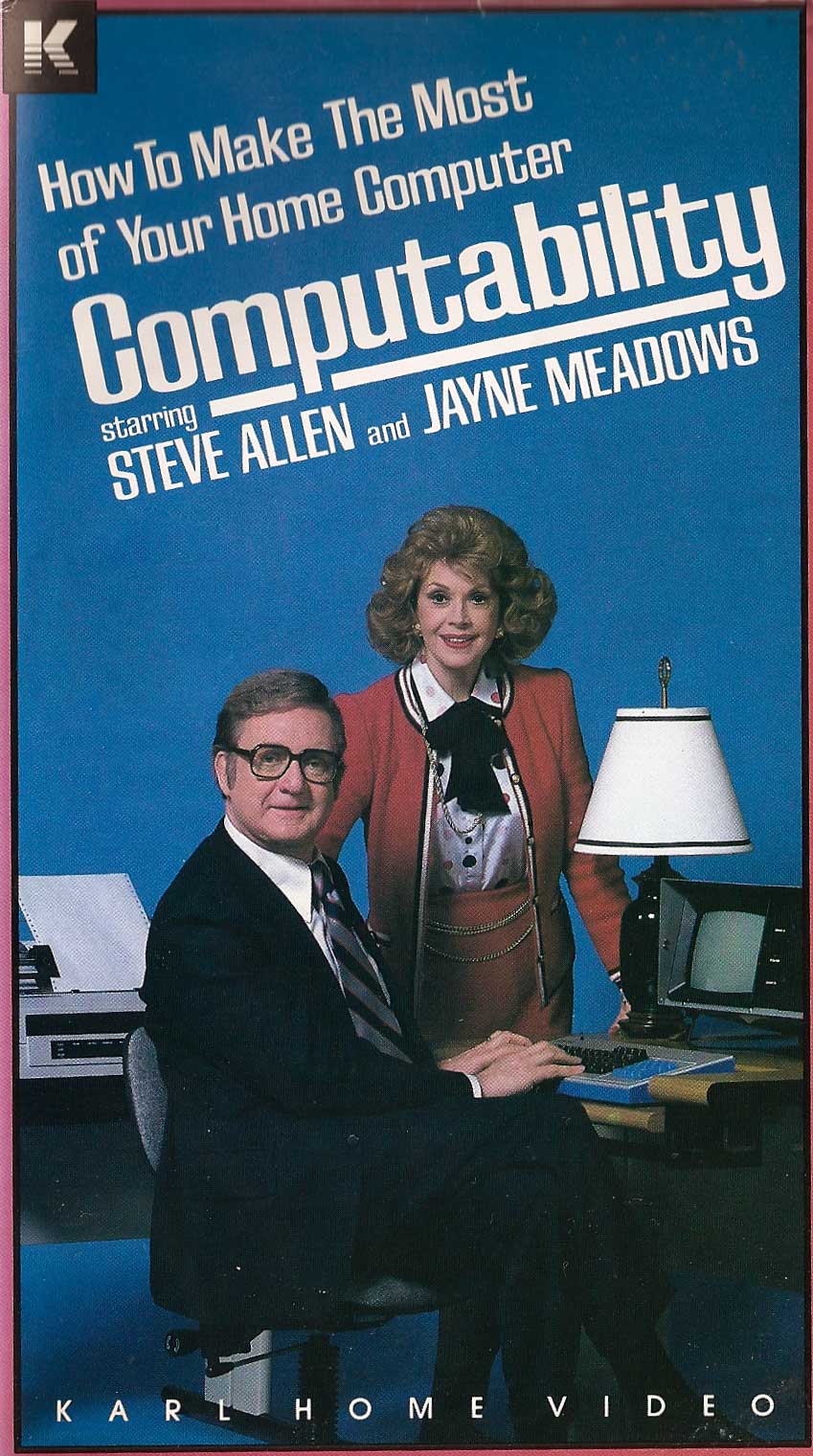
Fortunately, one unlikely celebrity couple is here to guide us through the brave new world of spread sheets, data banks, and modems. In Computability, an instructional VHS tape from 1984, comedian Steve Allen and actress Jayne Meadows “take us on a light-hearted but detailed tour of the ways a home computer can change your life by simply using the correct software packages to suit your needs.”

The video was originally inspired by the couple’s Grammy-nominated “Everything You Wanted to Know About Home Computers,” a vinyl LP released by Casablanca/Polygram Records in 1983. The LP’s completely unavailable, but thanks to Sammy Reed’s wonderfully strange podcast, I was able to recreate the full album. (Stream it below or download the 11 MB MP3.)

Continue reading ⇢ 11 Comments

Girl Turk: Mechanical Turk Meets Girl Talk's "Feed the Animals"

Girl Talk’s Feed the Animals is one of my favorite albums this year, a hyperactive mish-mash sampling hundreds of songs from the last 45 years of popular music. Gregg Gillis created a beautiful, illegal mess of copyright clearance hell, which you should download immediately. (It’s free, but I kicked in $20 for Gregg’s legal fund and a copy of the CD.)

Last month, Rex Sorgatz asked about collecting metadata on the album for data crunching. After spelunking through Billboard’s chart history, that sounded like my idea of a good time.

So I compiled all the data into spreadsheets, used Amazon’s Mechanical Turk to collect some additional information, and pulled out a few charts. As always, I’ve provided CSV downloads for all the data along with the original output from Mechanical Turk, for those interested in experimenting with the platform.

Update (October 30): Here’s the official sample list.

Continue reading (800 words) ⇢ 35 Comments

Pirating the Olympics, Then and Now

Back in 2004, I wrote about how high-quality videos from the Olympics in Athens were being digitized and posted online, in defiance of the networks and the IOC’s rules.

At the time, NBC’s online coverage was restrictive by today’s standards — mostly highlight clips and no live video, delayed until after the events aired on TV, and required a valid credit card to verify residency in the United States.

But that was four years ago! YouTube hadn’t launched yet, HD-quality streaming video on Vimeo was three years away, and BitTorrent or HDTV were only popular with early adopters.

This year, it’s much improved, albeit with some caveats. NBC’s official video is great quality, if you and your computer can stomach Silverlight (unavailable on non-Intel Macs). Their coverage is fantastic, though still tape-delayed. And, because of IOC regulations forbidding international distribution, NBC won’t allow you to download, embed, or transcode any videos for your iPod or phone.

Is this availability enough to satiate the pirates, and what does the quality look like compared to 2004? I went poking through Usenet and some public and private BitTorrent trackers to see.

Usenet

Back in 2004, the place to go for illegal Olympic videos wasn’t BitTorrent, popular trackers like Suprnova, or mainstream P2P clients. The best coverage, surprisingly, was found in the old-school Usenet binaries. It was a mish-mash of events, skewed heavily towards events with bikini-clad women, Brazilians, or bikini-clad Brazilian women, but other popular events and the opening ceremonies also showed up.

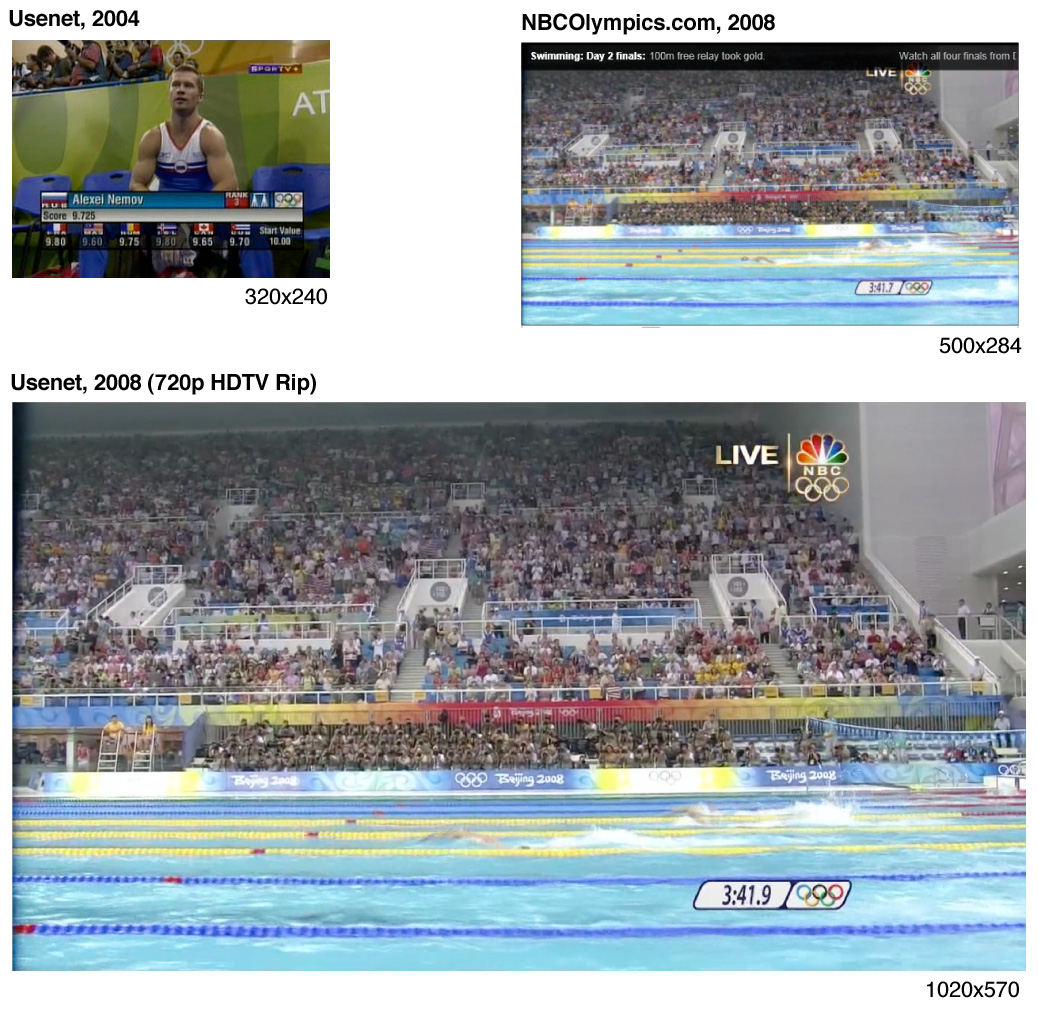
Today, the event coverage in Usenet is just as sporadic, but the quality is dramatically better. Compare the three videos below. The first is a sample from the gymnastics high bar finals from the 2004 games, followed by the same footage of Michael Phelps’ win from Saturday’s 400m IM final, as seen on NBCOlympics.com and a 720p HDTV rip found in Usenet.

Size Comparison (See Actual Size)

Sample Videos (right-click to download):

Here’s the full list of Olympics videos currently up on Usenet, as of this evening:

Olympic Games Opening Ceremony (720p)

Football – Group A – Ivory Coast vs. Argentina Extended Highlights

Football – Group B – Netherlands vs. Nigeria Extended Highlights

Football – Round 1 Highlights

Gymnastics – Men’s Qualifying – USA

Shooting – Women’s 10m Air Pistol Final

Swimming – Men’s 100m Backstroke Semifinals

Swimming – Men’s 100m Breaststroke Final

Swimming – Men’s 200m Freestyle Semifinals

Swimming – Men’s 400m Individual Medley (720p)

Swimming – Men’s 4x100m Freestyle Final

Swimming – Women’s 100m Backstroke Semifinals

Swimming – Women’s 100m Breaststroke Semifinals

Swimming – Women’s 100m Butterfly Final

Swimming – Women’s 400m Freestyle Final

Volleyball – Women’s Preliminaries – China vs. Switzerland

Most of these are in alt.binaries.tv, but some are also posted to alt.binaries.multimedia.sports. I’ll update this list at the end of next week.

BitTorrent

But the trend for this year is clear — Usenet passed the torch to BitTorrent.

A quick search on Mininova or BTJunkie returns a huge list of every video found on Usenet, plus dozens more and growing hourly. Beyond public trackers, I’ve seen extensive activity on several private communities. On one of them, its members compiled a list of every event and were slowly adding their own recordings to create a massive archive of Olympics video.

And this is only Day 4! It’ll be interesting to see how much of the Olympics was captured, digitized, and uploaded by the end of the games.

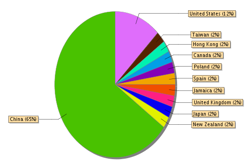
Also interesting: If this chart from Mark Ghuneim is accurate, the thirst for pirated Olympics coverage is greatest in China.

20 Comments

Friendfeed and Flickr

How often is Friendfeed hitting Flickr, and how many Friendfeed users are on Flickr?

We now have a glimpse into Monday’s traffic, thanks to a snapshot provided by Kellan and Rabble’s in their talk, Beyond Rest: Building Data Services with XMPP PubSub, presented earlier today at OSCON in Portland:

On July 21, 2008, Friendfeed hit Flickr 2.9 million times to get the latest photos of 45,754 users, of which 6,721 visited Flickr in that 24-hour period, and could have potentially uploaded a photo.

Three million requests for 6,000 updates. Clearly, polling isn’t ideal. Don’t miss the rest of the slides.

(Also, at its peak, Flickr is currently receiving 60 uploaded photos a second, “roughly 10 times the number of people born on Earth per second.”)

3 Comments

Interview with Alan Taylor, Creator of Boston Globe's The Big Picture


Alan Taylor, The Big Picture
Photo by Buster McLeod

With its vibrant oversized photographs and minimalist design, the Boston Globe’s The Big Picture weblog launched on June 1 to instant global acclaim. It’s designed, programmed, and written by Alan Taylor, an old-school web programmer and blogger, in his spare time while working on community features at Boston.com. (You might know Alan from his popular MegaPenny Project, Amazon Light, or his other projects.)

The idea’s simple, but extremely effective. Spend a few minutes with the Iowa floods, the faces of Sudan, or the daily life in Sadr City, and you feel like you’ve opened a window to another world.

I interviewed Alan about the inspiration for the site, his methodology, and what it’s like being a programmer in a journalist’s world.

The Big Picture’s become an essential read for me, and I totally agree with Jason Kottke when he called it “the best new blog of the year.” What inspired it?

Alan Taylor: Lots of things — my parents used to always have Life and National Geographic magazines around the house, I fell in love with the visual storytelling way back then. When I was getting my feet wet in the online journalism world as a developer at msnbc.com, I had the good fortune of working alongside Brian Storm and a few others in MSNBC’s photo department, who were just phenomenal as far as selection, editing and presentation.

I wondered why other sites didn’t reach that level. Many have by now, but I was still frustrated by the presentation — either far too small, or trapped in click-after-click interfaces that were in Flash or just acted as ad farms.

Continue reading (1,900 words) ⇢ 25 Comments

Code Rush, the Mozilla Documentary from 2000

In honor of the release of Firefox 3.0, I’m offering up a video that documented its very beginning in 1998 — the first open-source release of Netscape’s browser and the foundation of the Mozilla project.

Independent filmmakers followed the Mozilla team from March 1998 to April 1999, as they worked to open Netscape Communicator’s source code to the world, in a last-ditch effort to save the company. The result is an amazing snapshot of computer history, capturing the people that worked on it, the first internal beta test, the moment Jamie Zawinski uploaded the first builds publicly, the launch party, the all-hands meeting announcing the AOL acquisition, and so much more. It aired on PBS nationally in March 2000, the same month as the beginning of the dot-com collapse.

Out-of-print and never released on DVD, the used VHS copies start at $50 on Amazon. Like all the videos I release on Waxy.org, this material is commercially unavailable. If they ever come back into print, or the copyright holders contact me, I’ll take them down immediately.

Important Update (September 16): At the request of the the director, I’ve removed the video from Waxy.org and Viddler. I’ve interviewed the director about his plans for releasing the film and the unreleased footage.

Update (July 31): The documentary is back online, legally released under a Creative Commons license.

I’ve done my best to annotate the video, but many people in the film aren’t identified. I’ve left Viddler annotations open to everyone, so if you want to identify the people, places, or notable objects/events/trivia in the film, then please add your inline comments the video! (Or IM/email me and I’ll take care of it.)

The video’s now offline, but I’ve saved all the annotations. Thanks to Tman for creating the subtitle file, which can be used in video players like Media Player Classic or VLC, or simply viewed as plain text.

Now go download Firefox 3.0 and help make history!

Interviews and Appearances

36 Comments

The Machine That Changed the World: The World at Your Fingertips

Here’s the fifth and final episode of The Machine That Changed the World, this one focusing on global information networks including the Internet, and the communication benefits and privacy risks they create. This is the most familiar material of the documentary, so I’m going to skip the notes and annotations this time. I hope you enjoyed the documentary as much as I did.

And, as promised, here’s the BitTorrent file for high-resolution copies of all five videos. It’s a 3.1GB download with five H.264 encoded MP4 files. (If you only want a single video, use your BitTorrent client to select only the videos you need.) Enjoy!

Watch them all: Part 1, Part 2, Part 3, Part 4, Part 5

Interviews:

Robert Lucky (AT&T Bell Labs), Dave Hughes, Kathleen Bonner (Trader, Fidelity), George Hayter (Former Head of Trading, London Stock Exchange), Ben Bagdikian (UC Berkeley), Arthur Miller (Harvard Law School), Forman Brown (songwriter, died in 1996), Tan Chin Nam (Chairman, National Computer Board of Singapore), B.G. Lee (Minister of Trade and Industry, Singapore), Lee Fook Wah, (Assistant Traffic Manager, MRT Singapore), David Assouline (French Activist, now a senator), Mitch Kapor (founder, Lotus), Michael Drennan (Air traffic controller, Dallas-Fort Worth)

43 Comments

The Machine That Changed the World: The Paperback Computer

The third episode of The Machine That Changed the World covers the development of the personal computer and the modern graphical user interface, which made computing easy to use for everyone. Highlights include interviews with Apple’s Steve Jobs and Steve Wozniak, drawing with a computer in 1963, great footage from Xerox PARC, and some 1992-era predictions of the future from Apple and others.

Continue reading (500 words) ⇢ 12 Comments

The Machine That Changed the World: Inventing the Future

The first part of The Machine That Changed the World covered the earliest roots of computing, from Charles Babbage and Ada Lovelace in the 1800s to the first working computers of the 1940s. The second part, “Inventing the Future,” picks up the story of ENIAC’s creators as they embark on building the first commercial computer company in 1950, and ends with the moon landing in 1969 and the beginning of the Silicon Valley.

Watch them all: Part 1, Part 2, Part 3, Part 4, Part 5

Notes:

Shortly after the war ended, ENIAC‘s creators founded the first commercial computer company, the Eckert-Mauchly Computer Corporation in 1946. The early history of the company’s funding and progress is told through interviews and personal home videos. They underestimated the cost and time to build UNIVAC I, their new computer for the US Census Bureau, quickly sending the company into financial trouble. Meanwhile, in London, the J. Lyons and Co. food empire teamed up with the EDSAC developers at Cambridge to build LEO, their own computer to manage inventory and payroll. It was a huge success, inspiring Lyons to start building computers for other companies.

The Eckert-Mauchly company was in trouble, with several high-profile Defense Department contracts withdrawn because of a mistaken belief that John Mauchly had Communist ties. After several attempts to save the company, the company was sold to Remington-Rand in 1950. The company, then focused on electric razors and business machines, gave UNIVAC its television debut by tabulating live returns during the 1952 presidential election. To CBS’s amazement, it accurately predicted an Eisenhower landslide with only 1% of the vote. UNIVAC soon made appearances in movies and cartoons, leading to more business.

IBM was late to enter the computing business, though they’d built the massive SSEC in 1948 for scientific research. When the US Census ordered a UNIVAC, Thomas Watson, Jr. recognized the threat to the tabulating machine business. IBM introduced their first commercial business computers in 1953, the mass-produced IBM 650. While inferior technology, it soon dominated the market with their strong sales force, relative affordability, and integration with existing tabulating machines. In 1956, IBM soared past Remington-Rand to become the largest computer company in the world. By 1960, IBM captured 75% of the US computer market.

But developing software for these systems often cost several times the hardware itself, because programming was so difficult and programmers were hard to find. FORTRAN was one of the first higher-level languages, designed for scientists and mathematicians. It didn’t work well for business use, so COBOL soon followed. This led to wider adoption in different industries, as software was developed that could automate human labor. “Automation” become a serious fear, as humans were afraid they’d lose their jobs to machines. Across the country, companies like Bank of America (with ERMA) were eliminating thousands of tedious tabulating jobs with a single computer, though the country’s prosperity and booming job market tempered some of that fear.

In the ’50s, vacuum tubes were an essential component of the electronics industry, located in every computer, radio, and television. Transistors meant that far more complex computers could be designed, but couldn’t be built because wiring them together was a logistical nightmare. The “tyranny of numbers” was solved in 1959 with the first working integrated circuit, developed and introduced independently by both Texas Instruments and Fairchild. But ICs were virtually ignored until adopted by NASA and the military for use in lunar landers, guided missiles, and jets. Electronics manufacturers soon realized the ability to mass-produce ICs. Within a decade, ICs cost pennies to produce while becoming a thousand times more powerful. The result was the birth of the Silicon Valley and a reborn electronics industry.

Interviews:

Ted Withington (network engineer, industry analyst), Paul Ceruzzi (Smithsonian), J. Presper Eckert (ENIAC co-inventor, died 1995), Morris Hansen (former US Census Bureau, died 1990), John Pinkerton (Chief Engineer, LEO, died 1997), Thomas J. Watson, Jr. (Chairman Emeritus, IBM, died 1993), James W. Birkenstock (retired Vice President, IBM, died 2003), Jean Sammet (programming language historian), Dick Davis (retired Senior V.P., Bank of America), Robert Noyce (co-inventor, integrated circuit, died 1990), Gordon Moore (former Chairman of the Board, Intel), Steve Wozniak (Co-founder, Apple)

Up Next…

Part 3: The Paperback Computer. The development of the personal computer and user interfaces, from Doug Engelbart and Xerox PARC to the Apple and IBM PCs.

14 Comments

The Machine That Changed the World: Giant Brains

The Machine That Changed the World is the longest, most comprehensive documentary about the history of computing ever produced, but since its release in 1992, it’s become virtually extinct. Out of print and never released online, the only remaining copies are VHS tapes floating around school libraries or in the homes of fans who dubbed the original shows when they aired.

It’s a whirlwind tour of computing before the Web, with brilliant archival footage and interviews with key players — several of whom passed away since the filming. Jointly produced by WGBH Boston and the BBC, it originally aired in the UK as The Dream Machine before its U.S. premiere in January 1992. Its broadcast was accompanied by a book co-written by the documentary’s producer Jon Palfreman.

With the help of Simon Willison, Jesse Legg, and (unofficially) the Portland State University library, we’ve tracked down and digitized all five parts. This week, I’m uploading them, annotating them with Viddler, and posting them here as streaming Flash video as they’re finished. Also, the complete set is available for download as high-quality MP4 downloads via BitTorrent.

Here’s the first of the five-part series, The Machine That Changed the World. Enjoy!

Watch them all: Part 1, Part 2, Part 3, Part 4, Part 5

Continue reading (450 words) ⇢ 83 Comments

Star Wars Kid: The Data Dump

This Friday, I’ll be speaking at the Webvisions conference in Portland about Internet memes, how they spread, and how their distribution’s changed over time.

As part of that research, I’ve been digging into my original server logs from the Star Wars Kid debacle, five years after I played a major role in what some say is the biggest viral video of all-time.

Be warned, this is more detail than you’ll ever want about the origins of the Star Wars Kid meme and how it spread. You don’t care about this level of detail, but I’m writing this all down so that I never have to think about it again.

In addition, I’ve decided to release the first six months of server logs from the meme’s spread into the public domain — with dates, times, IP addresses, user agents, and referer information. (Download it below.)

Early Origins

Like I mentioned in my original entry, the video was first released by Ghyslain’s schoolmates to Kazaa on April 19, 2003 with the original filename “ghyslain_razaa.wmv.” Within three days, it was being passed around in the offices of Raven Software in Madison, Wisconsin, where a game developer named Bryan Dube posted it on his personal website on April 22. Two days later, he created the first Star Wars Kid remix, adding lightsabers and sound effects in a new video titled “TheLastHope.avi.”

On April 27, a mostly-NSFW online community called Sensible Erection linked to the video on Bryan’s website. Later that evening, an SE user cross-posted it to a private file-sharing community I belong to with the new filename “star_wars_guy.wmv.” It quickly became the most popular file on the site, which is where I found it the following day, April 28 at 7:52pm.

On April 29, I renamed it Star_Wars_Kid.wmv and posted it to my site at 4:49pm — inadvertently giving the meme its permanent name. (Yes, I coined the term “Star Wars Kid.” It’s strange to think it would’ve been “Star Wars Guy” if I was any lazier.) An hour later, Scott Gowell becomes the first person to link to the video.

From there, for the first week, it spread quickly through news site, blogs and message boards, mostly oriented around technology, gaming, and movies. Throughout the life of the meme, most of the referers are blank, suggesting people were primarily sending the links by email or instant message.

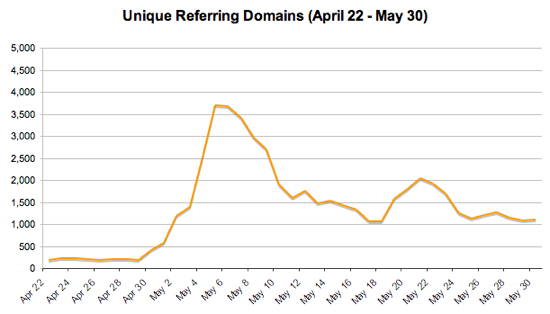
The chart below shows the distinct top-level domains that appeared in the referral logs grouped by day.

It’s worth noting that the majority of sites sent less than 10 referers in that first month, and 21% of domains referred only one user. (Note: The chart below is on a logarithmic scale for both axes.)

Mainstream News Coverage

Here’s some of the highlights from the mainstream media coverage. The New York Times was the first major paper to report on it, almost a week after I tracked Ghyslain down, Jish and I interviewed him for the first time, and we started the fundraiser.

May 19, New York Times

May 19, Wired News

May 20, Public Radio International’s “The World” (radio program)

May 20, Globe and Mail

May 20, National Post

May 23, The Mirror UK

Jun 6, LA Times

Jul 4, The Independent UK

Jul 12, The Age

Jul 23, Wired News

Jul 25, BBC News

Jul 31, NPR w/Tavis Smiley (radio interview)

Aug 21, USA Today, syndicated Associated Press article

Aug 25, NBC’s Today Show (TV program)

Aug 26, MSNBC’s Countdown (TV program)

Aug 28, USA Today

Aug 30, Seattle P-I

Sep 8, SF Chronicle

Sep 15, Variety

Sep 16, Globe and Mail

Nov 18, CBS Evening News

Statistics

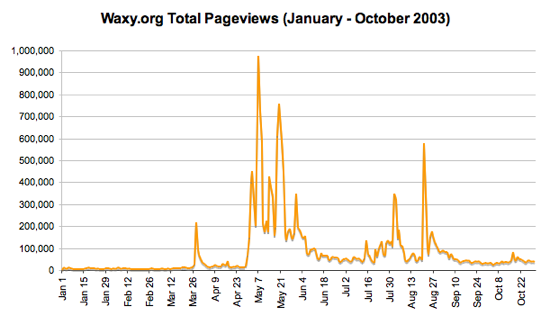
Here’s what the Star Wars Kid meme did to my overall traffic. At its peak, I received almost a million pageviews in a single day.

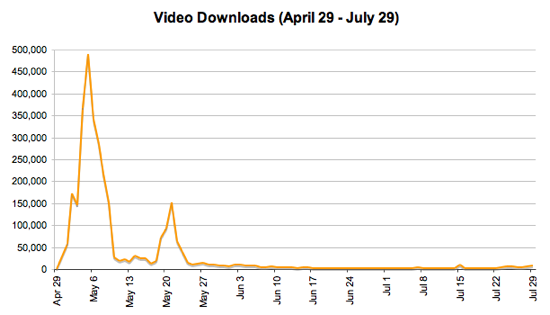
That includes all pageviews on my weblog entries. Isolating only the video downloads from my site, or later redirected to one of the mirrors, gives the following chart.

Download the Data

This file is a subset of the Apache server logs from April 10 to November 26, 2003. It contains every request for my homepage, the original video, the remix video, the mirror redirector script, the donations spreadsheet, and the seven blog entries I made related to Star Wars Kid. I included a couple weeks of activity before I posted the videos so you can determine the baseline traffic I normally received to my homepage.

The file is 158 megabytes — 1.6GB uncompressed — so I’m distributing it with BitTorrent. The data is public domain. If you use it for anything, please drop me a note!

Download: star_wars_kid_logs.zip.torrent

21 Comments

Garry Kasparov Griefed by Flying Penis

In a bizarre example of Second Life leaking into the real world, a political assembly on Saturday led by chess grandmaster Garry Kasparov was disrupted by a flying penis.

Kasparov is a leader of the Other Russia movement, a loose coalition of activists opposing Vladamir Putin and the current Russian government. Over 700 people showed up for the event in central Moscow, but Kasparov’s speech was interrupted when a large phallus-shaped helicopter started buzzing around the room. The Moscow Times attributed the prank to “a couple of pro-Kremlin Young Russia activists.”

Warning: Mildly NSFW images and video follow.

Continue reading (150 words) ⇢ 23 Comments

The Whitburn Project: One-Hit Wonders and Pop Longevity

How has the record industry changed in the last 50 years? Using the Whitburn Project spreadsheet I talked about yesterday, I’ve been trying to dig into some of the underlying trends. Today, I’ll be tackling the longevity and diversity of pop songs, and a look at which decades had one-hit wonders.

Longevity of a Pop Song

One of the trickier questions I’ve been trying to visualize is how long pop songs are staying on the charts relative to the past. Are they staying on the charts longer than in the past?

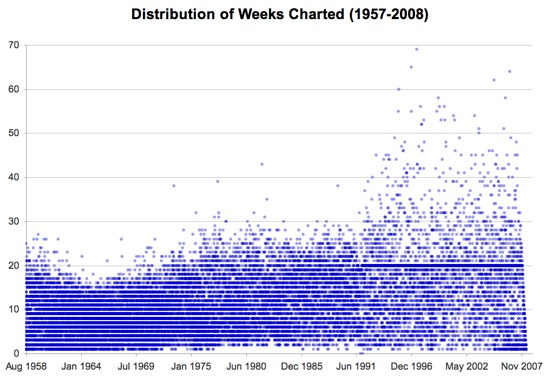
In the chart below, I plotted the total number of weeks charted for all 23,924 songs that appeared on the Billboard Hot 100 from 1957 to earlier this year. (In other words, a little dot on the “60” line means there was a song released that week that stayed on the Hot 100 chart for 60 weeks.)

See the heavy dropoff on the 20th week starting in 1991? In an attempt to increase diversity and promote newer artists and songs, Billboard changed their methodology, removing tracks that had been on the Hot 100 for twenty consecutive weeks and slipped below the 50th position. These songs, called “recurrents,” were then moved to their own chart in 1991, the Hot 100 Recurrent.

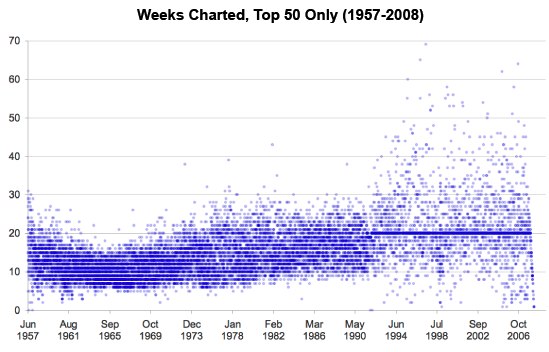
Unfortunately, this shift makes it much harder to compare the last 15 years to the decades before it. In the chart below, I’ve isolated the effect by only showing songs that reached the top 50.

A couple interesting observations… Looking at the very bottom of the chart, you can see that in the last couple years, it’s become very common for a single to appear in the Top 50 and fall out of the Hot 100 within four weeks. Prior to the mid-1990s, this almost never happened.

Also, songs are staying in the Top 50 for far longer than they used to. Unfortunately, I don’t have any actual sales numbers to compare to, so it’s hard to say if these 30-70 week singles are massive megahits eclipsing the #1 singles of the past, or if it’s because the record industry is producing fewer hits than before.

Diversity

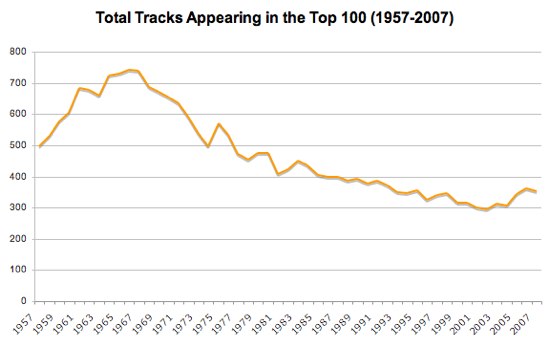
Did Billboard’s methodology changes in 1991 make the charts more diverse, like they hoped? By looking at the total number of unique songs that have charted yearly, it’s clear their changes did nothing to slow the decline.

According to Billboard, the late 1960s were the peak of musical diversity in popular music, with 743 different songs appearing on the 1966 Billboard Top 100. It’s fallen consistently since, hitting an all-time low in 2002 with only 295 songs. Since then, it’s improved only slightly, with 351 unique songs appearing on last year’s Top 100.

One Hit Wonders

I’ve always thought the 1970s were the decade of the one-hit wonder, but now I have the data to see for sure.

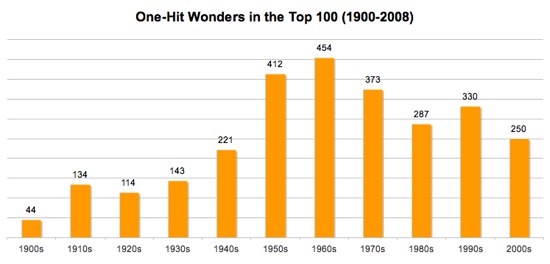
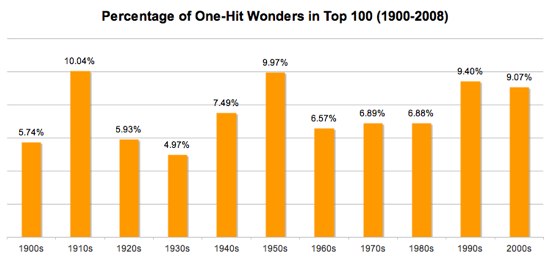
In raw numbers, the 1960s had more one-hit wonders than any other decade, followed closely by the 1950s. But that’s not entirely fair since, as we saw earlier, there were simply more unique songs on the 1960s charts. To find out the true numbers, we need to look at the number of one-hit wonders as a percentage of all songs in the Top 100.

This tells a totally different story. The 1960s, 1970s, and 1980s all had about the same ratio of one-hit wonders to hits by more established artists. The big surprise for me is that 1950s, 1990s, and 2000s really seem to be the eras where one-hit wonders dominated the charts.

Joshua Porter was wondering about the longest-charting one-hit wonders of all time. The longest-charting one-hit wonder to hit the #1 spot is Daniel Powter’s “Bad Day” from 2006, which stayed on the charts for 32 weeks. The one-hit wonder that stayed at the #1 longest is Anton Karas’ “The Third Man Theme” from 1950, which stayed in the #1 position for 11 weeks. Finally, the longest-charting one-hit wonder to appear anywhere in the Top 100 is Duncan Sheik’s “Barely Breathing” from 1997, which peaked at #16 but stayed in the top 100 for 55 weeks.

Have any other questions about the data, or done any analysis yourself? I’d love to hear about it.

May 20: Don’t miss Mike Frumin’s chart of pop longevity,from 1998-2002.

May 21: Using the Whitburn data, Tom Whitwell generated a tag cloud showing the top 100 commonly-used words in song names. Dianne Warren should write a #1 hit called “Love my Baby Blue Heart: A Girl’s Night Song.”

July 14: Pedro did some additional analysis, including artists with multiple hits in the same week and one-week wonders.

34 Comments

The Whitburn Project: 120 Years of Music Chart History

For the last ten years, obsessive record collectors in Usenet have been working on the Whitburn Project — a huge undertaking to preserve and share high-quality recordings of every popular song since the 1890s. To assist their efforts, they’ve created a spreadsheet of 37,000 songs and 112 columns of raw data, including each song’s duration, beats-per-minute, songwriters, label, and week-by-week chart position. It’s 25 megs of OCD, and it’s awesome.

As far as I know, this is the first time the project and its data have ever been discussed outside of Usenet. Despite its illegality, they’ve created a wonderful resource and you can do some fun things with the data. For the next three days, I’m going to publish some analysis and insights gleaned from their work. Update: I published an entry about one-hit wonders and pop longevity.

Continue reading (700 words) ⇢ 109 Comments

BBC Two's Horizon on "The Electronic Frontier" in 1993

Continuing the series of portrayals of technology from the VHS era, here’s another contribution from Martin Brewer, who brought us the first episode of The Net. This is another BBC Two show, an episode of Horizon from 1993 on “The Electronic Frontier.”

The broad theme of the episode is the information economy, and it’s a whirlwind tour of influential people and tech in the pre-Web 1990s. They focus heavily on Microsoft, Apple, and General Magic, with interviews from key players from each. (Plus, great footage of their headquarters and workspaces.) There’s plenty of footage of vintage ’90s tech in here, including giant cell phones, Windows NT 3.1, the Newton, General Magic’s Magic Cap, Corbis, Encarta on CD-ROM, interactive TV and software agents. Some of the highlights, with screenshots, after the video below.

Note: Like all the other materials I post here, this video is completely out-of-print and unavailable commercially, digitized from an old VHS tape. If it ever comes back into print, or the copyright holders contact me, I’ll take it down immediately. (Update: YouTube is blocking my upload in some countries, so I replaced the video embed below with this copy from the Internet Archive.)

Continue reading (1,250 words) ⇢ 12 Comments

ZombieURL

For the last few weeks, I’ve been spending every Friday with a small group of brilliant geeks — Rael Dornfest, Asha Dornfest, Chris Anderson, Greg Borenstein, and Adam Greene — for a weekly one-day hackathon. We call it Bottlecap Labs, a place to bounce around ideas, support each other’s work, and occasionally whip up a project.

The first is ZombieURL, a TinyURL-clone with a twist.

Put in a URL, send it to a friend, and enjoy. Keep a camera nearby to capture the fun. (Here’s a Zombie-fied version of Waxy, for example.)

(Warning: We’re not responsible for emotional scarring, concussions, or heart failure as a result of using ZombieURL.)

20 Comments

Milliways: Infocom's Unreleased Sequel to Hitchhiker's Guide to the Galaxy

From an anonymous source close to the company, I’ve found myself in possession of the “Infocom Drive” — a complete backup of Infocom’s shared network drive from 1989. This is one of the most amazing archives I’ve ever seen, a treasure chest documenting the rise and fall of the legendary interactive fiction game company. Among the assets included: design documents, email archives, employee phone numbers, sales figures, internal meeting notes, corporate newsletters, and the source code and game files for every released and unreleased game Infocom made.

For obvious reasons, I can’t share the whole Infocom Drive. But I have to share some of the best parts. It’s just too good.

So let’s start with the most notorious — Milliways: The Restaurant at the End of the Universe, the unreleased sequel to Infocom’s The Hitchhiker’s Guide to the Galaxy. For the first time, here’s the full story: with never-before-seen design documents, internal emails, and two playable prototypes. Sit back, this might take a while.

Note: I’ve pieced together this history from emails and notes from the Infocom Drive. I haven’t contacted any of the people mentioned, so if you’re a primary source or authority, please get in touch so I can make corrections.

Update: Don’t miss the comments section. Infocom alumni Dave Lebling, Steve Meretzky, Amy Briggs, and Tim Anderson all comment on the story, Zork co-author Marc Blank helps correct an error, and writer Michael Bywater provides an alternative view of the events.

November 26, 2009:

After much consideration, I’ve edited this entry to remove the private correspondence that I never sought permission to publish. In my eagerness to share the story, I rushed to post instead of taking the time to reach out to everyone involved, against the recommendations of my source. At the time, I felt that 20 years of distance and the material’s historical value was enough to warrant bringing it to light without contacting each individual. I was wrong, and I’d like to apologize to each of the Infocom employees for my lapse in judgment.

On these pages, I’ve frequently waded into murky legal waters and I’m used to catching a certain amount of heat. But this article cost me far more than I ever anticipated — I lost a very close friend because of it. I deeply regret the error.

— Andy.

Continue reading (4,250 words) ⇢ 498 Comments

Exclusive: Google App Engine ported to Amazon's EC2

One of the biggest criticisms of Google’s App Engine have been cries of lock-in, that the applications developed for the platform won’t be portable to any other service. This morning, Chris Anderson, the Portland-based cofounder of the Grabb.it MP3 blog service, just released AppDrop — an elegant hack proving that’s not true.

AppDrop is a container for applications developed with the Google App Engine SDK, running entirely on Amazon’s EC2 infrastructure. Just like Google’s Appspot, anyone can use a modified SDK to deploy their App Engine apps directly to Amazon EC2 instead of Google, and they work without modification.

This proof-of-concept was built in only four days and can be deployed in virtually any Linux/Unix hosting environment, showing that moving applications off Google’s servers isn’t as hard as everyone thought.

How does it work? Behind the scenes, AppDrop is simply a remote installation of the App Engine SDK, with the user authentication and identification modified to use a local silo instead of Google Accounts. As a result, any application that works with the App Engine SDK should work flawlessly on AppDrop. For example, here’s Anderson’s Fug This application running on Google App Engine and the identical code running on EC2 at AppDrop.

Of course, this simple portability comes at the cost of scalability. The App Engine SDK doesn’t use BigTable for its datastore, instead relying on a simple flat file on a single server. This means issues with performance and no scalabity to speak of, but for apps with limited resource needs, something as simple as AppDrop would work fine.

I spoke to Chris this morning about his project and where he wants it to go. “AppDrop is open-source just like the Google SDK, so I’m hoping someone will come along and take it to the next level,” he said. “It wouldn’t be hard for a competent hacker to add real database support. It wouldn’t be that hard to write a Python adapter to MySQL that would preserve the BigTable API. And while that wouldn’t be quite as scalable as BigTable, we’ve all seen that MySQL can take you pretty far. On top of that, you could add multiple application machines connecting to the central database, and load-balancing, and all that rigamarole.”

While this is only a hack, it demonstrates that App Engine developers don’t need to live in fear of Google’s reprisal. “The upshot is that if you put a lot of time into an App Engine app, and then run afoul of Google, you have alternatives, even if they are more work.”

Update: Chris announced the project on his own blog, with some design notes.

April 20, 2008: Addressing concerns with data lock-in, Google announced that large-scale data import and export for will be coming soon to App Engine.

20 Comments

Fanboy Supercuts, Obsessive Video Montages

This insane montage of (nearly) every instance of “What?” from the LOST series started me thinking about this genre of video meme, where some obsessive-compulsive superfan collects every phrase/action/cliche from an episode (or entire series) of their favorite show/film/game into a single massive video montage.

For lack of a better name, let’s call them supercuts. (Thanks, Ryan.)

Here are some examples I could find, but I’m sure there must be more. Post ’em in the comments and I’ll add them. Bonus points for supercuts with the most clips, the shortest clips, and in additional genres (sports? politics?).

UPDATE: This entire list (and many more) is now on Supercut.org. Add more there!

Film

Glengarry Glen Ross – Obscenity Count

Glengarry Glen Ross – “The Leads”

Ship, Computer, and Sauce in the first six Star Trek films

Shia LaBeouf in “No No No No”

Requiem for a Dream, montage of every drug montage (meta!)

Casino, every “fuck”

Big Lebowski, every “fuck”

Big Lebowski, Every “dude”

Big Lebowski, Every “man” (thx, Matt)

True Romance, every kill from the finale

True Romance, every “fuck”

Rushmore, handjob references (thx, Matt)

Scarface, every “fuck” (thx, oscar)

The Departed, every “fuck” (thx, oscar)

Jay and Silent Bob Strike Back, every “fuck” (thx, MeatFarley)

All the pauses and silence in His Girl Friday from 1940 (thx, progosk)

The Incredibles, buttons, doors, and explosions (thx, Joshua)

Fargo, every “yeah” (thx, Doobybrain)

Charles Bronson Death Wish Bodycount (thx, Dave)

Chris Hefner’s Talking Picture (The Road to Ruin), removes all words from a 1938 film (thx, Jamie)

Boondock Saints, every “fuck” (thx, Brandon)

Midnight Run, every “fuck” (thx, Lakawak)

Miscellaneous films, cops turning in their badge and gun (thx, Darrin)

Every “McFly” from the Back to the Future trilogy

Cell phone cliches in horror films

Mirror scares

Nearly every Hitchcock film cameo (thx, Oscar)

“We’ve Got Company” (thx, Buzzfeed)

“Get out of there!” (via Buzzfeed)

“It’s Gonna Blow!”

Every lightsaber ignition/retraction from the Star Wars series (thx, Buzzfeed)

Everything Chris Klein Says in “The Legend of Chun Li” (thx, Jeff)

“You look like shit.”

Every Arnold Schwarzenegger scream (thx, Buzzfeed)

Every Nicolas Cage freak-out

In 3D! (thx, Joe)

Every “Michael” in The Lost Boys

“Now if you’ll excuse me…”

“Blah blah blah.”

7 minutes of face slaps in film

“It’s Showtime!”

“Nooooooooo!” (thx, Scott)

Every Bone Steven Segal Has Broken

TV

Every “What?” from the LOST series

Legend of Zelda TV show, Excuse Me, Princess!

Knight Rider – Turbo Boosts

CSI: Miami, Caruso’s One-Liners

The Simpsons, every couch intro

The Sopranos, Every single whacking

Ojamajo Doremi, every transformation

Star Trek: The Next Generation, Last 10 seconds of every episode of season 1

Every Dragonball Z transformation

Mighty Morphin’ Power Rangers, every finishing move from Season 1

Deadwood, every curse in Episode 1, 2, and 3 (thx, Brian W)

LOST, Sawyer says “Son of a Bitch” (thx, Jordan)

Rozen Maiden, every “Desu” (527 times! More context, thx Jason)

Buffy the Vampire Slayer, every mention of “Buffy” from Season 1 (Chuck Jones)

Battlestar Galactica, every “frak” from season 1 (thx, Nowak)

Big Brother’s Julie Chen, every “but first” (thx, Cardhouse)

House M.D., every “lupus” reference (thx, engtech)

LOST, Sawyer’s nicknames in the first three seasons (thx, oscar)

Rachael Ray, “Mmm!”

MTV’s Newport Harbor, 82 “like”s in one episode (thx, Jamie)

Red Dwarf, every “smeg” reference in all 52 episodes (thx, arto)

LOST, Desmond saying “Brother” (thx, cypher)

The Wire, Clay Davis’ “Sheeeeeit” (thx, dunk3d)

24, Jack Bauer says “damn it” (thx, jonathan)

The Simpsons – Homer’s D’ohs, excerpt from an official episode (thx, Scott)

Scrubs – Every Girls Name to J.D. from Dr. Cox (thx, oscar)

Naruto – Every Rasengan from the filler story arcs (thx, Binkley)

The Hills, without the dialogue (thx, Rex)

Bea Arthur says “Whoa!” on the Golden Girls (thx, BWE)

The Office – “That’s What She Said” (thx, Jason)

“I’m not here to make friends” from every reality TV show (thx, Rich)

Dr. Who – “What are you doing here?” (thx, Duncan)

The Sopranos, every profanity

The Royle Family, every “My Arse!” (thx, Dunk)

Stargate SG-1’s Teal’c says “Indeed” (thx, Torley)

Kramer’s Entrances from Seinfeld (thx, Buzzfeed)

Every “Dude” from Hurley on LOST

Every Secret Ingredient from Iron Chef America (thx, Oscar)

Mad Men’s Don Draper says, “What?”

Every cigarette smoked on Mad Men

Every “Christmas” from the 90210 Christmas special

Star Trek, Spock says “Fascinating” (thx, Scott)

MST3K, The Many Names of David Ryder (thx, Nathaniel)

Games

Half-Life series, every G-Man sighting (and part 2)

Every Famicon (NES) Game Title Screen

Metal Gear Solid questions? (thx, William)

Miscellaneous Sources

Various films, Wilhelm Screams

Various films, The Slow Clap

Various films, NOOO!

Steve Jobs says “Boom!” in Mac keynotes (thx, Jeff)

Clip from Christian Marclay’s “Telephones” from 1995 (thx, progosk)

iPhone “Hello” ad, heavily inspired by “Telephones” (thx, progosk)

Phil Collins’ “In the Air Tonight,” every “Oh Lord” (thx, oscar)

2008 State of the Union, without any speech

Bill Gates says “Uh…” in Rocketboom interview

Collage of “Zoom In and Enhance” scenes

“Hey, Guys!”, collection of YouTube beauty guru intros

Collection of “Myspace salutes” (more context)

“I Could Tell You, But Then I’d Have to Kill You”

“We’re not in Kansas anymore.”

Club Drunk Party Hands, every use of those four words in the Billboard Top 10 for 2010

All the pauses in Sarah Palin’s response to the 2011 Arizona shootings

Obama says “spending”

Audio

Only the inhaling from an hour of NPR’s All Things Considered (Chuck Jones)

Loveline, every question asked by the hosts (Chuck Jones)

Loveline, every name mentioned in alphabetical order (Chuck Jones)

Loveline, every “Yes” and “No” (Chuck Jones)

Loveline, every number (Chuck Jones)

Loveline, interjections (Chuck Jones)

Loveline, dead air (Chuck Jones)

NWA’s Straight Outta Compton, obscenities only (thx, oscar)

Honorable Mention

A commenter points to the work of Chicago artist Chuck Jones, who’s created a number of excellent audio and video supercuts he calls Isolation Studies. I’ve listed them all above.

The “Most Obsessive” award goes to artists Jennifer & Kevin McCoy for their work Every Shot, Every Episode from 2001, a 277 DVD set compiling 10,000 clips from Starsky & Hutch, arranged by categories like “Every Dead Body,” “Every Mirror,” “Every Gunshot,” and “Every Affirmative Response.” Other work of theirs includes I Number the Stars, a shot-by-shot index of the first 20 Star Trek episodes in 120 categories, How I Learned, a 10,000 shot inventory of the show Kung Fu in over 100 categories, and Every Anvil, cataloguing the violence in 100 Looney Tunes cartoons. Mind-blowing. (Thx, Buzzfeed!)

June 15, 2011:

The earliest supercut appears to be Joseph Cornell’s “Rose Hobart”, a short film from 1936. It compiles nearly every scene featuring the obscure actress in the 1931 B-movie, East of Borneo.

Want more? Michael Bell-Smith and I launched a site dedicated to the supercut genre at Supercut.org.

112 Comments

Waxy.org Redesigns

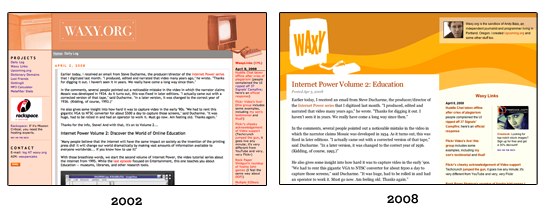
For the first time since I started blogging in 2002, I’ve redesigned Waxy.org. Over the last six years, I’ve grown pretty sick of the old design but never found the time to rework it. Mostly, the changes are cosmetic. Cleaner design, new logo, bigger type, headlines, better iPhone support, and more space devoted to Waxy Links.

I’ve also taken the opportunity to change my URL structure, removing some cruft and giving some additional length to the slugs. All old URLs should redirect, thanks to some mod_rewrite magic and a little PHP.

One change that might affect you is that you’ll now be seeing all of my longer articles in the Waxy Links feed, so you might want to unsubscribe from the main feed to avoid getting duplicates. Since I generally only post once a day, and I try to only write things I’d want to link to, this seems like a good alternative to linking to my own posts. If you really don’t like this change, please let me know privately and I’ll work something out.

What do you think? Nothing’s permanent, so I’m all ears.

Update: You’re probably seeing some weirdness in the RSS feed. Links appearing in the articles RSS feed, tons of old entries, and links pointing directly to Waxy.org instead of the sites I was linking to. All of these problems are fixed! But feedreaders take time to update, so it’ll be resolved as soon as your RSS reader of choice sees the updated feed. Sorry!

61 Comments

Internet Power Volume 2: Education

Earlier today, I received an email from Steve Ducharme, the producer/director of the Internet Power series that I digitized last month. “I produced, edited and narrated that video many years ago,” he wrote. “Thanks for digging it out. I haven’t seen it in years. We really have come a long way since then.”

In the comments, several people pointed out a noticeable mistake in the video in which the narrator claims Mosaic was developed in 1934. As it turns out, this was fixed in later editions. “I actually came out with a corrected version of that tape,” said Ducharme. “In a later version, it was changed to the correct year of 1936. (Kidding, of course, 1993.)”

He also gives some insight into how hard it was to capture video in the early ’90s. “We had to rent this gigantic VGA to NTSC converter for about $500 a day to capture those screens,” said Ducharme. “It was huge, had to be rolled in and had an operator to work it. Must go now. Am feeling old. Thanks again.”

Thanks for the info, Steve! And with that, it’s on to Volume 2…

Internet Power Volume 2: Discover the World of Online Education

“Many people believe that the Internet will have the same impact on society as the invention of the printing press did! It will change our world dramatically by making vast amounts of information available to everyone worldwide… if you know how to use it!”

With those breathless words, we start the second volume of Internet Power, the video tutorial series about the Internet from 1995. While the last episode focused on Entertainment, this one teaches you about Education — museums, libraries, and other research tools.

It’s very similar to the first episode with an almost-identical structure, but focusing on a new set of vintage websites. Microsoft’s Bret Arsenault appears again, and they focus on Yahoo! again.

Highlights

03:21. Using Yahoo circa 1995 to search for “civil war” sites. The results are in alphabetical order by category name, rather than any attempt at ordering by relevancy.

“We click on the hypertext link, the Civil War Gallery. The URL address for this site is hidden in the link and it automatically takes us to the Civil War Gallery.” Updated September 25, 1995!

05:55. “A reminder to you that clicking on links and moving from site to site usually will take a few seconds depending on the speed of your computer’s modem. For the purposes of this video, we are moving instantly to each screen with the help of video editing.”

06:30. Downloading a 1MB JPG from the Library of Congress and viewing it in ImageView for Windows.

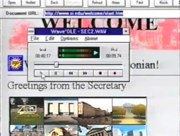
10:15. Listening to a WAV audio greeting from Michael Heyman, the Secretary of the Smithsonian Museum. 40 seconds of filler!

11:35. “This will get you started, but the best thing to do is follow the hypertext links. Explore the Internet and discover your own favorite sites. It’s kind of like going to a new city! The streets aren’t familiar at first, but after traveling around for a while you’ll discover your favorite places in the city that have the activities and interests you’re looking for.”

12:00. “The Internet has not forgotten about the children of the world.” I love this line.

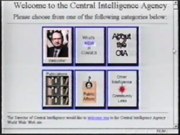
13:00. “This brings us to, of all places, the CIA Website. Don’t worry! It’s okay that we’re here. They keep their top-secret files someplace else.”

16:40. “Speaking of science projects, it’s pretty difficult going all the way through school without having to do a science project. If this is the case for you, there are ideas on the Internet if you look for them.”

20:20. Searching for tuition rates for the University of Washington. In 1994, $969 per quarter for full-time residents, $2,733 for non-residents. (Just for fun, I looked up the current rates. $2,129 for residents, $7,377 for non-residents.)

23:30. Browsing SPRY’s Gopher server, explaining how to download JPG files with Gopher.

25:50. “But if you really want to see the power of the Internet for doing research and finding information, just click on the folder ‘Libraries of the Internet.’ Now hold onto your hats and click the icon that says ‘Other Libraries around the US.’ Up comes over 100 libraries that you can click on and get even more information of all kinds.” He finally concludes, “Never again will you be able to use the excuse of ‘Gee, I just couldn’t make it to the library last night!'”

27:00. The big ending. “Not bad for 30 minutes, is it? We think you will agree after watching this video that the Internet will change the way we learn forever. Well, we’re off to our next website and we hope you enjoy the Internet as much as we do. Remember, in the next century, the person with the most information wins. Good luck on your journey, surf wisely, and have a great time!”

URL Addresses for Websites We Visited

Here’s a list of the URLs mentioned in the credits.

Smithsonian, http://www.si.edu

Virtual Science and Math Fair, http://www.educ.wsu.edu/fair_95 (misspelled as www.educ.wsu)

KidsWeb, http://www.npac.syr.edu:80/textbook/kidsweb

Yahoo!, http://www.yahoo.com

Internet College Exchange, http://www.usmall.com/college

University of Washington, http://www.washington.edu

Midlink, http://longword.cs.ucf.edu/~midlink

Web 66, http://web66.coled.umn.edu/schools.html

Welcome to the Planets, http://stardust.jpl.nasa.gov/planets

Library of Congress, http://www.loc.gov (misspelled as www.loc/gov)

Civil War Photo Gallery, http://www.magibox.net/~civilwar/harper.html

4 Comments

Game Neverending Relaunches

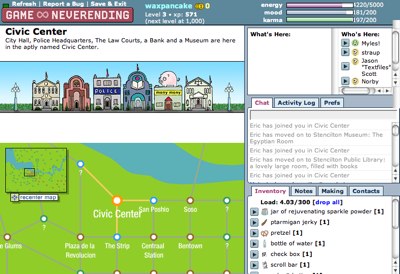
Just received word that Game Neverending is back online! This game was extremely innovative, but played by very few people during its limited beta test. One of the very first web-based MMOs, Game Neverending was eventually shut down as the Ludicorp team focused their efforts on Flickr.

Last year, Cal Henderson showed me an internal server running the original GNE code, but it wasn’t accessible outside the company intranet. Over the last year, Cal and Myles have ported the old ASP codebase to PHP, and it’s now live for anyone to play for the first time.

http://gne.flickr.com/

(You’ll need to be signed in to Flickr for the link to work.)

Here’s the April Fools-themed message that announced it publicly, a parody of Jerry Yang’s internal emails. More than an April 1 prank, I’ve been told that it’ll be around longer than today only but completely unsupported. Hooray!

Update: After much speculation, I’m happy to announce GNE is still alive on April 2. I spent all yesterday playing, got up to Level 7, built a lovely house in Fierov Heights, and had enough making points to build the final item of the game, a Game Neverending. Unfortunately, I was about $8 million short to buy the ingredients. (Stewart, Caterina, Ben, and five other Ludicorp employees must be purchased in the back room of a mash pub for $1M each.)

Everybody pooled their resources to buy the ingredients, and at about 8pm, a Game Neverending was created. We passed it around so everyone could hold it, and then handed it back to its creator so she could win the game. Screenshots here.

Update: GOD announced it’s shutting down in an hour (about 11am PST). As yeoz said, “GNE is a shared temporary hallucination.”

Aaand, it’s gone. I managed to send it off by winning the game in the last four minutes. I captured video of building the GNE and using it to win the game. Striatic also captured the last few minutes of the game.

21 Comments

BBC2's The Net, first episode from April 1994

“As computer technology becomes part of everyday life, a new program comes to BBC2 now: be you beginner, buff, or somewhere in between.”

Thanks to Martin Brewer, here’s the first episode of The Net, a documentary series that ran for four seasons from 1994 to 1998. Despite the name, this first episode has very little to do with the Internet. Instead, it’s an almost perfect video equivalent of the early Wired Magazine, covering a mish-mash of digital culture from video games to virtual reality.

This episode has five segments.

Continue reading (900 words) ⇢ 11 Comments

Dead Week

No entries this week. I’ve had a miserable flu since Sunday that’s made it impossible to think straight. I’ll see you Monday, Internet.

5 Comments

Olympia School District's Technology Program from 1995

The second in my series of Internet Videos from the VHS Era was contributed by James Burke. Here’s what he said about it:

“I enjoyed the Internet Power VHS tape and dug up an old VHS tape from my old school district. It’s a 20-minute video from June 1995 that discusses the district’s technology plan with lots of funny and archaic technology and it’s an interesting look at a school district that was on the cutting edge back in the mid nineties.”

After watching the whole film, it’s clear this public school district was way ahead of their time. Some of the video was a bit fluffy, so I edited the original video to focus on the technology and screen captures.


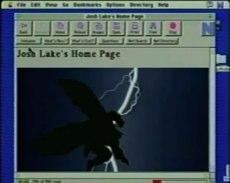
Josh Lake’s awesome homepage. Dig that big blue throbber on Netscape 1.0.

A breathless 3rd grader checks her email before learning about “Netscaping and writing our own homepages.”


Searching Webcrawler in Netscape 2.0.

The Clinton-era Whitehouse homepage in Netscape 1.0.


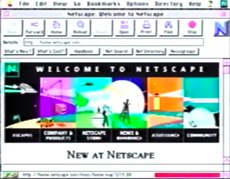
The sexy Netscape homepage, with interlaced GIF banner.

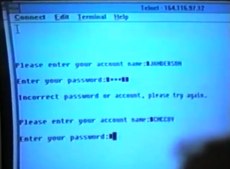
Telnet in Windows 3.1. The only PC in this video.


A pile of US Robotics modems jammed into holes in a cardboard box for dial-in network access.

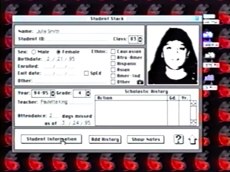
Mildly-creepy student profiling application.


IP address as official URL. Charming!


8 Comments

Abort, Retry, or EPIC FAIL


“This is not language. This chart is a fucking lie.”
Anil Dash, Battledecks 2008

A few years ago, I wrote an entry about knee-jerk contrarians on the Internet: those delightful people who find fault in anything and everything, dismissing months or years of work with a few words.

This is nothing new. It’s as old as communication itself. I’m sure that the moment man discovered fire, there was some guy nearby saying, “Too smoky. Can burn you. Lame.”

In the modern age, we’ve found a much more efficient way to express disdain, distilled into only four letters: FAIL. This usage as a standalone interjection has been around for years, since at least 2003, but its recent explosion in popularity comes from 4chan and the Lolcats memes. Dedicated blogs like FAIL Blog, Shipment of FAIL and Fail Dogs further spread the meme.

On Twitter, the conservation of space combined with a meme-savvy audience creates a perfect storm for spreading FAIL. With only 140 characters, it’s not surprising that people have taken to using this often as a shorthand for longer criticism.

Here’s a recent example from Chris Messina (who hopefully won’t mind me picking on him):

factoryjoe: @skitch Nice Twitter + Email integration, but where’s the OAuth?? FAIL!

Obviously, Chris adores Skitch. It’s the best screenshot application ever made, he uses it constantly, and evangelized it to friends (I found out about it from him, in fact). I’m sure he intended it as a gentle ribbing, but the message is pretty straightforward: Skitch has failed because it doesn’t support an emerging standard he feels strongly about. Pretend you’re one of the Skitch developers, and compare the original to this slight reworking:

@skitch Nice Twitter + Email integration! I’d love OAuth support, too.

Part of the problem is that “FAIL” implies objective truth, when it’s just your personal opinion. Tantek Çelik pointed out that, in LOLspeak, “DO NOT WANT” would be more appropriate since it clearly conveys a personal opinion.

I know many people who make stuff for the web, all of them very passionate about what they do. And every time I see a “FAIL” assigned to their work, it makes me sad. Yes, I know you’re trying to be funny. But I’m starting to see a trend away from the funny, and towards the angry, bitchy, or mean. So please, mind yer words.</missmanners>

24 Hours of FAIL on Twitter

The following is a small sampling of tweets mentioning “fail,” pulled from this Tweetscan search. Among the failures in the last day or so: Twitter, Facebook, Skype, Gmail, and Scrubs.

petroldarling: Oh my god. Metrotransit’s website is made of fail. In reality, the 84 stopped running an HOUR AGO. Now I am stuck in Midway.

nikete: facebook lacks a way to search the messages in your inbox. FAIL

jremsikjr: hulu.com FAIL! They cut out of full screen video to take me to the sponsors website at a commercial break 🙁

DjDATZ: skype = fail.

madpilot: Paypal development sandbox allows you to send payments to accounts that don’t exist. FAIL

93octane: top chef dumbass can’t follow directions. FAIL

rv510: San Francisco protest —–> FAIL

boyafraid: Twitter is currently looking broken. Word wrap/line breaking has experienced epic FAIL.

CocoaSamurai: I can’t rent “I am Legend”? iTMS FAIL

AndrewTerry: YouTube on iPod Touch; wotta lotta fail….

jkestr: you would think a movie called blackjack would come out on the 21st rather then the 28th. Marketing dept: fail.

nrturner: Safari 3.1 is *still* using the blue ‘RSS’ icon that looks like ‘ass’ in the address bar. Fail!

montythestrange: Google Mail spam filter in EPIC FAIL mode again.

px: BofA is really good at sales I suppose. But when it comes to training their employees in regards to the issues I am facing they FAIL.

rob_ballou: not allowing symbols in passwords = FAIL

sambrown: Billings only uses my System Preferences currency settings? I can’t change it per project? What a waste of time that was. *sigh* Major Fail.

aeoth: Oh I’m loving VicLink today. I want croydon -> mt waverley, it gives me Scorsby -> mt w. NOT EVEN CLOSE. EPIC FAIL

bobthecow: kronos webapp standards compliance FAIL.

tdcool: UK broadband = fail

ferhr: Used a 15 year old /usr/share/X11 over a 2007 one. Total FAIL. Gnome/gtk is really a fragile piece of software.

Pistachio: Oh FAIL. Quickbooks online does not run on a mac. MUAH, Quicken. I love you too.

ourfounder: Valve software requires you to update your warez very very slowly before you delete them. “Fail!”

dosminos: Friday Night Lights pilot – win, Scrubs pilot – fail. Supernatural and One Tree Hill pilots – maybe.

mjjames: Visual studio doesnt use jsdoc it uses its xml way. Fail

stevefleischer: very hazy and smoggy in HK today. Air has an orangy tinge to it. Mainland fatctories EPIC FAIL.

muffinresearch: No seats what a pile of FAIL

ndw: The Scala beginner’s guide is a PDF? FAIL

knufflebunneh: I have a prediction for 2008: you fail.

61 Comments

"Hot Hot Sex" Video Removed from YouTube

After weeks of criticism from YouTube commenters, the creator of the popular fan-made “Music Is My Hot Hot Sex” video finally pulled it offline. (It’s still mirrored here.)

On March 7, YouTube administrators removed it from its #1 spot on the rankings while they investigated it. Apparently, no foul play was detected and it was reinstated. Stephen Hutcheon from the Sydney Morning Herald has more on the story, including a screenshot from the leaderboard on the day it was removed.

It’s hard to get a sense of the scale, which roused suspicions in the first place. To put it in perspective, in the seven days from March 7-13, the CSS video gained 17 million new views. That’s more views than this week’s top 20 videos received, combined.

In one week, the CSS video got nearly as many views as the insanely huge Crank That (Souljah Boy) received in 7 months. It was six times as popular as Mariah Carey’s new video, in half the time. More popular in a week than the all-time views for Amy Winehouse’s “Rehab,” Tay Zonday’s “Chocolate Rain” or Chris Crocker’s “Leave Britney Alone.”

Assuming YouTube’s numbers are accurate, what was the mystery source of traffic? Now that the video is gone, I don’t think we’ll ever know. There have been a number of theories, but none of them really pan out.

  • Popular search terms like “hot sex” and “obama.” Unlikely, since the video never ranked well with those queries. Searching for “sex” or “hot sex” didn’t return the video anywhere in the top 100 results.
  • Social network embeds. It’s still possible that there’s a single source of traffic from an embedded video on an extraordinarily popular website on autoplay. If so, it’s managed to evade YouTube’s referral tracking, while still getting counted in views.
  • Leaderboard traffic. Once in the top 10, could traffic have snowballed from people clicking from the all-time most viewed page? No, since the video gained an additional 25 million views in the week it was removed from the leaderboard. Also, other videos in the top 5 only saw a small fraction of the growth.
  • Chinese users. Someone noted that Chinese users watch YouTube, but won’t (or can’t) sign in to rate/review/comment. Could they be coming from China?
  • Buzz from the iPod Touch ad. That might make sense in the days following the original commercial’s release last October, but the video’s growth was highest in the last two months.

Rajeev Kadam from Divinity Metrics, a company that provides video metrics for media companies, got in touch with me and provided these historical stats for the CSS video for the last five weeks. Here’s a chart of that data, or you can see the spreadsheet.

Philip Rogosky asked Clarus Bartel why he removed the video. Clarus reminded Philip that he’d contemplated deleting it before, but his friends advised him to wait to see if it would reappear on the leaderboard, clearing his reputation. At that point, he decided to delete it only because of the critical comments he was receiving on his other videos.

Asked how he felt when he pressed “delete,” Bartel responded, “Sad but relieved! If only I’d earned a buck or two or a job offer, I’d feel different today.”

9 Comments

Internet Power, Volume 1: Flashback to the VHS-Era Web

Lately, I’ve started collecting old VHS tapes about the Internet from the early- to mid-1990s. While most of these are pretty corny — think Gabe and Max’s Internet Thing — they also inadvertently captured pieces of the web that don’t exist anywhere else. The Internet Archive’s earliest snapshots were in late 1996, so anything before that is extremely sparse. The videos, silly as they are, still represent valuable documentation of the early web.

I spent most of the day yesterday working on a workflow to digitize VHS tapes, settling on VCR to MiniDV camera my Macbook Pro with Firewire. These tapes are pretty worn, so the quality’s not great, but that almost adds to their charm.

Here’s the result: the first volume of a two-tape collection called “Internet Power!” from 1995. I’ve included some select quotes and screenshots below.

Internet Power – Discover the World of Online Entertainment (00:36)
“The explosive growth in the number of people who have discovered the power of the Internet for learning, marketing and just plain having fun has been incredible. The Internet is changing the way we learn, work, and play forever. Today, some 35 to 40 million people from around the world are linked together through the Internet, the world’s largest computer network. Students of all ages are discovering the online power of the Internet as the ultimate tool for learning. Whether you’re in grade school or college or beyond, or you just want to be entertained and have a good time, the Internet has something for everyone.”

I love the Windows 3.1 references, and that they used 8-Ball Pool for Windows to demonstrate the power of the Internet.
“But before we go too far, let’s take a moment and have a look at just what the Internet is and what it takes to start surfing through Cyberspace. You may already be a net surfer and you may want to skip this section, but if you’re just starting out, we suggest you spend a few minutes getting familiar with some of the most common Internet terms.”

Dig that mid-1990s design aesthetic. Grey background, huge 3D rendered header graphic, Times New Roman italic, centered text… It’s 1995, all right.

“You’ll need a device to access the online world. That device is a Computer, with at least 386 power and 8 megabytes of RAM and has a modem installed that has 14.4 or greater speed or ‘baud rate.’ And of course, access to a phone line. If you have a slower modem, you will not be able to enjoy the growing multimedia aspects of the Internet, such as graphics, sound, and video.”
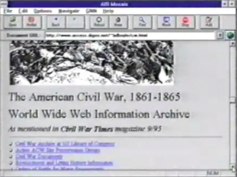
“You will also need a connection to the Internet that connects your computer to the millions of other computers that make up this Superhighway of Information.”

A number of vintage ISPs and screenshots are included, followed by an interview with a Microsoft tech named Bret Arsenault. Bret’s the only person interviewed in the video, as the resident expert.

“Any of the online services, such as America Online, will provide you with a connection to the Internet, along with a navigation tool called a Browser which enables you to move from location to location anywhere in the world.”

The browser pictured is AIR Mosaic, provided with Spry’s Internet in a Box.
“Parents concerned about unwanted content may want to sign up with a major online service where you can be assured that their own content is filtered, and then have your child advise you when they’re going directly onto the World Wide Web and provide parental supervision as required. There are software packages in development that will assist parents in locking out unwanted Internet content in the future.”

“The Internet has been around since the 1960s, but it was the development of the Mosaic browser in 1933 at the University of Illinois that made it possible to simply point and click your way to information that not only contained text, but also graphics. Now the average person can enjoy the full potential of the Internet, and especially, the fastest-growing part of the Internet called the World Wide Web.”

Yes, he said 1933. Apparently, the launch of Mosaic ushered in the Great Depression. Some nice shots of the original Smithsonian site, and a basic explanation of the Web by Arsenault and the narrator. How did you describe the Web in 1995?
“A Web site is like a book that is divided into chapters. By clicking on the hypertext links, you choose which pages you want to view in the book. A Home Page is like the first page of the book, with a Table of Contents and general introduction into what is contained in the site.”

Next comes a brief introduction to domain names, FTP, Usenet, Gopher, and email, before launching into the next section: Search Engines.

“When it comes to fun and entertainment, the power of the Internet is unlimited!”

Search Engines (08:04)
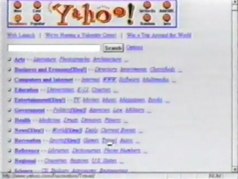
“To get started, we have to sift through the vast amounts of information on the Internet and find what we need. The best way to do this is by using one of the many Search Engines available. These sites gather the information that is out there and categorize it so we can narrow our search. One popular site to do this is called Yahoo!”

The list of search engines on the slide is a great flashback. “Web Crawler, Lycos, Einet, WWW Worm, Yahoo, Info Seek, Savvy Search… and More”

“Normally, these sites would take a few seconds to load to your computer, but in the interest of time, we’re cutting to them through editing for the purposes of this video.”

Later, they cover a long-lost site called “The Weatherman,” where you email your trip profile and a nice guy named George Gatto emails you a weather forecast by hand. I can’t imagine that’d scale very well.

Gopher (12:04)

“Gophers can be a one-stop source for finding information on the Internet. This particular site has many categories to choose from. Let’s keep our same subject, weather, to see how this differs from our Yahoo! search.”

Shopping (13:20)
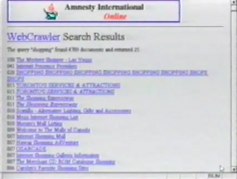
“The Internet has thousands of sites for shopping and many of them are grouped together in large Internet Malls… Let’s try a different search engine this time. We’ll use another popular one called Webcrawler.”

“Let’s choose one… The Mega Internet Shopping List sounds promising!”

I could go on all night. Later, they cover Online Games (16:36) and Online Entertainment (20:42), but the Online Magazines section (25:35) is my favorite, with screengrabs of Hotwired, Nintendo Power, and the craziest sitemap ever from a very early Time.com.

“You’ve got a lot of exploring to do, so surf wisely and have a great time!”

URL Addresses for Websites We Visited (27:35)

The Smithsonian, http://www.si.edu/

The Discovery Channel Online, http://www.discovery.com

The Weatherman, http://pixi.com/~gattoga/index.html

The Rock & Roll Hall of Fame Online, http://rockhall.com

Hollywood Online, http://www.hollywood.com

America Online, http://www.aol.com

Yahoo!, http://www.yahoo.com

The Internet Mall, http://www.mecklerweb.com:80/imall

The Toystore, http://www.toystore.com

Nintendo of America Online, http://www.nintendo.com

Happy Puppy Game Site, http://www.happypuppy.com

3D Riddler, http://cvs.anu.edu.au/andy/rid/riddle.html

CBS, http://www.cbs.com

NBC, http://www.nbc.com

PBS, http://www.pbs.com

ESPN, http://www.espnet.sportszone.com

Hotwired, http://www.hotwired.com

Time, http://www.timeinc.com

Price Costco Online, http://www.pricecostco.com

Credits (28:15)

Where are they now? Paul Barnett was Internet Power’s executive producer and it was produced, directed, and edited by Steve Ducharme — they later co-founded another company, the Internet broadcaster iShow. Bret Arsenault, originally an “Architectural Engineer, Internet Technology,” is now Microsoft’s Chief Security Advisor. (Here’s a recent webcast featuring Bret.)

Fun with VHS

Now that I’ve nailed the workflow, I’m going to be digitizing more of my collection. If you have any other classic Internet goodness locked up on VHS, get in touch. I’ll happily put it online for you.

39 Comments

Worst Website Ever, Redux

Yesterday’s Worst Website Ever session was standing-room only and judging from the response, it was a hit.

Once I can get a copy of the audio from the talk, I’ll upload a screencast of the entire session with the original slides. Until then, here are the descriptions of each pitch.

Jeffery Bennett, Image Search for the Blind

Image search is fundamentally broken, only allowing sighted people to use it for entertainment and research. But what about those who can’t see? Jeffery shows how harnessing the collective vision of users can describe and annotate images for use by the blind.

Michael Buffington, Pressca.st

Bloggers have been used as a powerful promotional tool, but finding bloggers willing to sell themselves out for cash takes too long! Michael demonstrates a better way that combines the worst of Amazon’s Mechanical Turk and PayPerPost. Upload your press release, deposit funds with Paypal, and Turkers around the globe will instantly blog about your crappy product for pennies on the dollar. Evil!

Ben Brown & Katie Spence, Happy Net Box

Facebook broke new ground in allowing developers to create applications for their website, and the OpenSocial effort took it to the next level by allowing anyone to embed applications anywhere. Ben & Katie propose a groundbreaking new open platform: allowing developers to embed the entire Internet in your webpage with a single line of code. Don’t settle for a single application — embed the whole damn thing.

David Friedman, PeopleIPO

Take yourself public with an Individual Public Offering through PeopleIPO, allowing anyone to buy or sell shares in you! Watch as your personal life events affect your stock price, but be careful not to sell a majority stake in yourself — or you might become a slave to your shareholders.

Lia Bulaong, Sickr

The social network for contagious diseases, where online communities go viral. See who’s spread chlamydia, clap, or the common cold to their social network using a convenient Facebook badge, or just try to get to the top of the leaderboard with poor hygiene and/or risky sex. Fun for the whole family!

Merlin Mann, FlockdUp

FlockdUp.com is a best-of-breed hosted solution for networking Thought Leaders. Our Enterprise-class suite of tools empowers Topic Experts, Blog Consultants, Marketing Minds, and Social Mediapreneurs to tag, profile, remix, mash-up, *and* monetize every person that they know (or claim to know — we’re not here to judge). We understand that your career is hard to explain, and most people wouldn’t understand it anyway. That’s why FlockdUp does the heavy lifting with robust, integrated applications for connecting you directly to the thousands of enterprising mavericks whose email addresses you’ve collected. That’s right: Leading with Thoughts(tm). Sign-up today for very limited, private pre-Alpha at FlockdUp.com.

Lane Becker, MMOmmerce

The next generation of shopping, from the comfort of your very own fully immersive fantasy universe. Think Kozmo meets World of Warcraft: from clicks and mortar to clicks and Mordor, rampant consumerism becomes rampaging consumerism. All without leaving your desk!

The winner, as decided by guest VC/judge David Hornik, was Merlin Mann’s FlockdUp, followed closely by Jeffery Bennett’s Image Search for the Blind. Here’s a video of Merlin’s talk, courtesy of Roo Reynolds. Thank you so much to all the presenters and everybody who attended.

April 15: Jeffery Bennett’s footage from the audience is now available on Vimeo. I’m waiting for the official podcast audio from SXSW, and I’ll edit together a presentation with the original slides.

8 Comments

Interview with the creator of YouTube's new #1 video

While researching the meteoric rise of the fan-made Hot Hot Sex video to the top of YouTube’s charts, I tried to get in touch with its creator, Italian writer Clarus Bartel.

I sent him a message through his Flickr account, but he responded that he didn’t speak English, so I asked Philip Rogosky to do the honors. Here’s the first published interview with Clarus Bartel about his #1 video.

Translated from Italian

It all started with the Qoob music channel’s video contest. I didn’t participate in the contest, I just downloaded the footage in order to edit it and I added a different track. I cut out some scenes where they were singing, added some effects to the background, and then I uploaded it to YouTube.

Never would I have imagined that such an ugly video, made on a whim, would make it to the top of the charts. Believe me, even taking the iPod commercial effect into account, nothing can explain the absurd number of views. I get constant messages accusing me of being a hacker, when i barely know how to turn a computer on and off. Some people call me a genius, because I beat the system. Everyone is free to imagine me as they choose, however they prefer. Like the kid from Rome who keeps writing me because he’s convinced it’s all some kind of conspiracy!

The discrepancy between the number of comments and the views has to do with the fact that I’m deleting hundreds of insults I receive every day. But for the rest of this absurd occurrence, I have no explanation. I have as much of a clue as you do!

His original response:

Tutto nasce da un “Video Contest” del canale musicale QOOB Io no ho partecipato al concorso, ho solo scaricato le sequenze per il montaggio inserendo un’altra canzone. Ho fatto dei tagli eliminando le scene in cui cantavano, poi ho aggiunto qualche effetto per lo sfondo e di seguito ho inserito il video su youtube. Mai mi sarei aspettato che un video così orribile e creato in un momento di svago, arrivasse al numero uno della classifica.

Credimi, anche se fosse stato aiutato dalla pubblicità dell’Ipod, questo non spiega il suo impressionante numero di visualizzazioni. Mi arrivano continuamente messaggi di accuse perchè vengo scambiato per un Hacker, io che a malapena so accendere e spegnere il Computer. Alcuni pensano che io sia un genio che ha fregato il sistema. Ognuno mi vede è mi immagina come vuole, a suo piacimente, come quel ragazzo di Roma che mi scrive continuamente e che crede in una cospirazione!

La discrepanza del numero dei commenti e il numero di visualizzazioni e dovuto al fatto che ogni giorno devo cancellare un centinaio di insulti indirizzati a me.

Il resto di questa assurda vicenda non so spiegarla.

Ne so quanto te!

Strangeness

He definitely seems sincere. Though I still don’t believe that the video’s been viewed 4.2 million times in the last 24 hours, I doubt that he had anything to do with it. (This Google cache from 1am yesterday showed 84,883,762 views. At the time I published my post early this morning, it was at 89,174,590.) That growth seems extremely unlikely for a video that’s been around for 11 months, but who knows? It’s always possible that 65% of Brazil’s broadband users viewed it yesterday, but I doubt it.

Also, I noticed Clarus disabled ratings on the video this morning. This makes it difficult to discover how many ratings he’s received, which I can’t help but wonder about. I can understand why someone would turn off comments (moderating them can be a nightmare), but why turn off ratings? I can only think of two reasons why someone would turn off ratings: they’re unhappy with the ratings they’re receiving, or they don’t want the rating counts tracked.

Update: In a followup email, Clarus confirms that he disabled ratings by mistake, and he’ll turn them back on once YouTube ends their maintenance period tonight. Here’s the second part of the interview, translated into English:

What do you do for a living? Some of your photos are very good.

Thanks so much for your appreciation of my photos! I make my livelihood working in a factory. In my free time I listen to music, watch movies, and I take photos. For fun, I recut films and music videos, re-editing my versions.

You’ve been adding and removing references to Barack Obama in the CSS video title and description. Why?

I took advantage of the video’s visibility and added in “Vote Obama” because, even though I’m Italian, I’m following the American primaries closely and I hope to see an African-American in the White House.

I deleted the phrase because the primary voting is suspended for the moment. If, when another vote comes up, the video is still there at its rank, I’ll continue my support for Obama, adding the phrase back in if necessary.

When did you decide to turn off ratings?

I read the article on Waxy.org. I see there are still (legitimate) doubts about me. I disabled ratings by mistake, and only noticed late because for a while there YouTube was doing maintenance.

It bothers me to see that in this article, I’m passed off as a hacker.

Before disabling comments there had been 486 of them in 5 or 6 hours, almost all of them with the usual accusations of hacking, and some with variations such as black bastard, gay bastard, Brasilian bastard, and similar crap.

I started to seriously consider deleting this goddamned video, when finally this article came to my rescue, calming me down some (unless my crappy translation is fooling me).

Thank you, Clarus!

9 Comments

New Video Overtakes "Evolution of Dance" for #1 Spot on YouTube

Yesterday, YouTube refreshed their leaderboards and a strange new video became the Most Viewed Video of All-Time, topping the world-famous Evolution of Dance video. With 89 million views, the new winner is a fan-made music video. But did it get there legitimately?

In early 2007, a popular Italian music community called Qoob.tv announced a contest for the Brazilian band CSS, in which fans could remix green-screen footage created by the band to create their own video for their song “Alcohol.” Instead, an Italian music blogger and photographer named Clarus Bartel remixed the “Alcohol” footage for a different song, Music Is My Hot Hot Sex, the song made famous by the iPod Touch ad. Update: See our interview with the video’s creator.

Since he uploaded the video to YouTube, it’s accumulated a staggering 89 million views, at an average 265,500 views per day. (Though, as you’ll see below, most of those viewers were in the last two months.) Not only would this make his video the most-viewed of all time, defeating runner-up The Evolution of Dance by over 12 million views, but it’s also added more views-per-day than any video but Britney’s latest single.

The commenters on the CSS video are baffled, many of them accusing foul play. I decided to look into it, to see if there was a method to determine if the number of views were somehow false.

One method of detecting suspicious view counts on YouTube would be to compare the ratio of social activity to the view count. If the number of ratings, comments, and favorites are much lower than other videos with similar views, then it’s possible that the numbers have been artificially inflated.

Using the YouTube API, I retrieved statistics for the top 500 videos. I chose to compare the number of ratings, because comments can be turned off or removed by video owners and the number of favorites was unavailable in the API. The spreadsheet is below.

Continue reading (350 words) ⇢ 26 Comments

Worst Website Ever at SXSW Interactive

If you’re going to be in Austin this weekend for SXSW Interactive, you should come to “Worst Website Ever,” the session I’m leading on Saturday 5pm. Eight smart people will be proposing their worst possible web startup ideas in short 5-minute presentations, punctuated by questions and heckling by yours truly.

When it comes to geek conferences, I’m not a huge fan of panels and I have a very short attention span. So I proposed something unorthodox, and the voters apparently liked it. (With ten people speaking, I’m pretty sure this is the largest SXSW session ever.)

The speakers are some of the most interesting and/or talented people I know: Lane Becker, Jeffery Bennett, Ben Brown, Katie Spence, Michael Buffington, Lia Bulaong, David Friedman, and Merlin Mann. I’ll be playing ringmaster and badass MC, accompanied by August Capital’s David Hornik as honorary judge.

Did I mention it’s not a panel?

As for the rest of SXSW, my picks for daytime programming at the Interactive/Film conference are on Sched.org, and you’ll find many more unofficial parties and gatherings on Upcoming (mine here). Naturally, you can stalk me on Twitter. If you see me, say hi. Don’t be shy, life’s too short.

I’ll see you in Austin.

3 Comments

Joni Mitchell’s “The Hissing of Summer Lawns” Demos

I’m working on a couple larger projects at the moment which I should be able to announce soon, but in the meantime, I wanted to share a very rare recording I found on Big O Magazine’s always-excellent ROIO of the Week (Recordings of Indeterminate Origin).

These are the unreleased demos from Joni Mitchell’s The Hissing of Summer Lawns, one of my favorite albums ever. Unlike the lush arrangements found on the album, these early versions are stripped down to only piano, and acoustic guitar. It’s like Hissing of Summer Lawns in the style of Blue or For the Roses. At the time of its 1975 release, The Hissing of Summer Lawns was panned by critics unhappy with her shift towards jazz/folk/rock fusion. I doubt they would’ve complained if these demos were the final cuts.

The Seeding of Summer Lawns

01. Harry’s House/Centerpiece
02. Edith and the Kingpin
03. In France They Kiss on Main Street
04. Sweet Bird
05. Shade of Scarlett Conquering
06. Shadows and Light
07. Dreamland (later released on Don Juan’s Reckless Daughter)
08. The Boho Dance
09. Hunter (unreleased demo from Blue sessions)

As I mentioned, I found these on Big O Zine. That site is an odd cookie, the web presence of a long-running music magazine in Singapore with no less than four active domain names that redirect to each other in strange ways. The navigation is obscure and each page on the massive site is created manually in Dreamweaver, so it feels like a throwback to online zines from the mid-1990s. There’s no homepage for the ROIO of the Week, so your best bet is finding the most recent ROIO of the Week on the homepage and skimming the hand-edited list of archives from there.

But man, what a resource. Not confining themselves to just live bootlegs, Big O posts demos, alternate studio sessions, and other extreme rarities from classic and current artists. (For example, Steely Dan’s Royal Scam Outtakes, Emmylou Harris’ Wrecking Ball outtakes, Barry Gibb’s unreleased 1970 album, Jeff Buckley’s Grace outtakes, and Janis Joplin’s 1964 audition tapes.) But you need to be quick: they’re usually removed within a week or two. The Joni bootleg was removed from their site, but this is so great, I’m giving it a permanent home so it can be heard by a wider audience.

Update: I’ve updated the links to point to this playlist of fan-remastered versions on YouTube.

27 Comments

Santa Monica Farmer's Market, a First-Person Narrative

It’s almost been five years since the Santa Monica Farmer’s Market tragedy, when an 86-year-old man accidentally took the lives of ten unsuspecting people with his burgundy Buick LeSabre. I was there, and documented the aftermath in real-time.

This morning, at around 2am, I received an anonymous comment on that entry from someone who survived. It’s a haunting glimpse into the experience of cheating death.

From: vancouverite

When it’s not your day to die, it’s just not your day to die.

I was there that day. Right there. My son was less than a year old at the time and it was a rarity that he and his father stayed home that day, they’d normally be rushing me along impatiently.

So I was dawdling, perusing the lovely organic greens and the beautiful melons, working my way up one side of the street stalls and back down the other.

I am only alive because at that moment, I was looking at Meyer lemons instead of arugula.

It started with a loud, continuous screeching/scraping noise, and then loud boombangs (the screeching turned out to be the upright poles of the display tents and the tables being dragged across the road surface, the bangs being those structures falling).

A young couple standing next to me at the lemons stand joined me in glancing up the street towards the growing cacophony that was heading our way. He gently moved in front of her, shielding her with his body instinctively as the disaster careened mere inches from us. We were so close I’m sure I could have touched the vehicle if I reached my arm out.

My first and only thought was to get home to my child as fast as I possibly could, everything else was suspended in time. I realized I had never let go of my 4 bags of produce. I looked down and saw red smeared on my legs. It seemed to be a combination of strawberries, raspberries, tomato and perhaps blood.

One minute I remember feeling jealous of a pretty slim girl with Manolo mules on talking on her cell phone. I can clearly remember seeing one of those perfect shoes lying sideways in the middle of the road with no idea where its wearer was who was right in front of me just a moment ago.

I remember the middle-aged black woman, separated from her teen daughter, distraught and focussed simultaneously as only a mother can be. I’ll never forget the raw sound of relief she uttered as she found and embraced her daughter a few moments later.

Worst of all, I remember being so close to him in his car, I could see the bodies, one under, one on the hood, and the utter chaos moving along in slow motion. The image of his face with his glasses askew will haunt me for the rest of my life. I could have sworn he looked right at me, he wasn’t even looking forward through the smashed windshield.

I remember the man running after the car crying and yelling “he just killed my wife”.

Just today, the accident invaded my life again. As I drove back to my downtown office this afternoon, the pedestrian traffic was quite heavy, and I thought to myself, as I have now and again since that day, “I know exactly what it would look and sound and be like if someone were to just plow through these people”.

I think about everyone that was there that day and have often wished for just one chance to get together to share our compartmentalized grief, to tell our stories, and to comfort one another in a way noone else can.

4 Comments

Greetings from 1993!

Excerpt of a letter sent to a grade-school friend in September 1993. I was 16.

I got a new computer...an IBM 386. It's a beauty of a computer, but I sunk all of my money into it and my parents still had to help pay it off... It has an 80 meg Hard Drive, a Super VGA card (not a monitor though, still stuck with VGA...), a brand new keyboard and mouse, 4 megs expanded memory, a High Density 3.5" and 5 1/4" drive. Cost about $800 but it was worth it. I consider it an investment for college. I plan to major in Computer Science in college with maybe a Psychology minor.

Have you ever heard of Virtual Reality? Of course you have... If by some odd chance you haven't, take a look into it. I'm telling you, it WILL be bigger than TV. I hope to get into it as soon as I can. Come to think of it, you should too.

This is the danger of keeping a digital record of everything you’ve ever written.

18 Comments

ForumWarz Postmortem: Interviewing the Game's Creators

ForumWarz is my newest obsession, a web-based game like nothing I’ve ever played. In short, it’s a parody of Internet culture in the form of a real-time role-playing game. You play as one of three Internet archetypes — the camwhore, emo kid, or troll — and try to disrupt message boards any way you can, using your sexuality, bad poetry, cross-site scripting attacks, or simply banging your head on the keyboard. In the process, you’ll meet a large cast of strange characters who will send you on missions in a very funny microcosm of the Internet.

Among those parodied: Furries, Google, script kiddies, Boing Boing, Apple Computer, ricers, 4chan, Ron Paul, gamers, Bill O’Reilly, Tubgirl, otaku, and the Church of Scientology. Also, it’s almost certainly the only game to include a text-adventure minigame based on R. Kelly’s “Trapped in the Closet.” This game isn’t for everyone.

Before reading any further, I’d highly recommend trying the first two or three levels. Warning: If you’re easily offended, this game is not for you. And don’t worry about getting stuck with the Jimmy character during the tutorial; you get to choose a username, avatar, and class when you hit level 2.

Continue reading (4,500 words) ⇢ 11 Comments

Still Alive at the Valve Party

At the risk of turning Waxy into a Jonathan Coulton fan site, he performed a short set at the Valve Software’s Steam Party capped by a finale of “Still Alive” performed on Rock Band, backed by the Harmonix developers on guitar and drums.

JoCo covers himself on Rock Band

I’m pretty sure this is the only published photo of their final score, a 5-star performance:

Jonathan Coulton's final score, backed by the Harmonix team

And yes, Coulton sang his own song on “Easy.” (Afterwards, he said the Harmonix guys lowered the difficulty because thought the crowd noise would mess it up.)

Shortly after the set, I saw a tipsy geek hop on stage to copy the unreleased song from the Xbox 360 with a USB key before a Harmonix team member tackled him. I discovered he wrote up the story this morning, which was a fun read.