
Improv Anywhere's Best Little League Game Ever
— hopefully, they managed to avoid post-gig bitterness #Pitchfork.tv goes live
— still beta and an awkward UI, but some great exclusive video including the full-length Pixies reunion documentary via Fimoculous #Ten Thousand Cents
— Mechanical Turkers reconstruct a $100 bill using custom drawing tools for 1 cent per drawing via Nelson Minar #Imageshack launches free BitTorrent downloading service
— for people who can’t run BT or limited by their ISP, this sounds great #The Making of the Flagpole Sitta lip dub
— Jakob made it look effortless, with quite a bit of planning #Infochimps, insane collection of open datasets
— subscribe to their blog, which tracks new data as its added #Charles Manson's 2005 album released under Creative Commons license
— how does a 73-year-old man who’s never used a computer hear about CC? via Boing Boing #Adrian Holovaty's jazz acoustic remix of Radiohead's "Nude"
— current ranked #35 out of 423 remixes #South Park meets the Internet Stars
— takes on Tay Zonday, Tron guy, Chris Crocker, Afro-Ninja, SWK, Dramatic Chipmunk, Numa Numa, and more #Internet Power Volume 2: Education
Earlier today, I received an email from Steve Ducharme, the producer/director of the Internet Power series that I digitized last month. “I produced, edited and narrated that video many years ago,” he wrote. “Thanks for digging it out. I haven’t seen it in years. We really have come a long way since then.”
In the comments, several people pointed out a noticeable mistake in the video in which the narrator claims Mosaic was developed in 1934. As it turns out, this was fixed in later editions. “I actually came out with a corrected version of that tape,” said Ducharme. “In a later version, it was changed to the correct year of 1936. (Kidding, of course, 1993.)”
He also gives some insight into how hard it was to capture video in the early ’90s. “We had to rent this gigantic VGA to NTSC converter for about $500 a day to capture those screens,” said Ducharme. “It was huge, had to be rolled in and had an operator to work it. Must go now. Am feeling old. Thanks again.”
Thanks for the info, Steve! And with that, it’s on to Volume 2…
Internet Power Volume 2: Discover the World of Online Education
“Many people believe that the Internet will have the same impact on society as the invention of the printing press did! It will change our world dramatically by making vast amounts of information available to everyone worldwide… if you know how to use it!”
With those breathless words, we start the second volume of Internet Power, the video tutorial series about the Internet from 1995. While the last episode focused on Entertainment, this one teaches you about Education — museums, libraries, and other research tools.
It’s very similar to the first episode with an almost-identical structure, but focusing on a new set of vintage websites. Microsoft’s Bret Arsenault appears again, and they focus on Yahoo! again.
Highlights
 03:21. Using Yahoo circa 1995 to search for “civil war” sites. The results are in alphabetical order by category name, rather than any attempt at ordering by relevancy.
“We click on the hypertext link, the Civil War Gallery. The URL address for this site is hidden in the link and it automatically takes us to the Civil War Gallery.” Updated September 25, 1995!
05:55. “A reminder to you that clicking on links and moving from site to site usually will take a few seconds depending on the speed of your computer’s modem. For the purposes of this video, we are moving instantly to each screen with the help of video editing.”
06:30. Downloading a 1MB JPG from the Library of Congress and viewing it in ImageView for Windows.
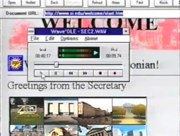
10:15. Listening to a WAV audio greeting from Michael Heyman, the Secretary of the Smithsonian Museum. 40 seconds of filler!
11:35. “This will get you started, but the best thing to do is follow the hypertext links. Explore the Internet and discover your own favorite sites. It’s kind of like going to a new city! The streets aren’t familiar at first, but after traveling around for a while you’ll discover your favorite places in the city that have the activities and interests you’re looking for.”
12:00. “The Internet has not forgotten about the children of the world.” I love this line.
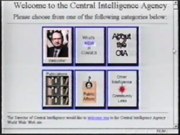 13:00. “This brings us to, of all places, the CIA Website. Don’t worry! It’s okay that we’re here. They keep their top-secret files someplace else.”
16:40. “Speaking of science projects, it’s pretty difficult going all the way through school without having to do a science project. If this is the case for you, there are ideas on the Internet if you look for them.”
20:20. Searching for tuition rates for the University of Washington. In 1994, $969 per quarter for full-time residents, $2,733 for non-residents. (Just for fun, I looked up the current rates. $2,129 for residents, $7,377 for non-residents.)
23:30. Browsing SPRY’s Gopher server, explaining how to download JPG files with Gopher.
25:50. “But if you really want to see the power of the Internet for doing research and finding information, just click on the folder ‘Libraries of the Internet.’ Now hold onto your hats and click the icon that says ‘Other Libraries around the US.’ Up comes over 100 libraries that you can click on and get even more information of all kinds.” He finally concludes, “Never again will you be able to use the excuse of ‘Gee, I just couldn’t make it to the library last night!'”
27:00. The big ending. “Not bad for 30 minutes, is it? We think you will agree after watching this video that the Internet will change the way we learn forever. Well, we’re off to our next website and we hope you enjoy the Internet as much as we do. Remember, in the next century, the person with the most information wins. Good luck on your journey, surf wisely, and have a great time!”
URL Addresses for Websites We Visited
Here’s a list of the URLs mentioned in the credits.
Smithsonian, http://www.si.edu
Virtual Science and Math Fair, http://www.educ.wsu.edu/fair_95 (misspelled as www.educ.wsu)
KidsWeb, http://www.npac.syr.edu:80/textbook/kidsweb
Yahoo!, http://www.yahoo.com
Internet College Exchange, http://www.usmall.com/college
University of Washington, http://www.washington.edu
Midlink, http://longword.cs.ucf.edu/~midlink
Web 66, http://web66.coled.umn.edu/schools.html
Welcome to the Planets, http://stardust.jpl.nasa.gov/planets
Library of Congress, http://www.loc.gov (misspelled as www.loc/gov)
Civil War Photo Gallery, http://www.magibox.net/~civilwar/harper.html
Metafilter roundup of Paul Green's School of Rock videos
— these videos of kids rocking out brings joy into my heart #Hoefler & Frere-Jones' Estupido Espezial, a joke version of OCR-A with swashes
— even their joke typefaces get them paid via Kottke #Guncho, a multiplayer IF system based on Inform 7
— upload Inform code to create realms browsable by multiple people at once #Dropclock, Mac/Windows screensaver
— lovely slow-motion Helvetica dunking; also: animate movement based on wind activity in your town via subtraction.com #Game Neverending Relaunches
Just received word that Game Neverending is back online! This game was extremely innovative, but played by very few people during its limited beta test. One of the very first web-based MMOs, Game Neverending was eventually shut down as the Ludicorp team focused their efforts on Flickr.
Last year, Cal Henderson showed me an internal server running the original GNE code, but it wasn’t accessible outside the company intranet. Over the last year, Cal and Myles have ported the old ASP codebase to PHP, and it’s now live for anyone to play for the first time.
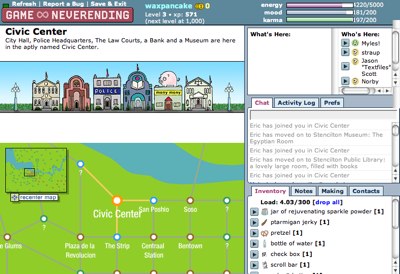
(You’ll need to be signed in to Flickr for the link to work.)
Here’s the April Fools-themed message that announced it publicly, a parody of Jerry Yang’s internal emails. More than an April 1 prank, I’ve been told that it’ll be around longer than today only but completely unsupported. Hooray!
Update: After much speculation, I’m happy to announce GNE is still alive on April 2. I spent all yesterday playing, got up to Level 7, built a lovely house in Fierov Heights, and had enough making points to build the final item of the game, a Game Neverending. Unfortunately, I was about $8 million short to buy the ingredients. (Stewart, Caterina, Ben, and five other Ludicorp employees must be purchased in the back room of a mash pub for $1M each.)
Everybody pooled their resources to buy the ingredients, and at about 8pm, a Game Neverending was created. We passed it around so everyone could hold it, and then handed it back to its creator so she could win the game. Screenshots here.
Update: GOD announced it’s shutting down in an hour (about 11am PST). As yeoz said, “GNE is a shared temporary hallucination.”
Aaand, it’s gone. I managed to send it off by winning the game in the last four minutes. I captured video of building the GNE and using it to win the game. Striatic also captured the last few minutes of the game.
BBC2's The Net, first episode from April 1994
“As computer technology becomes part of everyday life, a new program comes to BBC2 now: be you beginner, buff, or somewhere in between.”
Thanks to Martin Brewer, here’s the first episode of The Net, a documentary series that ran for four seasons from 1994 to 1998. Despite the name, this first episode has very little to do with the Internet. Instead, it’s an almost perfect video equivalent of the early Wired Magazine, covering a mish-mash of digital culture from video games to virtual reality.
This episode has five segments.
NYT's interactive tribute to the Mad Magazine fold-in
— the full article details Al Jaffee’s illustration process #home.mcom.com is back!
— a perfect snapshot of the Mosaic homepage from October 1994, thanks to JWZ #Dead Week
No entries this week. I’ve had a miserable flu since Sunday that’s made it impossible to think straight. I’ll see you Monday, Internet.