The Unified Theory of XOXO

Nearly three months have passed since XOXO, and I’m still digesting what happened in Portland on those warm September days.

The writeups on The Verge, Boing Boing, and Wired summed it nicely, and I did a big roundup of reactions from attendees and the press over on Kickstarter.

In case you couldn’t make it, we released the videos for every talk last week, over seven hours of video from 24 amazing speakers. There are too many great talks to mention, but personal highlights include Dan Harmon, Chris Poole, R. Stevens, Julia Nunes, and Adam Savage.

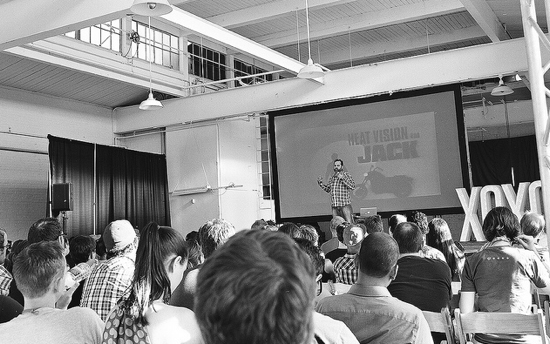
Here’s my opening talk from the conference portion of the festival, a quick ten minutes talking about what XOXO means and how it happened:

Last month, I was the opening talk at Farmhouse Conf in Los Angeles, attended Andy McMillan’s Build in Belfast, participated in the Open Internet Preservation Society at Mozilla Festival in London, and gave the closing talk at Beyond Tellerand in Düsseldorf.

At each event, I’ve started looking at them from a new perspective, hoping to learn what works and what to avoid, if we ever do XOXO again. A big event, like any startup, is a series of small decisions that roll up into a joyful or miserable user experience.

I’ve talked a bit about the philosophy behind XOXO and what we were hoping to accomplish — celebrating independent artists and hackers using tech to make a living doing what they love. But I haven’t talked at all about the logistics of running the festival, and all the decisions we made that made it unique.

After organizing Build for three years, XOXO was Andy McMillan’s fourth major event, but my first time organizing anything bigger than 50 people. From Build, Andy came equipped with concrete ideas about what makes a great conference. I didn’t have any experience running an event, but I’ve been to enough conferences to know what I like. Fortunately, we have very, very similar tastes.

Put simply, I designed the festival that I wanted to see in the world, with the hope that enough attendees shared my interests — if you care about the things I do, you probably had a great time at XOXO.

Speaking only for myself, here’s why I think XOXO worked and what we were trying to do.

Tone

XOXO was a snark-free zone, a reaction to the cynicism and knee-jerk contrarianism that’s so prevalent online. Playful, sincere, supportive, and meaningful. I wanted them to feel comfortable enough to approach strangers and make new friends. I never wanted them to feel like they were being marketed to. I wanted people to experience everything I love about Portland, have great food and drink, and never feel bored or confused. More than anything, we tried to optimize XOXO for fun.

During our opening comments, I took a moment to encourage everyone to approach people standing alone, or join groups of people they don’t know, knowing that everyone was supportive and nobody would be turned away. At the closing party, I heard self-described introverts tell me this guidance fundamentally changed their experience of a conference. They weren’t stumbling around alone anymore.

Curation

Curation is the most important factor of a great event. A clear editorial voice, a coherent theme, and who you invite to participate changes everything that comes after it — good curation brings great attendees, generates word-of-mouth, great press, and opens all kinds of doors.

Curation isn’t limited to just picking the speakers. In our case, it included the videogames and their designers in XOXO Arcade, the films and their directors at XOXO Film, the musicians in XOXO Music, every project featured in the Market and Hack Cafe, and all the local food carts on the street.

To get great speakers, you have to actively recruit them. For several speakers, XOXO was their first talk. Fortunately, designing the XOXO lineup got easier with each successive speaker, opening the doors to higher and higher profile people. By the time I approached Adam Savage, the lineup was already impressive. After we got Adam, signing on Dan Harmon was that much easier. But it was always a hustle, crafting and customizing the pitch for every single speaker — convincing them it was worth their time and effort for a first-time festival.
Location

The city, the venue, the neighborhood’s walkability, and the proximity to great restaurants and bars make the difference between an amazing event and a total slog. In many ways, the event is the location. Good events can succeed despite a bad location, but an amazing location can salvage even the most poorly-run event, giving attendees a memorable experience from the surrounding area alone.

It’s amazing to me how many conferences get this wrong, usually for convenience, cost, and capacity. Most commercial event spaces have no character at all, and are in less than ideal areas. Convention centers and hotel ballrooms are well-equipped for large events, but are universally awful places for a creative event.

We held XOXO in a historic two-story brick building in southeast Portland, formerly an industrial laundry converted into an arts space. It didn’t have a stage, lighting, sound, wifi, or bathrooms. But it had character, and it was in a perfect part of the city, with two great breweries within a half block and an awesome nightclub across the street, ideal for our opening party and music event.

So we built out all that infrastructure because it was worth it. And on top of that, we customized the venue for our needs, cracking open a long-defunct loading dock as our main entrance, constructing new stairs out to the street, and building a huge wooden deck for outdoor café seating in the parking lot.

It would’ve been way easier to just give up and use the Oregon Convention Center, with all of its creature comforts, but it has no soul. And every out-of-town attendee would leave thinking that Portland was like the area around the convention center.

We spent tons of money on all that stuff, but there’s no question it made a huge difference.

Talk Format

Panels are the best way to make four interesting people boring. They’re hard to prepare for, too much pressure to be interesting on the spot, and usually end up a meandering and unfocused conversation touching on a handful of topics. I hate them. Even with a strong moderator, I’d universally rather hear four short solo talks from each person than a four-person conversation. Why? Because preparing a solo talk forces the speaker to think carefully about what they want to say, conveying their message and meaning in a concise way.

As a result, the conference portion of XOXO was entirely solo talks, save for two interviews. I don’t love the interview format either, but logistical issues made an interview the best option for both. We made the best of it by getting amazing interviewers, each one an expert and accomplished speaker in their own right.

Another thing missing from XOXO: audience Q&A after talks. Opening up for audience questions is always a huge gamble, giving the captive attention of the entire room to a single audience member. That kind of free attention always seems to inspire the one douchebag in the audience to promote their website or try to impress the crowd with their rambling commentary on the subject. “This is more of an observation than a question…” Sit down, jackass.

One benefit of avoiding professional speakers is that they’re much more likely to actually attend the festival, instead of parachuting in and out for just another paying gig. All but one of XOXO’s speakers stayed for the entire festival. So, instead of Q&A, we encouraged attendees to go talk to speakers at the evening events and buy them beers. This worked really well. (Maybe too well, in the case of one speaker who showed up before his talk with an epic hangover.)

Single Track

Multiple tracks allow for more talks, more attendees, and more money. The drawback is that you’re dividing the attention of attendees and forcing speakers to compete against their peers.

By its nature, multiple-track conferences are forced to pit the most popular sessions at the same time as one another, so that attendees split fairly evenly and don’t flood any single room. The result is that attendees are forced to choose between multiple things they want to see, and you end up missing half of what you were hoping to see.

It also changes the shared experience, exposing attendees to ideas and people they may have not sought out on their own. At XOXO, every attendee heard the same speakers and could reflect on them together. I think this is a much better experience for everyone.

Commercialization

Conferences make money in two ways: ticket sales and sponsorship. Unlike journalism, many event organizers don’t have any qualms with mixing editorial and advertising.

It’s not uncommon for conferences to sell keynote talks, on-stage mentions, video interviews, blog posts, tweets, email blasts, and brochures distributed to every attendee. This is in addition to all the standard on-stage advertising, swag bag inserts, outdoor tents, vendor booths, and branded conference merchandise. Everything at a conference is for sale, including you.

XOXO took a different approach. Instead of sponsors, we had patrons that contributed to the event. What’s the difference? Our three patrons weren’t bidding for your attention — they wanted to make the event better, and they wanted to participate in it. We gave them passes to the event for their team, mentions in the guide and homepage, and that’s it. Wieden+Kennedy invited attendees to a party on their roof. Mailchimp quietly picked up the bar tab at XOXO Music, without any prompting.

As a side effect, this self-selected for interesting, creative companies. The kind of company that’s excited to buy a keynote slot and shove their brand down everybody’s throats with email blasts isn’t the kind of company that’s open to this kind of low-visibility patronage.

The result was better for everyone: attendees never suffered a deluge of unwanted advertising and sponsored keynotes, and these three companies helped make something great, while meeting some of the most interesting people in art and tech. From a cost-benefit basis, I’d argue that each patron walked away with something more important than other sponsorship — meaningful connections and a whole lot of goodwill. I’d love to find more creative ways to incorporate patronage in future events.

Big conferences can keep their payola. I’m happy to leave that dirty money on the table.
The Attendees

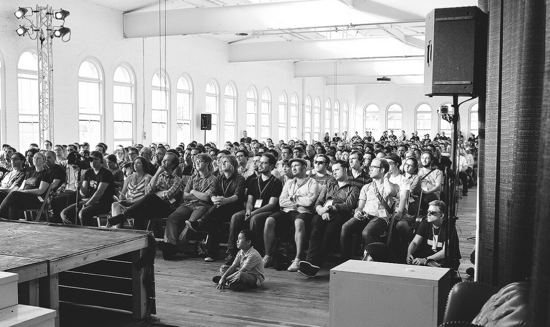
All the decisions that you make shape the attendees that decide to show up, and ultimately, the attendees decide the fate of a conference. Our attendee list was a ridiculously great roster of creative people.

The biggest challenge for XOXO, if we decide to do it again, will be the attendees. XOXO is a festival for artists and makers, not for people focused on business, PR, and marketing. If enough of those people leak into your event, it shifts the focus and creates a downward spiral that’s hard to recover from. The trick is that the biz/marketing/PR crowd often has more resources, and it may take some creative measures to keep them out.

There’s also a larger tension between inclusiveness and intimacy. Attendees want an intimate event where they can talk to every person in the room over the course of three days. But, at the same time, I don’t want to run an event for the same 400 people every year. I want more diversity and more new voices, with a better balance between artists and technologists, and a better age, gender, and racial breakdown. And, if I’m devoting a chunk of my life to this, I want something with a larger cultural footprint that can make a difference in more lives.

But to do that without excluding the core group of XOXO that made it great, we’d need to grow the attendance, at the potential cost of intimacy. My hunch: an event double or triple XOXO’s size with the most creative people in art and tech will still be amazing. Big conferences don’t suffer because of their size, they suffer because of a bad crowd.

Looking Forward

XOXO was one of the most rewarding things I’ve ever done. There’s something so magical about connecting interesting people together, and you never know where it will lead — new projects, startups, friendships, marriages… it’s hard to imagine never doing that again.

I know it’s a cliché, but it’s true — you had to be there. Words only go so far, so we made a little montage that tried to convey the feeling of XOXO a little better. I hope you like it.

(All photos from our CC-licensed photo set on Flickr.)
5 Comments

Spelunky Pancakes

My eight-year-old son and I are completely obsessed with Spelunky, the brilliant 2D platformer-meets-Roguelike game that launched last week on XBLA.

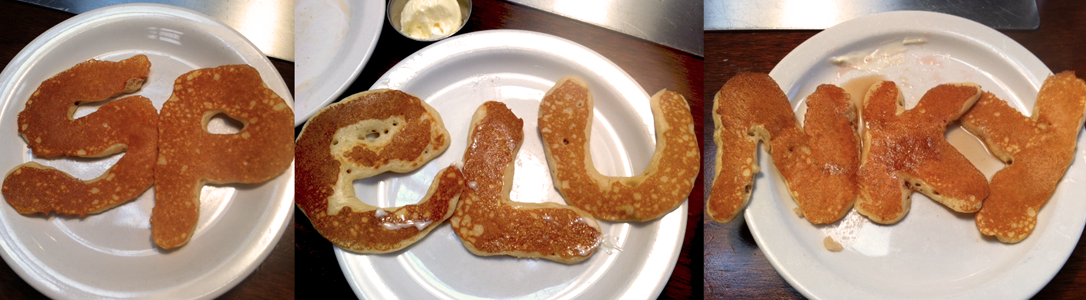
How obsessed? Yesterday, at brunch at Slappy Cakes, he asked me to make this:

Tasty!

The new Spelunky is a reboot of the brilliant 8-bit freeware game that Derek Yu released in 2009, still available for Windows, with an unofficial Mac port.

Spelunky borrows two elements I hated back in the 8-bit era — randomized levels and no way to save progress — and makes them eminently enjoyable. Like NetHack meets La-Mulana, Spelunky is brutally hard. Like other Roguelikes, when you die in Spelunky, you’re dead. There’s no way to continue.

In an interview with Anthony Carboni, Derek Yu said, “When you die and have to start from the beginning, it makes death meaningful, just like in real life.” I’d recommend watching the interview, and Derek trying to play his own game, on New Challenger.

Unlike other hard games, Spelunky feels fair to me. Every time I die, I know that it was my fault. I never felt cheated because of awkward controls or unpredictable behavior, because the processes running the environment are so consistent and learnable. You can palpably feel yourself mastering the game, learning the mechanics and traps and creature movement and every other detail, until the next time you stupidly fumble.

To feel what it’s like to play Spelunky, and how deep it goes, I’d recommend reading Tom Francis’ quest to find the lost city of gold.

P.S. Eliot just came downstairs to tell me he finished the Worm level, grabbed the Crysknife, and unlocked the Super Meat Boy character. If you’ve played the game, you know how hard that is. My boy!

1 Comment

Can't Wait for iOS 6? Renegade Developers Trade Access for Cash

Every year, Apple’s keynotes hype the latest and greatest iOS software, receive unprecedented media coverage, and tout hundreds of new features on the Apple homepage. But then, like an evil Santa Claus, Apple asks their most passionate fans to wait months to play with the new toys. This year, like the year before, they didn’t announce a release date, promising only sometime “this fall.”

If you’re a diehard Apple fan that desperately wants to run a buggy beta version of iOS 6 right now, your only legal option is to shell out the $99 to join the iOS Developer Program. Affordable for a developer, the barrier to entry is high enough to keep out casual fans from accidentally bricking their phones and cluttering up the Genius Bar.

But over the last couple years, a cottage industry’s popped up around illicit UDID activations — startups exploiting Apple’s Developer Program to sell access to prerelease iOS software, usually for less than $10 per device. The craziest thing? Apple doesn’t seem to care.

Do a search for “UDID Activation” and you’ll find a dozen web sites, including some advertising on Google, with SEO-friendly names like ActivateMyiOS, Activate My UDID, UDID Registration, and Instant UDID Activation. Unlike casual registration trading of the past, these new startups offer secure payment options, solid customer support, Twitter and live chat, and quick turnarounds. One service even offers an AppleCare-like guarantee called “SafetyNet” that protects you if you lose your device or buy a new one.

Behind the scenes, each service uses the same simple backdoor: Registered iOS developers can activate up to 100 unique device IDs (or UDIDs) for their account, an essential tool for testing apps on multiple devices. Once registered with Apple, the activated device is also able to run prerelease versions of iOS, though developers are forbidden from sharing prerelease software outside their own team.

Ignoring these warnings, activation services charge a small fee to add a customer’s device to their developer accounts. When they hit the 100-device limit, they just register a new account with Apple.

I spoke to the founder of UDID Activation, an activation service based in Galesburg, Illinois, who asked not to be named. “I set up a new Apple developer account every time I need another list,” he said. “I have 30 developer accounts, all with the same name and address, and Apple’s never said anything.”

There have been isolated reports of Apple disabling developer accounts, but some of these services have been running uninterrupted for years without any apparent consequences.

“It’s obvious it’s there, and there are tons of people doing it,” said UDID Activation’s founder. “If they wanted to look into it, it wouldn’t be very hard for them to find out what was going on. I’ve been doing this for about three years and I’ve never been contacted by Apple, and they’ve never shut down my accounts or anything. It really does seem like they don’t care that much.”

I chatted over instant message with a support representative from a competing service that claimed to have ten iOS developer accounts and a bot to reactivate expired UDIDs. I asked how often Apple kills their accounts. “Never in five years,” he said.

Apple clearly states in its Developer Program License Agreement, and on its Developer Portal, that membership can be terminated if a developer provides pre-release Apple Software to anyone other than registered employees, contractors, or others with a demonstrable need to know or use the software to build and test applications. Apple adds that unauthorized distribution is prohibited, and may be subject to both civil and criminal liability.

Despite Apple’s threat of “civil and criminal liability,” the service operators I spoke to didn’t seem concerned. “In the developer section, there’s a notification that says selling spots to your developer account can get it shut down,” said UDID Activation’s founder. “But I’ve never heard of anyone getting their account shut down for selling spots.”

It might not be that simple. Detecting fraudulent activity isn’t as straightforward as it seems, unless Apple actually purchased activations from each service to identity the account holder. Purchased accounts don’t look any different than normal beta testers, though the rate of registrations could be an indication of service violations.

For a small developer, unauthorized activations are a lucrative business that’s likely worth the risks. UDID Activation publishes their order queue on their official site, which shows over 2,300 devices activated in the last week alone. At $8.99 for each activation, that’s over $20,600 in revenue, with $2,277 paid to Apple for the 23 developer accounts. Their homepage claims that over 19,000 devices were activated so far, and that’s only one of several services.

Outside of commercial services, some fans are forgoing commercial services and self-organizing, using discussion forums to crowdfund shared developer accounts, as these Reddit members did last year. On Twitter, authorized developers trade UDID activations for followers and retweets, or just offer them for fun.

Apple may not like it, but all of these back-alley transactions are clearly meeting a market demand. The software may be buggy, incomplete, and not ready for mainstream consumption, but a sizable class of power users doesn’t care and is willing to pay to use it.

For these cheap and impatient users, activation services offer an easy, affordable, and low-risk way to experiment with the cutting edge before the rest of the world. And until Apple starts cracking down, there’s little reason not to use them.

13 Comments

Busting the iOS 6 Transit Map Myths

There’s a ridiculous amount of misinformation spreading online about the new maps in iOS 6, compounded by incorrect press reports, vague statements by Apple, and the developer NDAs. I’m even guilty of spreading it myself, based on reports I’d seen on the blogs.

Using information provided to me by an anonymous Apple developer, I’ve pieced together the facts. Keep in mind that iOS 6 is still prerelease beta, and Apple may change anything at any point. Everything below is based entirely on the existing beta software and documentation that Apple’s provided to developers.

Were walking directions removed in iOS 6? Some press reports have stated that walking directions are removed from iOS 6. This is completely false, and walking directions are still in iOS 6. Here’s a screenshot of walking directions in iOS 6, courtesy of Philip Bump.

Were biking directions removed? Bike directions have never been available on the iPhone, and still won’t be in iOS 6.

Were public transit directions removed? As of this beta, inline public transit directions are gone from the Maps application in iOS 6. Clicking the public transit button will display a list of third-party apps that support routing in the defined map area, and will launch the app when clicked. Here’s the current screen in the beta, with no apps registered.

By release, this blank screen will be populated with a default list of appropriate apps from the App Store. The documentation states, “If the user’s device does not currently contain any routing apps, Maps refers the user to apps on the App Store that do.”

What about the new Transit APIs? The new Transit APIs, referred to by Scott Forstall at 108:58 in Monday’s keynote, allow developers to register their app as a directions provider for routing directions for a particular set of coordinates. It will then be displayed in the list of available third-party apps for transit. Clicking a transit app launches that app, passing the start and end values to the app. Contrary to other analysis, transit routes can’t be displayed inline from the Maps app.

How do the Transit APIs work? Apps can enable directions support by setting the type of directions they support, a geoJSON file specifying the map regions they support, and uploading it to iTunes Connect. Developers can specify a category (Car, Bus, Train, Subway, Streetcar, Plane, Bike, Ferry, Taxi, Pedestrian, Other).

Directions requests from Maps are handled by a special URL. From the documentation: “When the user asks the Maps app for directions and chooses your app, Maps creates a URL with the start and end points and asks your app to open it.” From there, the app can “compute and display the route using your custom routing technology.”

Of course, any of this may change before release. But, for the moment, the APIs simply don’t support inline transit routes from within the Maps app.

Are Street View photos removed? Yes, these were also provided by Google.

Why is Apple doing this? Do they hate public transit?! Of course not. Transit directions aren’t in iOS 6 because Apple replaced Google’s maps with their own solution, which didn’t include access to transit data. Maintaining transit feeds and keeping it up-to-date for hundreds of cities was presumably too difficult to attempt for this first release, so they decided to outsource it to third-party apps.

Is Google going to release a Maps app for iOS? We don’t know. Google hasn’t announced any plans for a native Google Maps for iPhone. And there’s a big unknown: if they developed it, would Apple approve it?

Hope that helps. Hit me up with any more questions, or if you have internal information, I’ll happily honor your anonymity.

90 Comments

Turning Patrons into Producers: Fan-Commissioned Art on Kickstarter

Wired posted my new column yesterday, an attempt to coalesce some thoughts around a trend in fan funding that isn’t really happening yet, but really should be — fans hiring artists directly to make the art they want to experience and own. I’ve been thinking about this since 2008, and surprised it hasn’t emerged yet in a big way. I’m really just hoping that someone sees this and gives it a try.

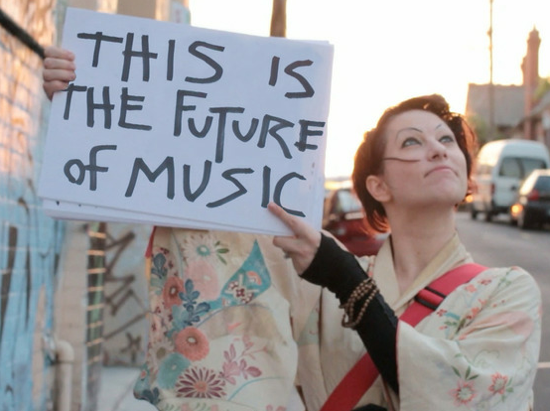
Amanda Palmer blows up the music business.

Two weeks after Kickstarter launched in April 2009, I was fishing around for an idea to test the platform and launched a project for Kind of Bloop, an 8-bit tribute to Miles Davis’ Kind of Blue.

Like many to follow, my Kickstarter project hit the initial goal in the first few hours and eventually quadrupled it, with $8,600 raised from over 400 backers. Modest by today’s multimillion dollar blockbusters, it’s still considered one of the site’s early successes. The album was released shortly after, adored by the only 400 people in the world who find the idea of “chiptune jazz” thrilling.

But unlike nearly every other album project on Kickstarter, I’m not a musician. I’ve never written a song, with or without vintage videogame consoles, and wouldn’t know where to start.

Instead, I hired musicians I love to make the music. My job was organizing the project — giving the musicians feedback, setting the budget and timeline, and handling all the mundane chores of licensing, production, promotion and fulfillment.

Without intending to, I’d added a new title to my résumé: I was a record producer!

As Kickstarter’s exploded in popularity, I’ve started to see signs that there are others like me — a movement of fans as producers, commissioning work from their favorite artists instead of waiting for the artists to come to them.

To me, it feels like the next logical step in the evolution of fan funding. Already, fans are expecting to witness the creative process with behind-the-scenes progress updates and feedback forums. Now, they may actually help decide what gets made. If I’m right, the implications for working artists is potentially huge, providing an unexpected source of revenue, as well as potential creative headaches.

Here are some potential applications, and some who are leading the way.

The New Event Organizers

The idea for Kickstarter began seven years before its launch with a concert in New Orleans that never happened. Perry Chen, founder and CEO, wanted to organize a late night event during the 2002 New Orleans Jazz and Heritage Festival that would cost $20,000, but didn’t want to deal with the upfront risk. His thought: pre-sell the tickets to the nonexistent event on a conditional basis. If there wasn’t enough interest, he wouldn’t lose his shirt.

He gave up the project, but not the underlying idea. Ever since it launched, I’ve thought events were the most underrated use for the platform. The very first project to crash the Kickstarter servers, in fact, was the flood of people trying to buy a ticket to see Neutral Milk Hotel’s Jeff Mangum at a benefit concert in NYC.

Last week, I launched a Kickstarter project to fund XOXO, a new conference and festival in Portland, Oregon. I worked with Andy McMillan, the creator of The Manual and Build, to budget the costs, invite speakers, book venues, and effectively design an event without spending a dime. Within 50 hours, the event was completely sold out with over $160,000 raised, making it the largest event ever funded on Kickstarter.

We’d designed an event we would want to attend, and tested the waters to see if anyone else agreed. If they hadn’t, the only loss would have been our time.

Again, like Kind of Bloop, I found myself in the position of a producer; this time for a festival organizer instead of an album. I’m getting more and more comfortable in these shifting roles.

From the beginning, musicians have experimented with Kickstarter for funding their tours, from Amanda Palmer and Neil Gaiman’s five-city tour to Kim Boekbinder’s Impossible Tour, a set of ten separate projects testing local audiences.

As far as I can tell, nobody’s flipped it around and tried to commission a musician to play for fans. Most bands already play corporate events and private parties. If fans collectively raise the same amount of money, why not play a house show for them instead? For fans, it’d be a once-in-a-lifetime experience to see an artist they love in an intimate setting. For musicians, it’d pay well without the malaise that comes from playing the Intel holiday party.

Though there’s no reason commissioned works need to be limited to music.

Commissioned works are perfect for collaborations. Why not team up your favorite indie comic book artist with your favorite videogame creator, like Pixeljam and James Kochalka? Or musicians with authors, like Ben Folds’ collaboration with Nick Hornby? Or hire an illustrator you love to make art based on that cult indie film you and your friends keep watching? Sure, go ask Olly Moss to make prints based on Ghosts With Shit Jobs.

Projects like these have three big requirements.

  1. Strong, achievable concept. Commissioned works should be scoped down to something realistic, because you’re paying for their time, but high-concept enough to capture the excitement of other fans.
  2. Organizer. The funding may come from the crowd, but there needs to be a single person managing the project and handling all the logistics and small details.
  3. Due diligence. The organizer will need a firm agreement from the artist, committing to a timeline, payment, and any other demands. Also, if the project results in a tangible work, determine who owns the rights to it before you start raising money.

Fans Liberating Art

The rights issue is an interesting one. With Kind of Bloop, it was effectively work-for-hire. I paid the artists the complete proceeds of the Kickstarter fundraiser and I owned the finished album, with the ability to sell it in the future without hassle.

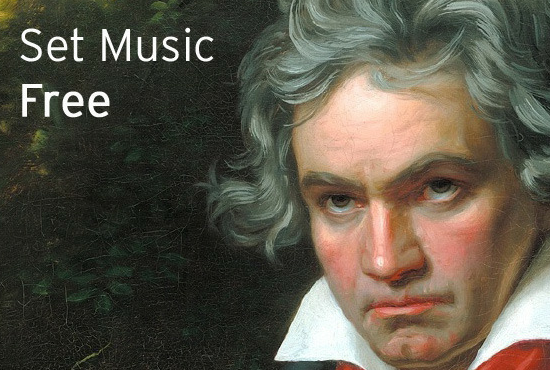
But a new class of commissioned projects are taking the rights issue a step further, liberating works into the public domain. This week, two classical music projects that funded on Kickstarter released their work into the world, free of all copyright limitations.

Of course, symphonies from the Baroque period are already in the public domain, but the modern recordings of those compositions are almost all copyrighted.

The Musopen project, funded in September 2010, raised over $68,000 to hire the Czech Filmharmonic to perform original recordings of classical symphonies from Mozart, Beethoven, Brahms, and others. The result was announced last week: 27 symphonies, uploaded to Archive.org in raw ProTools format with individual recordings for each instrument.

A second German project, funded in June 2011, sought to create a new score and recording of Bach’s Goldberg Variations. The Open Goldberg Variations completed recording in January and released the new score and recording into the public domain last week. A free iPad app followed, released only yesterday.

Both projects were organized and funded by fans of classical music. Fans did the research, raised the money, and paid musicians to do what they do best. Together, everyone worked together to enrich our shared culture, to the chagrin of classical record labels.

Every day, it seems like Kickstarter is evolving into a kind of dream factory — manifesting the dreams and wishes of an individual that shares a vision with their community.

If this is the future of fan funding, I’m in.

2 Comments

Content ID Run Amok: Isaac's Lip-Dub Proposal Removed from YouTube

I’ve written a couple times about YouTube’s Content ID in the past, the powerful and oft-abused technology used to automatically detect potential copyright infringement and allow the purported copyright holders to block or monetize videos.

You probably saw Isaac’s adorable lip-dub proposal, choregraphed by a bunch of drama geeks in Portland.

In the Vimeo description, they also posted the video to YouTube, which is now “blocked on copyright grounds.” There’s only one possible infringement claim, and that’s the soundtrack, which used Bruno Mars’ “Marry You.”

Despite the fact that Bruno Mars himself loved the song:

Before blocking copies of the YouTube video, Warner Music Group filed a DMCA notice with Google to remove 27 links to the song from their search results.

There’s a strong argument that their non-commercial use of the song should be fair use, and that hyperlinks from Google should never be censored, but let’s just grant WMG the benefit of the doubt. It’s their song, and they’re clearly the copyright holder.

Instead, I want to draw attention to the other claimants for the YouTube copyright takedown — Keshet, La Red, and Scripps Local News.

I wasn’t able to find any information about Keshet and La Red, but why would Scripps be listed in the copyright claim?

A number of Scripps-owned local ABC TV affiliates aired the story, like this report from ABC 2 Baltimore. Content ID is smart enough to detect partial use of a video, and now even detects the melodies in cover songs. But it’s not smart enough to figure out that the original video predated the newer upload, as in this recent example with a comedian’s video broadcast on The Tonight Show with Jay Leno.

So the Scripps TV broadcasts are indexed by YouTube, and the Content ID robots do the rest. And because Content ID disputes are judged by the copyright holder, complaints are routinely ignored or denied.

As a final stupid footnote, there are still multiple copies of Isaac’s proposal on YouTube. The most popular? This one — uploaded by a TV news network.

9 Comments

Google+ Search API Weirdness

I’m doing some testing with the Google+ Search API, and it seems like it’s completely broken. Can anyone else confirm?

Try searching for something popular using the Google+ API, ordered by recent. Here’s a test for ‘iphone’. For me, the most recent result was 25 minutes ago. (Your results may vary, depending on time.)

Now, do the same search on Google+ itself, and click the “Most recent” link to only show recent posts.

At first, Google+ shows the same sparse results of relatively outdated posts… Then, slowly, it populates with newer posts from the last couple minutes.

Unfortunately, I can’t figure out a way for the Google+ API to show those newer posts. Any help? Any Googlers out there able to help out?

1 Comment

Introducing XOXO

On Tuesday morning, Andy McMillan and I launched XOXO, an epic festival and conference about disruptive creativity — bringing together artists and makers bypassing traditional middlemen to do what they love for a living, with the technologists building the platforms to make it possible.

If you haven’t already seen it, take a look at the video we made, which pretty much explains everything:

We’d confirmed most of the entire lineup by Monday, including the founders and CEOs of Etsy, Kickstarter, Metafilter, 4chan, Canvas, Simple, VHX.tv and The Atavist, and the creators of World of Goo, MakerBot, Indie Game: The Movie, Star Wars Uncut, Diesel Sweeties and Black Apple. And Julia Nunes! (This is as close to WaxyCon as you’re ever going to get.)

Andy and I debated back and forth about whether the project was ready to announce, and both of us were nervous. It’s a unique project for Kickstarter, and we didn’t know if we’d provided enough detail to convince people that we’re working on something really exciting. We’d run all the numbers, and to do everything we wanted without cutting corners or selling out, the tickets would cost around $400. Was that price too high? What if only business and marketing types sign up? Is the festival too long, too short, too far to travel?

So many doubts, so many fears. We were betting it all — pre-selling every single ticket with a $125,000 goal. And we were serious: if it came up short, we’d walk away. Months of planning would be wasted, but at least we wouldn’t have lost our shirts.

Until the last minute, we were debating whether to push it yet another week out to polish things up. Finally, we bit the bullet, cleaned up some final issues, and launched at 11:20am on Tuesday.

The reaction was explosive and immediate. In fact, I’d fully intended to write about the launch on Tuesday morning, but within 30 seconds of posting the Kickstarter project, my inbox exploded. I knew that Kickstarter’s new social features were powerful, but this was intense. Before I’d even tweeted it myself, 20 people backed the project.

Less than two days later, it’s passed $110k raised with over 60% of the tickets sold. (Update: It sold out completely in 50 hours!)

The list of speakers we’ve put together is great, but the list of attendees is amazing. We could easily do five more conferences just from the current attendee list. Some of the smartest and most creative people in the world are coming to XOXO, and almost every time I search a name I don’t recognize, I’m impressed. Putting all these people in one room is going to be something special.

As far as I know, XOXO is also the biggest event ever funded on Kickstarter. When I first started working with Kickstarter in 2008, the idea of funding events came up regularly. Kickstarter was originally inspired by a concert that Perry wanted to throw in New Orleans back in 2001, but didn’t want to deal with the up-front risk. I’ve always thought it was a perfect use for the site, but up until this point, barely anybody’s tried to fund their entire ticket sales on it. I think this really validates Kickstarter as a tool for funding events.

There are a million things to do and we’re just getting started. But, for now, I’m just grateful that everyone got it. We’re at the very start of a Cambrian explosion of creativity, made possible by technology. Everything is awesome.

Tonight, I watched Neil Gaiman’s commencement speech to this year’s graduating class of the University of the Arts. All of it’s worth watching, but this part of the speech (at the 17:20 mark) resonated with me.

We’re in a transitional world right now, if you’re in any kind of artistic field, because the nature of distribution is changing, the models by which creators got their work out into the world, and got to keep a roof over their heads and buy sandwiches while they did that, are all changing. I’ve talked to people at the top of the food chain in publishing, in bookselling, in all those areas, and nobody knows what the landscape will look like two years from now, let alone a decade away. The distribution channels that people had built over the last century or so are in flux for print, for visual artists, for musicians, for creative people of all kinds.

Which is, on the one hand, intimidating, and on the other, immensely liberating. The rules, the assumptions, the now-we’re supposed to’s of how you get your work seen, and what you do then, are breaking down. The gatekeepers are leaving their gates. You can be as creative as you need to be to get your work seen. YouTube and the web (and whatever comes after YouTube and the web) can give you more people watching than television ever did. The old rules are crumbling and nobody knows what the new rules are.

So make up your own rules.

I couldn’t have said it better.

So, go check out the project, watch the video, and check out the speaker lineup. If you want to, back it. And I hope to see you in September!

8 Comments

The Final ROFLCon and Mobile's Impact on Internet Culture

A little late on this, but wow, ROFLCon III was amazing. I was there to moderate a morning keynote panel on the supercut meme with Rich Juzwiak, Duncan Robson and Aaron Valdez, three of my favorite supercut creators. It was a privilege to share the stage with these guys, who are all amazing at what they do. It ended with a debut of Duncan’s Three Point Landing, which the audience adored. Here’s the whole thing.

Every talk I saw was amazing. All the sessions are making their way onto YouTube, and are all worth checking out. I posted some of my personal highlights on Twitter, but if you missed them, here are my favorites:

Jonathan Zittrain’s introductory keynote was thoughtful and inspiring. Jason Scott’s solo talk on the Mysterious Mr. Hokum is a crazy story of a pre-Internet scammer. Flourish Klink’s panel on fangirl culture was eye-opening, a glimpse into a massive subculture of the web I know far too little about.

The most entertaining, hands down, was Craig Allen’s behind-the-scenes story of the Old Spice campaign, with a surprise Skype cameo by Isiaiah Mustafa.

The most underseen and misunderstood session was Wonder-Tonic’s pitch for Localoffrly.biz, a douchebag startup turned into comedy performance art. (Bonus points for actually launching a site.) Hard to believe, but some people in the audience weren’t sure whether it was a joke, and started to get frustrated when they stopped the gamified talk between each “level.” Brave.

And, of course, Chris Poole’s solo talk, which ended up inspiring my Wired column that was published last Wednesday. I reprinted it below, hope you enjoy it.

Early this month, the Internet invaded the MIT campus for ROFLCon III, the biennial two-day conference that brings together the subjects of net memes with those who study and adore them.

Among the meme celebrities — Tron Guy, Paul “Double Rainbow” Vasquez, Antoine Dodson, Scumbag Steve and Chuck Testa all attended — were those who are deeply invested in the future of Internet culture, both emotionally and financially. Founders of community sites like Reddit and 4chan, academics studying memes, and the cottage industry that’s capitalized on them, most notably the Cheezburger Network’s Ben Huh. And, of course, the whole audience participated in their propogation.

From the moment I boarded the plane to Boston there was an undercurrent of change running through the conference. I sat next to Whitney Phillips, a University of Oregon doctoral student speaking on a panel about her research on troll culture. She’d attended every ROFLCon since 2008, and realized that she’d have to revise her thesis in the next month — the meme landscape is in a transitional period, but it’s not clear what it’s transitioning into. She echoed something I heard repeatedly over the weekend: “It just feels different.”

It felt apropos that this was the last ROFLCon, with the organizers “putting this trilogy to bed and riding out into the sunset.” Or, at least, until “we can figure out how to continue doing it great justice.”

The Internet is still spawning memes at an accelerated rate — and they’ll never go away. But there are some major shifts under way that may fundamentally change the way they’re created.

Every meme, like folklore, shares two common characteristics: It must show reproduction (the ability to be copied) and variation (the ability to mutate).

These days, memes spread faster and wider than ever, with social networks acting as the fuel for mass distribution. But it’s possible we may see less mutation and remixing in the near future. As Internet usage shifts from desktops and laptops to mobile devices and tablets, the ability to mutate memes in a meaningful way becomes harder.

From the Interest Web to the Social Web

Over the last few years, we’ve seen a fundamental shift away from discussion forums and other niche communities to social networks and aggregators. In a 20-minute talk at ROFLCon, 4chan and Canvas founder Chris Poole characterized this as a shift from the interest-based web to the friend-based web.

Poole is concerned that the web is losing its emotional depth, a richness that comes from lurking, failing and learning before finding your place in a community. The difficulty gave it more meaning, and the resulting communities added far more value to the web than they extracted.

Now, aggregators like 9GAG and Cheezburger are ridiculously popular, but memes rarely originate there. Unsourced images are posted and watermarked by their new hosts, muddling their origins and diluting the context of the original image. As Poole said, “It’s hard to feel emotionally invested in 9GAG.”

To me, this is part of the natural expansion of online community. Reddit users hate 9GAG for stealing their memes, but 9GAG is popular because it’s easier to use, making it more inclusive to Facebook users than Reddit’s sprawling subgenres and somewhat esoteric community norms. It’s the same reason that, for years, 4chan users hated Reddit for stealing their memes and bringing them to a community that was much easier to understand.

Unlike social networks, each successive community doesn’t seem to cannibalize its predecessor, but instead simply finds a larger, newer audience. The original community stays largely the same, which feels like stagnation relative to the “next big thing.” With each new site, the mainstream base and shared knowledge we call “Internet culture” converges into a mixed cultural heritage.

But there’s one potential risk that affects the cultural production of memes.

Meme Mutation

Ever tried using 4chan on a iPhone? It’s completely impossible to upload images from an iPhone or iPad, immediately limiting your contribution to the community to commenting alone. Sites like Reddit let you post a URL, but modifying and uploading images to a public URL from a mobile device is, for the moment, not easy.

Also for the moment, it’s extremely rare for mobile apps to allow community remix and sharing. In fact, I could only find two iOS apps that supported posting your own remixes to a public community space: Mixel and Make Pixel Art. (If you know more, leave them in the comments.) All others only support sharing to your contacts or your own social network, but not the public, unmediated space that memes thrive in.

It’s not surprising, then, that the only memes that seem to originate on smartphones are text-based — autocorrect fail, iPhone whale, and texts from last night.

It feels like we’re on the verge of a breakthrough to unleash the creative potential of these devices, but mobile developers are limiting our options to mild tweaking, at best. Instagram’s filters made the simplest cosmetic changes, and you weren’t able to modify anybody else’s work. Draw Something let you draw, but only with a single person and no shared history. Where’s the Canvas, Polyvore, deviantArt, and YTMND of the app world?

In the absence of good remix apps, image macro generators like Meme Generator and Quick Meme have filled the gap, making it possible to instantly generate a new meme from a mobile browser in seconds. No tools, or time investment, required.

This is incredibly empowering, but also limiting. Your imagination, and the scope of the meme’s breadth, is limited to the capabilities of the meme generator.

It’s reasonable to think the shift from desktops and laptops to mobile and tablets will continue, especially for the new generations of young Internet users that typically generate memes. If the app ecosystem doesn’t grow to accommodate it, we may see remix participation drop, largely substituted by the lightweight interaction of likes, favs and comments and lightweight prebuilt memes from generators.

In his talk on Saturday, Poole said, “Memes are the instruments with which we play music. The way things are going, we’re going to lose our song.”

Memes may not go away, but I’m worried we may lose the concert venues where the music is performed — the quirky, difficult communities that foster creative expression and make it meaningful.

2 Comments

Criminal Creativity: Untangling Cover Song Licensing on YouTube

We all break laws. Every day, millions of people jaywalk, download music, and drive above the speed limit. Some laws are obscure, others are inconvenient, and others are just fun to break.

There are millions of cover songs on YouTube, with around 12,000 new covers uploaded in the last 24 hours. Nearly 40,000 people covered “Rolling in the Deep,” 11,000 took on “Pumped Up Kicks,” 6,000 were inspired by “Somebody That I Used to Know.”

Until recently, all but a sliver were illegal, considered infringement under current copyright law. Nearly all were non-commercial, created out of love by fans of the source material, with no negative impact on the market value of the original.

This is creativity criminalized, quite possibly the most popular creative act that’s against the law.

I don’t think it’s an act of civil disobedience; nobody’s making a statement. Most people don’t know that cover songs need a synchronization license, and even if they did, trying to get one is a confusing and expensive proposition. Unlike the mechanical licenses used to release a cover song on an album, video sync licenses don’t have an affordable flat rate and require the publisher’s explicit permission.

Even as YouTube forges agreements with publishers to handle the synchronization rights for cover songs, it’s nearly impossible for musicians to tell whether their songs are covered or not.

This week, I set out to answer a seemingly simple question: when are YouTube cover songs legal, and how can we do this better?

Conflicting Information

Even trying to determine if a cover song is legal can be confusing for most musicians. There’s no shortage of answers online, but most of them are conflicting. Publishers, musicians, and lawyers all give different answers, none of which are totally accurate. Even YouTube’s own FAQs are incomplete, made inaccurate by recent settlement agreements.

Like any area of copyright law, there’s no shortage of armchair lawyering on blogs and discussion forums about cover songs. A common belief is that cover songs fall under the “fair use” provisions of the Copyright Act, but the question of whether a non-parody cover song could fall under fair use is untested in the courts. Despite this, over 60,000 cover songs on YouTube cite “fair use” in their title or description. (Whether uploaders actually believe that or are preemptively using it as a defense is anyone’s guess.)

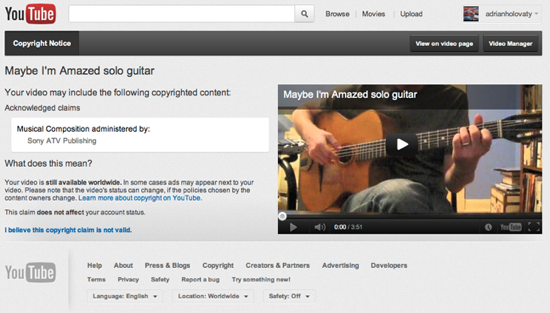
Content ID detects one of Adrian Holovaty’s cover song

While they happily encourage fans to upload covers, YouTube makes it clear that users must have the rights to all content they upload. “We tell users they must own the copyright or have the necessary rights for any content they upload,” said a YouTube representative. “It’s ultimately their responsibility to know whether they possess the rights for a particular piece of content.”

Their only specific guidance for cover songs is in their Copyright FAQ, which says, “Recording a cover version of your favorite song does not necessarily give you the right to upload that recording without permission from the owner of the underlying music.”

But this answer isn’t fully accurate. YouTube’s negotiated blanket synchronization licenses for its users from thousands of publishers, most notably the settlement with the National Music Publishers Association last August. This agreement allowed publishers to opt-in to a program that let them take a cut from a $4 million advance pool and up to 50 percent of the advertising revenue from any cover song they own the rights to.

Frustratingly, we have no idea which publishers have signed on. The NMPA doesn’t publish the list, making it impossible to figure out whether your song is covered by the agreement or not. (I contacted the NMPA, but a spokesperson confirmed that information appeared to be unavailable, but was looking into it.)

Begging for Forgiveness

In reality, the only way to tell whether a song is legal is to risk breaking the law and losing your YouTube account — by uploading the video and waiting for copyright notices.

In the last few months, YouTube has quietly expanded Content ID beyond original recordings to detect cover versions and live performances using the underlying melodies. A YouTube representative confirmed with me, “Content ID’s technology allows us to identify works in an original sound recording, or in a cover version (by identifying the underlying melody of a song), using information provided to us by the publishers.”

YouTube hasn’t talked much about its melody matching technology, but it was in the news recently after a drunk Edmonton man belted “Bohemian Rhapsody” in the back of a police car. After the Content ID identified the song, EMI initially decided to take the video down, but soon changed its mind and authorized it with advertising.

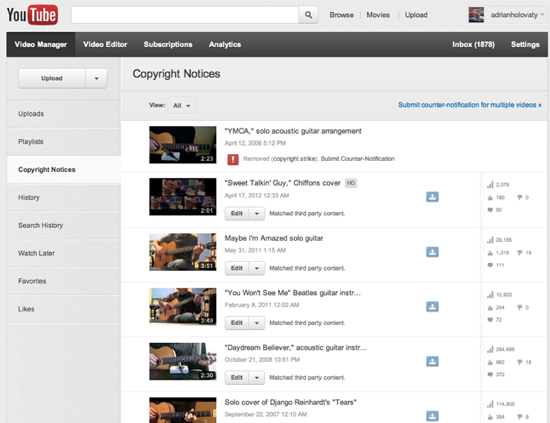
Adrian shared a screenshot of his copyright disputes page.

Everyblock founder Adrian Holovaty is well known on YouTube for his acoustic guitar covers, which have amassed millions of views. I asked him if Content ID identified the melodies in any of his videos. So far, seven of his videos were identified, with all but one rights holder choosing to leave the video online and collect the revenue. Only one video his cover of the Village People’s “YMCA,” was taken down by the songwriter, leaving Adrian with a “copyright strike” on his account. YouTube’s policy allows three strikes before the account is terminated and all videos removed.

The Flaws in the System

The system’s not perfect, though. Unscrupulous individuals are routinely using Content ID to claim content they don’t own to harvest ad dollars from unsuspecting users. For example, two of Adrian Holovaty’s disputed tracks are Django Reinhardt songs from the 1930s, claimed by an obscure company named “Social Media Holdings.”

Other copyright claims may be accidental, as material they don’t actually own finds its way into the Content ID database, like this poor guy who’s received eight consecutive claims from companies claiming to own George Romero’s public domain Night of the Living Dead.

And Content ID isn’t immune to false positives, like the bird calls misidentified as music. Worse, for all these case, disputed Content ID claims bypass the DMCA process for counter-claims entirely, as I wrote about in February.

How can a musician decide what’s legitimate or worth fighting?

Still, YouTube’s Content ID is pushing publishers and rights holders into the modern age. It’s an ingenious approach for an otherwise dysfunctional copyright system that’s too hard for amateurs to navigate, making money for everyone involved while still allowing free creative expression.

The Need for Change

But there’s something strange about this begging-for-forgiveness approach to copyright. It’s like driving without traffic signs, only finding out you broke the law when you’re pulled over.

The real question: Why is it illegal in the first place?

Cover songs on YouTube are, almost universally, non-commercial in nature. They’re created by fans, mostly amateur musicians, with no negative impact on the market value of the original work. (If anything, it increases demand by acting as a free promotional vehicle for the track.)

The best solution is the hardest one: To reform copyright law to legalize the distribution of free, non-commercial cover songs.

Copyright law was intended to foster creativity by making it safe for creators to exclusively capitalize on their work for a limited period of time. Cover songs on YouTube don’t threaten that ability, and may actually prevent new works by chilling talent that could go on to do great things.

As we’ve seen with countless breakout artists from YouTube, budding musicians have built their careers from cover songs that evolved into original material. Karmin, Pomplamoose, Julia Nunes, Greyson Chance…. Even Justin Bieber started with covers of Chris Brown and Nee-Yo before getting discovered.

Now, the next generation of budding pop stars are covering Justin Bieber, with about 216,000 of them so far. It’s all part of the virtuous cycle of culture: We take from it, build on it, and then give back in return. The law should help that along, not hinder it.

Update: I originally published this column over at Wired on May 2. The woman I spoke to at the NMPA confirmed the list of publishers appeared to be unavailable, but promised to look into it. I haven’t heard back, so I followed up again. I’ll update here if I hear anything.)

4 Comments

Super Mario Summary Shame

Is there a word for being totally proud of something and completely ashamed at the same time?

Context: Super Mario Summary reworks every level of Super Mario Bros. on a single screen, turning a side-scrolling platformer into a devious, addictive puzzle. Amazingly, it was built in only 48 hours by Swedish developer Johan Peitz as part of the Ludum Dare game competition. Read his postmortem of making the game.

4 Comments

In a Rigged Game, Twitter's IPA Lets Developers Rewrite the Rules

Last month, in response to Yahoo’s wrongheaded patent infringement lawsuit against Facebook, I wrote about my experience filing patents at Yahoo. Patents I helped to file, ostensibly only for defensive purposes, were turned into blunt weapons to thwart innovation and extort money.

As I said, “I thought I was giving them a shield, but turns out I gave them a missile with my name permanently engraved on it.”

This week, Twitter announced their Innovator’s Patent Agreement, an open source contract intended to guarantee patents will only be used defensively, even when sold. The IPA seems to directly address the issues raised in my article.

Adam Messinger, Twitter VP of Engineering, wrote that, “With the IPA, employees can be assured that their patents will be used only as a shield rather than as a weapon.”

Every one of Twitter’s existing patent filings, including Loren Brichter’s famous pull-to-refresh patent, will fall under this agreement later this year.

Still, the IPA isn’t perfect, and it needs work to protect the intentions of designers and engineers. Instapaper founder Marco Arment pointed out that the contract’s definition of “defensive” is overly broad, allowing an unethical company to initiate a lawsuit for a range of reasons without requiring the inventor’s permission.

Hypothetically, if Yahoo had adopted the IPA, would it have prevented them from later suing Facebook for patent infringement? Maybe not. Facebook’s threatened several startups over trademark name issues in the past, including Lamebook, Placebook, and Teachbook. If any of them were also users, customers or affiliates of Yahoo, then Yahoo could bypass the Patent Agreement and file a patent lawsuit. (Though, if they did, the inventors could choose to sublicense their patents directly to Facebook.)

These problems are correctable though, and Twitter should be commended for taking this important first step. In a deeply broken patent system, it’s heartening to see an established company proactively try to work around its flaws. I hope agreements like these find wide industry adoption.

But this isn’t a real fix. Union Square’s Fred Wilson dubbed it Twitter’s “Patent Hack,” and that’s exactly what it is — it’s duct tape to patch a broken system, but it doesn’t solve any of the underlying problems.

The ideal would be patent reform, or if the system’s beyond reform, the abolition of business method patents entirely.

Marco Arment wrote, “A truly innovative stance would be for a large technology company to avoid filing patents, and to lobby aggressively for progressive patent reform to make that a practical choice for every technology company.”

Like I did last month, Marco vowed not to file any patents. “I fundamentally disagree that software patents (and many other types of patents) are a net gain for society, and I can’t participate in that system in good conscience.”

After all, if you only use them defensively, why do you need patents at all? Publish your work and establish prior art.

Sadly, prior art only works in an ideal world. As we’ve seen, the U.S. patent office routinely grants patents even when prior art exists. The recently passed reforms to the patent system, switching from a first-to-invent to a first-to-file system, make this more likely than ever.

For the moment, avoiding patents entirely isn’t a realistic legal strategy for large companies. Maintaining a patent arsenal won’t ward off shell company-style patent trolls, but it can protect you from competitors by allowing cross-licensing settlements. But all of that feeds into the “cold war” mentality of stockpiling patents you never hope to use.

Until we have real reform or abolition, ethical tech companies are forced to play the patent game, but at least engineers and designers now have a way to rewrite the rules in their favor.

3 Comments

Memeorandum Colors 2012: Visualizing Bias on Political Blogs

I don’t watch sports, but every four years, I lose myself in the horse race of the U.S. presidential elections. That competition kicked off in earnest Monday, as Gallup started its daily tracking polls for the general election between Barack Obama and Mitt Romney.

In 2008, I was hooked on one drug for my daily fix: Memeorandum, a completely automated aggregator that surfaces popular stories from political news sites, often within minutes.

As you’d expect, the universe of political blogs is largely split in two, with conservative and liberal blogs rarely covering the same stories or linking to the same sites. But it can be very challenging to tell their political leanings at a glance, especially with names like “Balloon Juice,” “Weasel Zippers,” or “The Volokh Conspiracy.”

So, four years ago, I launched a project with Delicious/Tasty Labs founder Joshua Schachter to visualize the linking biases of various political blogs on Memeorandum by looking at their past behavior.

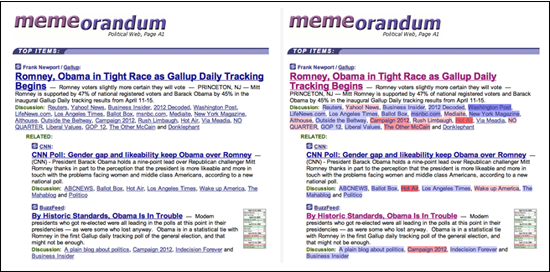
Using singular value decomposition, the linear algebra at the heart of your Netflix recommendations, we reduced the entire matrix of blogger-to-article relationships to a single dimension. Imagine a single line grouping like-minded blogs together based on the diversity of the stories they cover, with hardcore left- and right-leaning blogs on opposite sides of the spectrum.

Using those precalculated values, we load the data from Google Spreadsheets and color the links on Memeorandum, based on where they fall on the spectrum. The brighter the color, the more frequently they only cover stories by their counterparts.

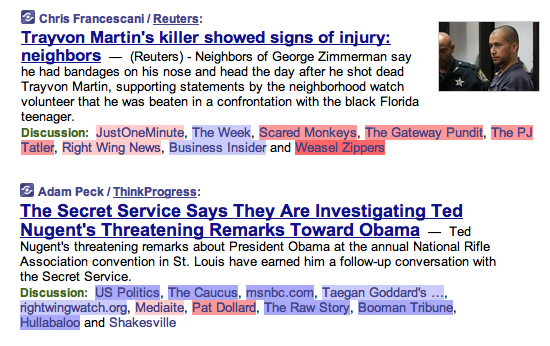
This simple visualization leads to some interesting insights. Compare these two articles, which were trending on Memeorandum at this writing:

Seeing each site’s potential bias provides the context for understanding how news is spread. Right-leaning blogs are eager to point out new evidence that George Zimmerman was hurt the day he shot Trayvon Martin, but left-leaning blogs aren’t covering that story. Likewise, only left-leaning news sites appear to be covering the news of Ted Nugent’s threatening remarks to the president, but conservative blogs aren’t. This visualization also makes it easy to spot outliers, the sources that are breaking away from their past behavior to link to something beyond their usual circle.

This browser add-on is free and open source on Github. We’ve updated the data sources for the first time since 2008, and Memeorandum Colors now works natively in Chrome, in addition to Firefox.

You can try the browser add-on by following these simple directions.

Google Chrome

  1. Click the memeorandum_colors.user.js link.
  2. In the warning dialog at the bottom of Chrome window, select “Continue.”
  3. Visit Memeorandum and wait a moment for the links to color.

Firefox

  1. Install Greasemonkey.
  2. Restart Firefox.
  3. Click the memeorandum_colors.user.js link, wait three seconds, and Install.
  4. Visit Memeorandum and wait a moment for the links to color.

Four Years of Data

Along with this release, we now have four years of historical activity to work with. The collected scores are on Google Fusion Tables, and I’ve included a dump of the activity in Github.

Looking at historical activity can reveal some interesting trends, especially in how attitudes have shifted since the last election.

For example, Little Green Footballs is a long-running political weblog started by Charles Johnson, a web developer who aligned himself with the conservative right wing after the World Trade Center attacks. In late 2009, he publicly parted ways with the right.

That shift away from conservatism was reflected in his linking behavior at least a year before his public statement. If you look at the timeline below, you can see that Johnson started linking to a wider variety of stories outside the conservative conversation, until his activity was mostly neutral in early 2010. Now, his activity tends neutral but slightly favors articles popular in the liberal blogosphere.

Bias In Linking, Not Beliefs

Memeorandum was created by San Francisco developer Gabe Rivera, who followed its introduction with aggregators for media, celebrity gossip, and baseball news. The most popular of these is Techmeme, a daily destination for tech industry watchers.

A month after Obama’s election, Rivera announced he’d hired a human editor for Techmeme to help prevent inaccurate results from the algorithm. This editorial oversight would affect any link-based analysis on Techmeme, but he confirmed that Memeorandum is still completely machine-driven.

This automated analysis is not a commentary on the personal opinions and beliefs of any blogger — no amount of linear algebra can prove that. What this shows is the biases in their linking behavior: the stories that each site chooses to cover, or not cover, and their similarity to others like them.

If you’d like to learn more about the math behind how this works, there’s more detail and links to tutorials on my original blog entry.

Let me know if you have any questions and I’ll try to answer them in the comments.

1 Comment

Waxy.org Turns 10

Ten years ago, I started this site with three simple rules: no journaling, no tired memes, and be original. 18 months later, I added a little linkblog.

In those ten years, I’ve posted 415 entries, including this one, and over 13,000 links.

The decision to start writing here regularly changed my entire life. It’s given me exposure, a place to share my projects and crazy experimentation with technology. It’s created new opportunities for me, directly or indirectly responsible for every major project I’ve gotten involved in. It’s a place to play and experiment with ideas, some of which led to big breakthroughs and passions. And it connected me to people who cared about the things I did, many of whom became lifelong friends.

Personal homepages and weblogs have long since faded from the popular trends. They’re no longer hip and nobody’s launching the hot new startup to reinvent them or make them better.

Most of the interest in writing online’s shifted to microblogging, but not everything belongs in 140 characters and it’s all so impermanent. Twitter’s great, but it’s not a replacement for a permanent home that belongs to you.

And since there are fewer and fewer individuals doing long-form writing these days, relative to the growing potential audience, it’s getting easier to get attention than ever if you actually have something original to say.

Carving out a space for yourself online, somewhere where you can express yourself and share your work, is still one of the best possible investments you can make with your time. It’s why, after ten years, my first response to anyone just getting started online is to start, and maintain, a blog.

And now, just for the hell of it, some of my favorite posts from the last ten years. 🙂

2002

Tracking the All Your Base Meme with Usenet. The first chart appears only two weeks in, setting a precedent for the next ten years.

Dar Kabatoff’s In Town. My first deep-dive into Internet kookiness, an amazing example of Usenet lunacy that eventually led to my first stalker. To this day, people still link to this on various forums that Kabatoff appears in.

Spamming Weblog Comments. Where I casually predicted the rise of blog spam and Bayesian filters designed to stop it.

Steve Martin Fans. Another exploration into a sad, weird corner of the Internet, a prolific stalker turned suicidal in a Steve Martin fan forum.

October 2002 Dictionary Domains. I used to periodically run a script, check for the available of dictionary word .com, .org and .net domains, and post the results. Note the last one in the list, which I later snatched up for myself.

2003

Eldred, Shared Culture Loses. My first mashup landed me in the New York Times and Boston Globe, my first real press coverage ever. Soon after, a Disney exec bought a print of the comic from me, with the sale facilitated by Larry Lessig himself!

NYT and Lost Friends. Two weeks later, I was in the NYT again for my Lost Friends page. This was very new to me.

Google Buys Blogger. I was sitting front and center at the Blogosphere panel in Los Angeles when Ev announced Google bought Blogger, and was one of the first to report the news.

Bias Affects Story Updates on Political Weblogs. My first controversial tech exposé, manually analyzing sites to understand linking behavior. Most of these sites found my article from their referers, leading to some very upset bloggers. People don’t like to be accused of bias.

Typo Popularity Tracking with Google. I feel like I started to hit a stride with posts like these, doing some simple analysis to find entertaining results.

Star Wars Kid. The post that launched a meme, melting my server and the servers of most of my friends. I later tracked him down, interviewing him with Jish’s help and doing a fundraiser to buy him a newly-introduced iPod. Later, I reported on the lawsuits. Years later, I wrote a final summary of the whole thing, along with the logs for that period.

Santa Monica Farmer’s Market Tragedy. My personal reporting from a freak car accident that killed nine people outside my office led to coverage in the BBC. Horrifying.

Upcoming.org Launch! The side project that changed my life.

2004

Researching the 2004 Oscar Screeners. Inspired by a delusional film industry, I sat down and tried to figure out exactly how often Oscar screeners leak online. Eight years later, I’m still doing it every year.

Waxy v2.0. Announcing our pregnancy and, a few months later, the birth of our son.

Danger Mouse’s The Grey Album. I was the first person to put the Grey Album on the web, leading to the first takedown request from EMI, which spawned the Grey Tuesday protests.

InfocomBot for AOL Instant Messenger. One of my favorite hacks ever, it let you play classic and modern text adventures over AIM.

Nanniebots: Hoax, Fraud, or Delusion? I helped Ben Goldacre and Cameron Marlow debunk a ridiculous hoax, someone who claimed he developed chatbots to lure pedophiles in chatrooms.

Waxy’s Bandwidth Blowout #1: Heat Vision and Jack. In the years before YouTube, serving video was a massive pain in the ass. If you were lucky enough to have a dedicated server, excess bandwidth was a handy commodity. I always loved hosting commercially-unavailable materials.

Amazon Knee-Jerk Contrarian Game. This post, tracking horrible Amazon reviews of critically-loved media, still makes me laugh.

Kleptones, “Night at the Hip-Hopera”. Still my favorite mashup album ever, I originally hosted a copy and crowdsourced the sample list for the Kleptones. It netted me my second cease-and-desist, this time from Disney/Hollywood Records.

Afro-Ninja Found! I managed to track down the identity of a stuntman having a very bad day.

Amateur Tsunami Video Footage. Another pre-YouTube phenomenon, the demand for this tragic disaster footage was so high, it melted my server and even took down Archive.org for a time. The videos I uploaded to Archive.org dominated their most downloaded lists for years.

2005

Boing Boing Statistics. I built a simple visualization tool for Boing Boing’s five-year archive, following my own Waxy.org Stats and Metafilter growth charts.

WordPress Website’s Search Engine Spam. The biggest story I’d ever broken, at that point, covering search engine spam hidden on WordPress.com. For me, this was a switch from casual blogging to serious journalism, including quotes from Matt Mullenweg before publishing. More in the followup.

Automating Wikipedia History. I started a contest to make a Greasemonkey script to visually browse Wikipedia history, and got some amazing entries, including one by future-jQuery creator John Resig.

Yahoo and Upcoming, Sitting In A Tree. One of the craziest things that ever happened to me, the optimism in this post is almost blinding.

House of Cosbys, Mirrored. After the brilliant Cosby-inspired animated series was shut down, I mirrored all of the videos and got a takedown order from Bill Cosby’s lawyer. I publicly defied it, compiled a list of Cosby parodies in the media, and did an interview about it with the New York Times. I never heard from team Cosby again.

2006

Metafilter Sources 2006. Tracking how the top 50 link sources on Metafilter changed between 2004 and 2006.

Sex Baiting Prank on Craigslist Affects Hundreds. I broke the story of Jason Fortuny’s “Craigslist Experiment” after seeing a link to it in a private discussion forum. This ended up being a huge story, involving Craigslist, lawsuits, and ruined lives.

2007

Outgoing. Waxy.org went into cryogenic sleep while I was working at Yahoo and raising my baby boy, so I decided to take some time off to write again and explore new ideas.

2008

Colin’s Bear Animation. Four years later, this video still makes me laugh. I tracked down Colin and interviewed him about it.

Personal Ads of the Digerati. I dug up vintage personal ads from Dave Winer and Richard Stallman, and I interviewed RMS about his unusual methods of accessing the web.

The Times (UK) Spamming Social Media Sites. I exposed some nefarious SEO practices from a mainstream newspaper, and interviewed founders of online communities to see what they thought.

Highlights from the British MovieTone Darkweb. Some wonderful vintage videos from a service that doesn’t want you to find them. I’m amazed these videos still work.

ForumWarz Postmortem: Interviewing the Game’s Creators. This innovative game never got popular, but I was very proud of this interview.

WIRED and The WELL. I have a complete archive of The WELL, and occasionally dig into it for research. For anyone who cares about Wired history, it’s a treasure trove.

Internet Power, Volume 1: Flashback to the VHS-Era Web. I set up a VCR and started ripping vintage VHS tapes about the Internet. This was the first of a series of VHS rips, including Internet Power Vol. 2, Olympia School District, and Computability.

Fanboy Supercuts, Obsessive Video Montages. The blog post that named the “supercut” genre, I continued adding to it for years before starting Supercut.org.

Milliways: Infocom’s Unreleased Sequel to Hitchhiker’s Guide to the Galaxy. This post caused me more pain and heartache than anything I’ve ever written. On its release, I was extremely proud of it, reconstructing the never-before-told history of an unreleased Infocom game using digital archives. But I didn’t ask permission before quoting private emails, causing major fallout on the source that provided me with the archives, ending our friendship forever. You have no idea how often I wish I could unpublish this post.

The Whitburn Project: 120 Years of Music Chart History. I’ve always loved this story about a group of record collectors on Usenet, illegally swapping Billboard chart spreadsheets. In my followup post, I used the data to analyze music history.

The Machine That Changed the World: Great Brains. An awesome, out-of-print documentary series on computer history that I ripped from VHS, and created annotated show notes for each of the five episodes.

Girl Turk: Mechanical Turk Meets Girl Talk’s “Feed the Animals”. The first of my Mechanical Turk experiments, crowdsourcing metadata about the album to make neat charts.

Cheap, Easy Audio Transcription with Mechanical Turk. People still cite this post regularly as the guide for DIY crowdsourced transcription.

Kickstarter. The first of many posts about Kickstarter, when I first met the team and joined the board. “Ultimately, everybody should be able to support themselves doing what they love using the web.”

Memeorandum Colors: Visualizing Political Bias with Greasemonkey. I worked with Joshua Schachter on this Greasemonkey script analyzing linking behavior on Memeorandum. I still use this every day.

The Faces of Mechanical Turk. I wanted to know what they looked like, and was willing to pay them to find out. This image seems to show up in every conference presentation about Mechanical Turk.

2009

Robin Hood’s “Oo De Lally,” Translated Into 16 Languages. This makes me happy.

Translating “The Economist” Behind China’s Great Firewall. One of the strangest online communities I’ve ever discovered, a group of Chinese fans of The Economist translating the entire thing cover-to-cover as a learning tool. I ended up writing a shorter version of this piece for the New York Times.

Attribution and Affiliation on All Things Digital. This investigation into AllThingsD’s linking practices led to concrete change. They never use long quotes anymore, clearly attribute, and drive traffic to the blogs they link to. Everyone wins.

Category Inflation at the Webbys. In the three years since, the number of categories continues to explode. Planning on writing a followup soon.

Kind of Bloop: An 8-Bit Tribute to Miles Davis. My first Kickstarter project was a big success, hitting its goal in four hours, and went on sale later that year.

Meme Scenery. One of my all-time favorite posts, I removed the subjects of famous memes from their backgrounds. There’s something weirdly serene about these background locations without context.

Code Rush in the Creative Commons. In 2008, I’d posted an annotated copy of the classic Mozilla documentary and interviewed the director after he requested I take it offline. A year later, he decided to release it under a Creative Commons license, allowing me to put my annotated version back online.

2010

Interviewing Ted Rall on Comics Journalism in Afghanistan. I interviewed several project creators for the Kickstarter podcast, including this one with author and cartoonist Ted Rall, Pixeljam and James Kochalka, and R.U. Sirius.

Wikileaks Cablegate Reactions Roundup. Sometimes, there’s value in just curating the best set of links around a topic. Every time I’ve ever done this, people seem to like it. I need to remember that more often.

Joining Expert Labs At the end of 2010, I took a leap and joined Expert Labs to work on tools to help government agencies better listen to citizens using social media.

2011

Metagames: Games About Games. Quite possibly the most entertaining research I’ve ever done. It took me forever, largely because I ended up playing so many clever games.

The Daily: Indexed. I got a lot of press for creating a public index of The Daily’s iPad app, against their will. After my trial was up, I wrote about how I did it.

Making Supercut.org. The product of one very, very long night, I worked with artist Michael Bell-Smith to make a script that generated randomized video clips composed entirely of spliced-together supercuts.

Playable Archaeology: An Interview with Telehack’s Anonymous Creator. I was so floored by this tour de force of computing history, I interviewed the brilliant, but anonymous, genius behind it.

Kind of Screwed. The long, frustrating tale of the contested Kind of Bloop artwork, which cost me a large out-of-court settlement and a bunch of legal bills. Makes a good story, though!

Apple’s 1987 Knowledge Navigator, Only One Month Late. As I was watching the Knowledge Navigator video, I started piecing together dates to figure out when it was supposed to take place. I was blown away by the coincidence.

Google Kills Its Other Plus, and How to Bring It Back. My first column for Wired ended up being a big one. Lots of other power users were justifiably upset, and it directly led to the “Verbatim” feature being added to Google Search.

Supercut: Anatomy of a Meme. I dug into the supercut meme using Mechanical Turk and my database of clips. This doubled as the launch announcement for Supercut.org, a community-contributed index of videos.

Google Analytics A Threat to Potential Bloggers. Exposing one of my techniques for researching anonymous sites, I was surprised how many people didn’t know about this.

Viewing the UC Davis Pepper Spraying from Multiple Angles. Sometimes, the simplest ideas are the most powerful. The video’s been viewed on YouTube over 150k times.

No Copyright Intended. Remix culture is the new Prohibition.

I’ll wrap it up there. With luck, I’ll see you in ten more years. Thanks for reading.

24 Comments

Instagram's Buyout: How Does It Measure Up?

Instagram’s billion-dollar sale to Facebook raised eyebrows yesterday, renewing cries of a new bubble. But relative to other major acquisitions of the past, how does it measure up?

I crunched the numbers, pulling together data from a selection of 30 notable internet acquisitions over the last ten years, from Broadcast.com to OMGPop, to see if the Facebook/Instagram acquisition was as crazy as everyone thinks. (I left out companies without public purchase prices or user stats.)

The spreadsheet below captures the acquisition date, dollar amounts, and ballpark counts of the users and employees at the time of acquisition. Be warned: any of these numbers are very rough, cobbled together from Internet Archive searches, old news articles, Quora answers, and tech blogs. If you have more accurate information, please leave a comment and I’ll fix it.

Download the spreadsheet or view it on Google Docs.

Cost Per User

When a startup’s acquired, they’re purchased for any combination of the technology, talent, or the user base.

If we look strictly at the acquisition cost per user, Facebook got a relative deal with the Instagram purchase, paying roughly $37 for each of Instagram’s 27 million users. (The median cost across all the acquisitions is about $92 per user.)

Compare that to acquisitions like Aardvark ($555/user) or Jaiku ($240/user), and you can systematically see which were likely technology or talent hires. The glaring exception is Yahoo’s famous purchase of Mark Cuban’s Broadcast.com in 1999, which paid nearly $10,000 for each of their 520,000 monthly active users, ten times any other startup. (Broadcast.com skewed the chart so much, I had to leave it off.)

Cost Per Employee

But if you look at the payout per employee, Instagram is completely off the charts. If split equally, each of Instagram’s 13 employees would make nearly $77 million. The nearest runner-up is YouTube, with a paltry $24M for its 2006-era staff of 67. Skype, Broadcast.com, and Myspace all top the charts. The median? About $3 million.

Some would point to this as a sign of a bubble, but I think it’s more likely it just reflects the incredible scalability of modern app architectures. Using cloud services, failover, and solid monitoring, Instagram can quickly scale up to support a million new users overnight with very little additional engineering effort.

The User-to-Employee Ratio

Instagram’s numbers are exactly what you’d want to see in a social network — high user counts with the lowest number of employees. This ratio is a measure of your efficiency, and it’s no surprise that Instagram comes out on top here, with a ratio of one employee for every 2.07 million users.

The second highest user-to-employee ratio is OMGPOP, famous for developing Draw Something, the fastest-growing mobile app in history. With only one employee for every 875,000 users, they were able to scale to 50 million users within 50 days.

On the other end of the scale are the short-lived Q&A service Aardvark, with one employee for every 1,800 users, and customer-service giant Zappos with one employee for every 3,400 users.

More than anything, the app ecosystem rewards efficiency; your ability to massively scale with very little engineering effort. I’m guessing these ridiculously lean startups with huge exits aren’t a freak occurrence. We’ll see more of them as the rest of the world catches up, and learns how to do more with less.

Methodology

All figures are at the time of acquisition, and I favored active user counts over total registered users for calculating acquisition cost per year.

Thanks to Tristan Louis for providing some of the rumored numbers.

Update

I originally published this yesterday on Wired, under a different headline and revised lede from my editor. To be clear, I don’t know if we’re in a bubble or not. My only point is that, relative to other acquisitions, the per-user cost for Instagram isn’t insane. Union Square Ventures’ Albert Wenger added some additional thoughts, noting that the per-user costs should be discounted as the userbase grows.

Many Wired commenters complained I was wrong because Instagram has no revenue. In 2006, YouTube had 34M users, zero revenue, and were bleeding $1M/month for bandwidth alone. Was Google crazy to buy them, too?

Anyway, it was a good excuse to collect all of this data in a spreadsheet for the first time. I went looking, and couldn’t find the numbers available in one place anywhere. Hope you liked it.

14 Comments

The End of Expert Labs, The Start of Something New

Gina and Anil both announced this already, but I was so busy wrapping up loose ends, I didn’t get around to my announcement.

Short version: Expert Labs — the non-profit I’ve worked on for the last 18 months — is over. Gina and Anil are rebooting ThinkUp into a commercial entity, but I’ve decided to move on. I’ll continue to act as a ThinkUp advisor, and have already started work on two brand new, soon-to-be-announced projects.

A Quick Review

I worked on a whole bunch of stuff while at Expert Labs, but it took on two themes: bringing ThinkUp to a new audience, and analysis of the data we collected. Since most of this work wasn’t high-visibility outside of the existing ThinkUp community, here’s a quick roundup.

Outreach. It’s the first time in my career I’ve ever worked with self-hosted software, and I spent quite a bit of energy trying to help people understand why they’d want to use ThinkUp and make it as easy as possible to get it installed. It’s hard enough to get people to sign up with a new web service, but one that requires you to install it on your own web server? Damn hard.

Part of this was marketing: I produced two promo videos, showing off the capabilities of the app at different stages. The first video was overly long, too detailed, and a bit cheezy. With the second, I cut out all the crap and asked Clay to narrate a tight, 74-second elevator pitch for why ThinkUp is an essential utility. If you’ve never seen it, take a minute to watch.

Unfortunately, offering a hosted version ourselves was never an option. As a nonprofit, it would have been irresponsible for us to archive people’s social media activity and then disappear when funding dried up. Instead, we tried to make installation as simple as possible.

My first attempt was just getting it up and running on EC2, and making that process as easy as possible with a step-by-step tutorial. Later, I replaced that with the ThinkUp Launcher, a one-click installer that booted a custom EC2 instance with ThinkUp preinstalled. I released the code on Github, so any open-source project could easily make their own launcher.

Finally, in December, a commercial service appeared that offered drop-dead simple ThinkUp hosting. We worked with PHP Fog, a Portland-based cloud hosting company, to support a one-click ThinkUp jumpstart. Here’s the screencast I made, showing off how to get up-and-running in seconds.

To help expand the reach of the app, I worked with Mule Design to figure out what ThinkUp does well, what it could do better, and incorporate those learnings to redesign the next version of ThinkUp. Elements of the redesign have already made their way into ThinkUp 1.0, and will guide later versions of the app.

Analysis. Whether it was making charts, building mashups, or crunching data, I spent quite a bit of effort trying to make sense out of the incredible amount of data being collected by ThinkUp.

I showed off the ThinkUp API with ThinkBack, an open-source mashup that extracted entities from your historical Twitter history to make a time machine of the people, places, and things in your past.

I analyzed Twitter reactions to 2011 and 2012 State of the Union speeches, as well as the White House’s Twitter Town Hall, releasing datasets for each. I even made my first, and only, linkbait infographic summing up the White House’s Year in Review on Twitter.

One of the biggest projects I created was the Federal Social Media Index, which used ThinkUp to gather activity from 125 federal agencies on Twitter, and try to measure their engagement for the questions they ask using some simple metrics. The response was great, showing how much interest there is for additional tools in that world.

Over the last few weeks, I’ve adapted it to use the ThinkUp API and will be open-sourcing the results soon to use on your own projects.

Overall, working with Expert Labs was fascinating for me. I’d never worked with government before, and was able to work with motivated and passionate teams from the White House down to local city government. It was an eye-opening experience, and I learned a ton about cultivating an open-source community, the challenges facing state and federal government agencies, and distributing hosted software. Best of all, I was able to do it all while working with three friends I deeply respect: Gina Trapani, Anil Dash, and Clay Johnson.

The Future

Expert Labs may be ending, but ThinkUp is just getting started. It’ll continue to be free and open-source, and Gina and Anil are spinning ThinkUp off into a commercial entity, using the open-source base to create a new media property. You can read more about their plans on their Knight News Challenge application on Tumblr, which you should totally like and reblog. (The number of votes factors into the Knight Challenge judging!)

And me? I’ll be doing new stuff, like always. I’m still writing my weekly Wired column, working on Playfic, and thinking about big future projects.

I’ve started working on two unannounced projects simultaneously that I’m crazy excited about. Both have to do with this problem: how do you use technology to connect people together in new ways, and help people make a living doing what they love? It’s a running theme through everything I’ve ever worked on, and I’ll be writing much more about them soon.

For the first time in a very long time, I’m also open to hearing about new opportunities. If you’re working on anything along these lines and want help, get in touch!

2 Comments

Flashback Trojan Creators Scared of Xcode, But Not Norton Antivirus

On Wednesday, a Russian antivirus firm announced that over 600,000 Macs were infected with the Flashback trojan, exploiting a Java vulnerability to create the first significant malware infection in OS X history.

If you’re running a botnet, the goal is to avoid detection for as long as possible. Flashback took an interesting approach to hiding itself — if one of several popular antivirus or monitoring tools is detected, it immediately deletes itself. Merely installing a utility like Avast, Clam Antivirus, Little Snitch or HTTP Scoop was enough to protect you, even if you didn’t keep them running.

Funny enough, major commercial antivirus utilities like Norton Antivirus, McAfee VirusScan, and F-Secure weren’t included in the blacklist. It seems the Flashback authors aren’t afraid of the effectiveness of those utilities or, maybe, the technical expertise of their customers.

From the threat description:

On execution, the malware checks if the following path exists in the system:

/Library/Little Snitch

/Developer/Applications/Xcode.app/Contents/MacOS/Xcode

/Applications/VirusBarrier X6.app

/Applications/iAntiVirus/iAntiVirus.app

/Applications/avast!.app

/Applications/ClamXav.app

/Applications/HTTPScoop.app

/Applications/Packet Peeper.app

If any of these are found, the malware will skip the rest of its routine and proceed to delete itself.

Note the presence of Xcode, Apple’s IDE for Mac and iOS development. To a virus author, the presence of development tools like Xcode is a perfect indicator of a tech-savvy user… the kind of person most likely to detect your work.

If you want to stay safe, or see if you were infected, Macworld has the best roundup.

5 Comments

Crate-Digging Through YouTube

I love when I’m crate-digging through the weird part of YouTube and stumble on something truly amazing, seen only by a handful of other people. Just now, I was looking for the redneck bar scene from 48 Hrs. and found this:

It’s the opening titles for 48 Hours of Hallucinatory Sex (originally “48 Horas de Sexo Alucinante“), a 1987 trash/sexploitation film from Brazil. (Don’t worry, the clip’s safe for work.)

Everything about this video is amazing, from the face-melting porno synth to the Amstrad-like scrolling fonts. (You can see the blinking cursor!) With the VHS warble, it sounds like an unreleased track straight off of DJ Shadow’s Endtroducing… I couldn’t find any information about the soundtrack online, but would love to hear more.

The sequel to a 1985 movie called 24 Hours of Explicit Sex, the plot of 48 Hours is totally meta: a sex psychologist sees the original film and hires the original cast and crew to make her own. It’s like the ’80s porno version of The Human Centipede 2: Full Sequence, where a psychopath is inspired to recreate the events of The Human Centipede using the real-life actors from the film.

The last time I stumbled on anything this funky, it was this scene from low-budget indie comedy Apple Pie from 1976, that ends with this insane 15-minute-long choreographed dance sequence set on the streets of 1970s NYC. And the music? An improvised funk jam by Hall & Oates.

This happens to me every time I go to NYC.

6 Comments

Waiting for Molydeux: What the Web Could Learn from Indie Games

Over April Fool’s Day weekend, hundreds of independent game developers came together for What Would Molydeux?, a 48-hour gamejam celebrating the tweets of Peter Molydeux – the anonymous doppelgänger of Peter Molyneux, the legendary British game designer known for his grandiose visions for games as art.

For the last three years, @PeterMolydeux’s written hundreds of surreal game ideas on Twitter, satirizing the game industry and the high-minded aspirations of his real-world namesake. For example:

  • Your loved one has turned into a snowman. Yet your body needs to be as hot as a oven on high heat to survive. What would you do?
  • What if everyone in the world had an explosive telephone in their body? If you could find out their number you can detonate their phone?
  • You are a small girl flying a talking kite. The kite seems to know about a upcoming major terrorist attack and floats towards clues.

Double Fine lead programmer Anna Kipnis was first to suggest a gamejam, in which each developer would build a game inspired by one of Molydeux’s tweets — in two days, start to finish. The idea spread quickly and, within days, local events were planned in more than 30 cities worldwide.

The end result: nearly 300 insane games of wildly varying quality from 900 participants, with more trickling in daily.

I’ve spent the last three days obsessively playing through dozens of these. So far, I’ve been an innocent man with psychopathic arms, a pigeon trying to save suicidal businessmen, a road manipulating emotional cars, and a bear that needs hugs to survive.

I’ve played games with unreliable narrators, games that hide the rules from you, games with emotional title screens, and games that use the pause button as a weapon.

It won’t be for everyone, and that’s totally okay. Indie games often won’t appeal to the Call of Duty crowd, just like most Taylor Swift fans won’t listen to Hüsker Dü. Good things happen when you stop worrying about what’s marketable, and just make something you believe in.Not every game works — they were made in 48 hours, after all — but it’s surprising how many do.

So much of what I love about the indie gaming scene is embodied in the MolyJam event. It’s daring, creative, silly, and not afraid to fail. More and more, I find myself drawn to this world, even though I’ve never made a game, and I think it all comes back to what I love about the web.

Rise of the Indie

Indie games are in the middle of a renaissance right now, a Cambrian explosion of creativity enabled by the internet. Digital distribution platforms including Steam and the App Store have lowered the barrier to entry for indies, while crowdfunding sites like Kickstarter have reduced the importance of traditional publishers for funding projects.

Combined with a litany of complaints about the mainstream gaming industry, from exploitative working hours to the lack of creative and financial control, talented game developers are increasingly choosing to strike out on their own.

It’s resulted in a cultural movement, with commercial blockbusters like Minecraft, Braid and Super Meat Boy coming from small teams of one or two people, with even smaller budgets.

In some ways, this is a return to form for the gaming industry. Many games from the 8-bit era were created by a single developer who handled all the code, art and sound.

As graphics and audio capabilities grew, so did the budgets and team size. Larger budgets meant more risk, which directly hampered experimentation. Like the film industry, the gaming industry’s seen its own shift towards sequels and licensed brands instead of innovative, original works. (All ten of last year’s best-selling games were sequels.)

The indie gaming movement is a direct challenge to the old way of doing things.

Finding the Niche

It seems like the web’s going through a similar cycle of growth, stagnation, and disintermediation.

Fortunately, web developers have never faced the same publishing and distribution middlemen that games, television, and film were forced to deal with. The only major gatekeepers now are the entrenched social networks.

It seems like the web’s losing some of its original experimental glow. There’s no shortage of people making awesome stuff online, but I can’t shake the feeling that much of the interesting creative coding is now happening elsewhere — mobile, gaming, physical computing. For new entrepreneurs, the landscape couldn’t be better. Lean startups composed of very small teams are bootstrapping or joining incubators like Y Combinator in lieu of traditional funding, allowing them more creative control while retaining greater ownership of their work.

But the ultimate goal of a startup is making money, not art. For me, the most exciting part of the indie gaming movement is that commerce still feels secondary to making something innovative, fun, and creatively interesting.

In the last few years, it seems like the web’s losing some of its original experimental glow as it’s matured. There’s no shortage of people making awesome stuff online, but I can’t shake the feeling that much of the interesting creative coding is now happening elsewhere — mobile, gaming, physical computing.

Part of this could be market forces; there could be less experimentation when lots of money is getting thrown around. Or maybe the web is just losing its appeal in a universe increasingly ruled by native apps.

Maybe, like the desktop metaphor, the web has served its purpose and it’s slowly being replaced by platforms that solve these problems more effectively. Bookmarks, location bars, URLs, extensions, and even the browser itself will be abstracted away, hidden from view for a better user experience, as most people flock to walled gardens on simplified tablets and mobile devices.

All of that may be true. But it feels like it’s set the stage for a new indie movement, focused on using the web as an expressive creative medium over a commercial one. The tools at our fingertips are incredible: WebGL, WebSockets, Node.js, browser geolocation, standardized audio and video, among many others. And it’s easier than ever to get your work in front of an audience who cares: the people who still love the quirky indie web and everything it stands for.

It won’t be for everyone, and that’s totally okay. Indie games often won’t appeal to the Call of Duty crowd, just like most Taylor Swift fans won’t listen to Hüsker Dü. Good things happen when you stop worrying about what’s marketable, and just make something you believe in.

We already have the tools, the distribution, and the audience. We even have our own gamejams; the tech world pioneered hack days for this kind of experimentation years ago.

Now we just need our own Peter Molydeux — someone with audacious, ridiculous ideas to inspire new vectors of awesomeness from the rest of us.

(Note: This was originally published in column on Wired.)

Leave a comment

A Patent Lie: How Yahoo Weaponized My Work

I originally wrote this column over at Wired back on March 13 about my experience with patents at Yahoo, but forgot to republish it here on Waxy.org in my permanent archive.

This article received a bigger response, hands-down, than anything I’ve written for Wired so far, resting at the top of Techmeme for a full day, with widespread coverage from The Telegraph, The Verge, Fox News, and Business Insider. (That’s a good signal you’ve written something notable: when competing tech magazines start linking to your work.)

Almost two weeks later, I’m still angry but happy that the column ignited such a powerful discussion about the patent issue. I’m especially pleased that “weaponizing patents” is entering the lexicon; articles like these use the phrase without mentioning me at all. Awesome.

For two other perspectives on this issue, I enjoyed Mark Cuban’s linkbait take and Fred Wilson’s short, furious rant.

Anyway, if you hadn’t seen it, I hope you enjoy it.

❖

While most of the tech world was partying at South by Southwest in Austin yesterday, Yahoo announced it was filing a lawsuit against Facebook for allegedly infringing on 10 patents from their 1,000+ patent warehouse.

I’m no fan of Facebook, but this is a deplorable move. It’s nothing less than extortion, expertly timed during the SEC-mandated quiet period before Facebook’s IPO. It’s an attack on invention and the hacker ethic.

In the interest of full disclosure, I have a small supporting role in this story. None of the patents I co-invented are cited in the Yahoo complaint, but a handful of applications I worked on with Yahoo were granted patents, weaponized now to use against people like me.

Here’s how the process worked, in my case:

In 2005, Yahoo acquired Upcoming.org, the collaborative events calendar I’d launched two years before.

Back then, the Web 1.0 behemoth seemed on the verge of turning things around. A series of smart moves — high-profile hires, the Oddpost and Flickr acquisitions, the launch of the Yahoo! Developer Network, and their Research Lab — was breathing new life into things. Two months after we were acquired, Del.icio.us and Webjay joined us in the Yahoo fold.

After we moved in, we were asked to file patents for anything and everything we’d invented while working on Upcoming.org. Every Yahoo employee was encouraged to participate in their “Patent Incentive Program,” with sizable bonuses issued to everyone who took the time to apply.

Now, I’ve always hated the idea of software patents. But Yahoo assured us that their patent portfolio was a precautionary measure, to defend against patent trolls and others who might try to attack Yahoo with their own holdings. It was a cold war, stockpiling patents instead of nuclear arms, and every company in the valley had a bunker full of them.

Against my better judgement, I sat in a conference room with my co-founders and a couple of patent attorneys and told them what we’d created. They took notes and created nonsensical documents that I still can’t make sense of. In all, I helped Yahoo file eight patent applications.

Years after I left I discovered to my dismay that four of them were granted by the U.S. Patent and Trade Office.

I thought I was giving them a shield, but turns out I gave them a missile with my name permanently engraved on it.

I was naive. Even if the original intention was truly defensive, a patent portfolio can easily change hands, and a company can even more easily change its mind. Since I left in 2007, Yahoo has had three CEOs and a board overhaul.

The scary part is that even the most innocuous patent can be used to crush another’s creativity. One of the patents I co-invented is so abstract, it could not only cover Facebook’s News Feed, but virtually any activity feed. It puts into very sharp focus the trouble with software patents: Purposefully vague wording invites broad interpretation.

In their complaint, Yahoo alleges that Facebook’s News Feed violates “Dynamic page generator,” a patent filed in 1997 by their former CTO related to the launch of My Yahoo, one of the first personalized websites. Every web application, from Twitter to Pinterest, could be said to violate this patent. This is chaos.

Software patents should be abolished, plain and simple. Software is already covered by copyright, making patent protection unnecessary.

Ask any programmer — developing software is as creative and unique as writing poetry.

Yahoo’s lawsuit against Facebook is an insult to the talented engineers who filed patents with the understanding they wouldn’t be used for evil. Betraying that trust won’t be forgotten, but I doubt it matters anymore. Nobody I know wants to work for a company like that.

I’m embarrassed by the patents I filed, but I’ve learned from my mistake. I’ll never file a software patent again, and I urge you to do the same.

For years, Yahoo was mostly harmless. Management foibles and executive shuffles only hurt shareholders and employee morale. But in the last few years, the company’s incompetence has begun to hurt the rest of us. First, with the wholesale destruction of internet history, and now by attacking younger, smarter companies.

Yahoo tried and failed, over and over again, to build a social network that people would love and use. Unable to innovate, Yahoo is falling back to the last resort of a desperate, dying company: litigation as a business model.

That it’s Yahoo makes it even sadder. The complaint isn’t really wrong when it asserts that: “For much of the technology upon which Facebook is based, Yahoo! got there first.”

But being first with something generic that would have been invented by someone (like the wheel) — as opposed to something few could have imagined (like the Segway) — is a big difference.

Ask any start-up CEO — execution is everything.

As the fictionalized Mark Zuckerberg says in The Social Network, “If you guys were the inventors of Facebook, you’d have invented Facebook.”

4 Comments

YouTube's Content ID Disputes Are Judged by the Accuser

Last Friday, a YouTube user named eeplox posted a question to the support forums, regarding a copyright complaint on one of his videos. YouTube’s automated Content ID system flagged a video of him foraging a salad in a field, claiming the background music matched a composition licensed by Rumblefish, a music licensing firm in Portland, Oregon.

The only problem? There is no music in the video; only bird calls and other sounds of nature.

Naturally, he filed a dispute, explaining that the audio couldn’t possibly be copyrighted.

The next day, amazingly, his claim was rejected. Not by YouTube itself — it’s unlikely that a Google employee ever saw the claim — but from a representative at Rumblefish, who reviewed the dispute and reported back to YouTube that their impossible copyright for nonexistent music was indeed violated.

Back at YouTube, eeplox found himself at a dead end. YouTube now stated, “All content owners have reviewed your video and confirmed their claims to some or all of its content.” No further disputes were possible, the case was closed.

Whether caused by a mistake or malice, Rumblefish was granted full control over eeplox’s video. They could choose to run ads on the video, mute the audio, or remove it entirely from the web.

A History of Screw-Ups

On Sunday night, Reddit took notice. Within hours, the thread was on the homepage, commenters were freaking out and, to his credit, Rumblefish CEO Paul Anthony was fielding questions in an IAmA interview until 2:30am.

His argument: One of Rumblefish’s Content ID reps made a mistake by denying the dispute, and they released the claim on Sunday night. “We review a substantial amount of claims every day and the number is increasing significantly,” said Anthony. “We have millions of videos now using our songs as soundtracks and keeping up is getting harder and harder.”

This is the latest in a long series of foibles or outright abuses of YouTube’s Content ID system. Content ID was intended to help copyright holders manage the chaos of YouTube. They’d provide copies of their audio and video for analysis, which would then algorithmically match newly-uploaded videos. If a match was found, rightsholders could automatically block the video or, increasingly, claim money from video advertising.

Content ID’s monetization was a huge boon for copyright holders. Uploaders could keep their videos online, while copyright holders profited from the creative reuse of their work.

But the last couple years have seen a dramatic rise in Content ID abuse, using it for purposes that it was never intended. Scammers are using Content ID to steal ad revenue from YouTube video creators en masse, with some companies claiming content they don’t own, deliberately or not. The inability to understand context and parody regularly leads to “fair use” videos getting blocked, muted or monetized.

Bypassing the DMCA

The problem is that media companies and scammers are using Content ID as an end run around the DMCA.

With the DMCA, the process works like this. A rightsholder could file a claim against a video with YouTube, and YouTube would immediately take the video offline. If there was a mistake, the uploader could file a counter-notice. The video would then be restored by YouTube within 10-14 business days of the counter-notice, unless it went to court.

It wasn’t perfect, by any means, but it was fair. Disputes could always be appealed, and both parties were given equal power. And if a claimant lied about owning the copyright to the material in question, they could face perjury charges.

The current system, led by Content ID, tips the balance far in favor of the claimant.

Rumblefish never needed to prove they were the copyright holder, but were still given ultimate control over the video’s fate. Uploaders can dispute claims, but the only people reviewing claims are the Content ID partners that filed the claim in the first place, who are free to deny them wholesale.

A Simple Fix

The solution is simple: if a copyright holder wants to pursue a disputed Content ID match, they should file a DMCA claim. That’s the only way to guarantee their rights, and make the copyright holder legally responsible for telling the truth.

In fact, this is exactly how YouTube says that Content ID “fair use” claims should work. In practice, this doesn’t appear to be true any longer. Content ID partners, of course, can file a DMCA notice at any time, but why bother if they can reject the counter-claims themselves?

(Preferred partners like Universal Music Group can go a step further and block videos directly without filing a claim.)

This problem has been on YouTube’s radar for at least two years, but it’s only getting worse as unsavory companies discover this nascent business model. Claim copyright on media you may or may not own, and let Content ID do the rest.

By letting Content ID partners have the final word, and not trusting their own users, YouTube is violating its trust with its community and damaging fair use in the process.

Update

I originally published this article over at Wired, where a commenter pointed out that this process may actually violate YouTube’s “safe harbor” granted through the DMCA. If they choose to ignore disputes, they’re effectively giving content providers an end run around fair use and the DMCA.

Selfish Crab wrote:

It seems like by providing the Content ID system, Youtube was trying to pre-emptively identify copyrighted material, like a first-pass dispute system. Their lawyers probably concluded that so long as the content ID system falls back onto DMCA takedown procedure, they are still in compliance with the DMCA sufficiently to retain their safe harbor.

So if Content ID claim disputes do not fall back onto DMCA takedown, as Andy’s article suggests, there’s a case to be made that YouTube no longer has liability protection from users. It is a whole another can of worms to analyze what a legal claim against youtube would look like. You’d have to look at the YouTube Terms of Service (i.e., the contract) to see if maybe they contracted around this problem already, you’d have to figure out damages, etc etc. Or I guess you can just raise a shitstorm and that’s enough of a moral victory.

In a Google+ comment last December, senior copyright counsel for Google and former EFF staff attorney Fred von Lohmann acknowledged the problem.

Yes, we’re aware of that problem in the Content ID dispute process and are looking at what we can do to fix it. It’s the result of a complicated collision of how to handle geographically limited Content ID claims, disputes, and global DMCA removals. Turns out to be a hard problem to figure out. But we’re thinking on it.

Virginia law student Patrick McKay got in touch with Annie Baxter, a public relations manager at YouTube, about this issue.

This is one of those corner-case outcomes that emerges from several different rules, none of which was intended to yield the result you’ve encountered (i.e., DMCA takedowns are global, but Content ID ownership claims are territorial). Unfortunately, addressing it YouTube-wide is going to take some time, both for pondering and implementing.

So while we can promise you that we’re thinking about this, we can’t promise you a fix or time-table. And feel free to tell the OVC we’re looking at it and trying to come up with something.

In the meantime, anyone in the Content ID program is offered free rein to claim copyright on your videos and profit directly from them. I’m hoping this gets cleared up soon.

58 Comments

Introducing Playfic

So, I made a weird new thing with my 15-year-old nephew, Cooper McHatton. It’s experimental and has lots of rough edges, but quite frankly, I’m tired of working on it, so here you go.

Playfic is a community for writing, sharing, and playing interactive fiction games (aka “text adventures”) entirely from your browser, using a “natural language”-inspired language called Inform 7.

Inform 7 is incredibly awesome and weird. For example, this is a fully functional game:

East of the Garden is the Gazebo. Above is the Treehouse. A billiards table is in the Gazebo. On it is a trophy cup. A starting pistol is in the cup. In the Treehouse is a container called a cardboard box.

Type that into Playfic, and you end up with this simple game, ready to send to the world.

The official documentation is extensive, with a great manual and recipe book. I’ve collected a list of resources to help you get started.

For now, there’s very little documentation on Playfic itself, but you can click the “View game source” link on every game to see how it was made, and Cooper’s adding sample games from the official Recipe Book.

My hope is that Playfic opens up the world of interactive fiction to a much wider audience — young writers, fanfic authors, and culture remixers of all ages.

While the language can be tricky, building simple games is surprisingly easy. Cooper had never coded anything or made a game before trying Playfic, and within 30 minutes of futzing around, he’d made his first game.

Some stuff is broken and missing, but I’d love to hear what you make of it. Open to any and all feedback. Go make some games!

22 Comments

The Perpetual, Invisible Window Into Your Gmail Inbox

The other day, I tried out Unroll.me, a clever new service that reads your inbox to let you unsubscribe from mailing lists and other unwanted e-mail flotsam with a single click.

As I was about to connect my Gmail account, my finger hovered over the “Grant access” button.

Wait a second. Who am I giving access to my Gmail account, anyway? There was no identifying information on their site — no company address, no team page listing the names of its team members, and broken links to their privacy policy or terms of service.

For all I knew, it could be run by unscrupulous spammers or an Anonymous troll looking for lulz. And I was about to give them unfettered access to eight years of my e-mail history and, with password resets, the ability to access any of my online accounts?

I had to dig around online to find out who’s behind it, and fortunately, Unroll.me is a totally legit NYC-based startup providing a useful service. I spoke to Perri Blake Gorman, Unroll.me’s cofounder and CMO, who assured me they’ll add all the company information as they roll out their public beta.

But since Gmail added OAuth support in March 2010, an increasing number of startups are asking for a perpetual, silent window into your inbox.

I’m concerned OAuth, while hugely convenient for both developers and users, may be paving the way for an inevitable privacy meltdown.

The Road to OAuth

For most of the last decade, alpha geeks railed against “the password anti-pattern,” the common practice for web apps to prompt for your password to a third-party, usually to scrape your e-mail address book to find friends on a social network. It was insecure and dangerous, effectively training users how to be phished.

The solution was OAuth, an open standard that lets you grant permission for one service to connect to another without ever exposing your username or password. Instead of passwords getting passed around, services are issued a token they can use to connect on your behalf.

If you’ve ever granted permission for a service to use your Twitter, Facebook, or Google account, you’ve used OAuth.

This was a radical improvement. It’s easier for users, taking a couple of clicks to authorize accounts, and passwords are never sent insecurely or stored by services who shouldn’t have them. And developers never have to worry about storing or transmitting private passwords.

But this convenience creates a new risk. It’s training people not to care.

It’s so simple and pervasive that even savvy users have no issue letting dozens of new services access their various accounts.

I’m as guilty as anyone, with 49 apps connected to my Google account, 80 to Twitter, and over 120 connected to Facebook. Others are more extreme. My friend Sam is a developer at Kickstarter, and he authorized 148 apps to use his Twitter account. Anil counted 88 apps using his Google account, with nine granted access to Gmail.

For Twitter, the consequences are unlikely to be serious since almost all activity is public. For Facebook, a mass leak of private Facebook photos could certainly be embarrassing.

But for Gmail, I’m very concerned that it opens a major security flaw that’s begging to be exploited.

The Privacy Danger

A long list of services, large and small, request indefinite access to your Gmail account.

I asked on Twitter and Google+ for people to check their Google app permissions to see who they’ve granted Gmail access to. The list includes a range of inbox organizers, backup services, email utilities, and productivity apps: TripIt, Greplin, Rapportive, Xobni, Gist, OtherInbox, Unsubscribe, Backupify, Blippy, Threadsy, Nuevasync, How’s My Email, ToutApp, ifttt, Email Game, Boomerang, Kwaga, Mozilla F1, 0boxer, Taskforce, and Cloudmagic.

Once granted, all of these services are issued a token that gives unlimited access to your complete Gmail history. And that’s where the danger lies.

You may trust Google to keep your email safe, but do you trust a three-month-old Y Combinator-funded startup created by three college kids? Or a side project from an engineer working in his 20 percent time? How about a disgruntled or curious employee of one of these third-party services?

Any of these services becomes the weakest link to access the e-mail for thousands of users. If one’s hacked or the list of tokens leaked, everyone who ever used that service risks exposing his complete Gmail archive.

The scariest thing? If the third-party service doesn’t discover the hack or chooses not to invalidate its tokens, you may never know you’re exposed.

In the past, Gmail’s issued security warnings to accounts being accessed from multiple IP addresses. I spoke to OtherInbox founder Joshua Baer, and he said that Google’s eased up on the warnings because of the prevalence of third-party services.

It’s entirely possible for someone with a stolen token to read, search, and download all your mail to their server for months, and you’d never find out unless they exposed themselves, or you were diligently auditing your “Last account activity” history.

Stay Safe

Clearly, we’re not going to stop using awesome new utilities just because there’s a privacy risk. But there are best practices you can follow to stay safe.

  • Clean up your app permissions. The best thing you could do, right now, is to log into each service you care about and revoke access to the apps you no longer use or care about, especially those that have access to Gmail. Finding the permissions pages can be tricky, but the nice folks at MyPermissions.org made a handy dashboard linking to every one.
  • Think before you authorize. Before authorizing an account, find out who you’re granting access to. Look for a staff page, contact address, and take a look at the privacy policy to make sure they’re not sharing or selling your info with third parties. Bonus points if they outline their security policies and offer a way to disconnect service from within the app. If anything seems off, don’t do it.
  • When in doubt, change your password. Have a feeling that someone might be reading your mail, but not sure which app is to blame? Changing your password instantly invalidates all your Google and Facebook OAuth tokens, though Twitter tokens persist after password changes.

Google could improve, as well. Their permissions page is too hard to find, even for experienced users, and it’s impossible to see which apps have accessed your account recently.

Facebook does an excellent job with this, but Google only shows you the IP address and the protocol it used to connect. Surfacing this information, as a periodic e-mail or on-site notification, would go a long way to averting a potential disaster.

The Greatest Troll of All

So, I originally published everything above over on my Wired column yesterday, but I left off something else I’ve been thinking about.

While I think a compromised database is the most likely scenario, there’s another possibility that disturbs me more.

Imagine that a brand new service pops up, offering a simple, fun service that uses your Gmail account. Maybe a neat visualization like Tout’s Year in Review, or maybe something more practical like sending all your attachments to Dropbox.

But it’s all just a giant troll, where the app’s creators are silently running targeted searches, downloading your mail, and looking for compromising photos and sensitive documents behind-the-scenes. They could collect the documents for months or years, and then release it all online in an anonymous blast. Lulz!

You’d likely never find out where the data came from, and the perpetrators would never be caught. Hell, if you’ve Gmail-authed a questionable app, this could be happening to you right now and you’d never know. Whee!

19 Comments

Pirating the Oscars 2012: Ten Years of Data

Every year, the MPAA tries desperately to stop Oscar screeners — the review copies sent to Academy voters — from leaking online. And every year, teenage boys battling for street cred always seem to defeat whatever obstacles Hollywood throws at them.

For the last 10 years, I’ve tracked the online distribution of Oscar-nominated films, going back to 2003. Using a number of sources (see below for methodology), I’ve compiled a massive spreadsheet, now updated to include 310 films.

This year, for the first time, I’m calling it: after three years of declines, the MPAA seems to be winning the battle to stop screener leaks. But why?

A record 37 films were nominated this year, and the studios sent out screeners for all but four of them. But, so far, only eight of those 33 screeners have leaked online, a record low that continues the downward trend from last year.

(Disclaimer: Any of this could change before the Oscar ceremony, and I’ll keep the data updated until then.)

They may be winning the battle, but they’ve lost the war.

While screeners declined in popularity, 34 of the nominated films (92 percent) were leaked online by nomination day, with 25 of them available as high-quality DVD or Blu-ray rips. Only three films — Extremely Loud & Incredibly Close, My Week with Marilyn and W.E. — haven’t leaked online in any form (yet!).

If the goal of blocking leaks is to keep the films off the internet, then the MPAA still has a long way to go.

There are a number of theories about what’s causing the decline.

It could be attributed to tighter controls — personalized watermarks, the aggressive prosecution of leakers, and greater awareness of the risks for Academy voters.

But the MPAA may have little to do with the decline. Oscar-nominated films could be coming out earlier in the year, making screeners less important.

Or maybe the interests between the mainstream downloader and industry favorites is diverging? If the Oscars are mostly arthouse fare and critical darlings, but with low gross receipts, they’ll be less desirable to leak online. It would be very interesting to track the historical box office performance of nominees to see how it affects downloading. (Maybe next year!)

The continuously shrinking window between theatrical and retail releases may be to blame. After all, once the retail Blu-ray or DVD is released, there’s no reason for pirate groups to release a lower-quality watermarked screener.

The chart below tracks the window between U.S. release and its first DVD/Blu-Ray leak online, which shows how the window between theatrical and retail release dates is slowly closing since 2003.

Whatever the reason, online movie releasing groups are taking longer to pirate movies than ever. When I first started tracking releases in the early- to mid-2000s, the median time between theatrical release to its first leak online was 1 to 2 days. Now, that number’s crept up to over three weeks.

The rise in leak time correlates with a dip in popularity for lower-quality sources, like camcorder-sourced footage. This year, only eight of the 37 nominees (21 percent) were sourced from camcorder footage. (This is likely because there are fewer blockbuster nominees than in the mid-2000s.)

As the industry slowly transitions from physical media to streaming video, it’ll be interesting to see if the downward trend continues, or if the ease of capturing streaming video spawns a new renaissance for screeners. Last year, Fox Searchlight distributed screeners with iTunes, and all were quickly and easily pirated.

The Data Dump

Skeptical of my results? Want to dig into it yourself? Good! Here’s the complete dataset, available on Google Spreadsheets or downloadable as an Excel spreadsheet or comma-separated text file.

Methodology

I include the full-length feature films in every category except documentary and foreign films (even music, makeup, and costume design).

I use Yahoo! Movies for the release dates, always using the first available U.S. date, even if it was a limited release, falling back to the first available U.S. date in IMDB.

All the cam, telesync, and screener leak dates are taken from VCD Quality, supplemented by dates in ORLYDB. I always use the first leak date, excluding unviewable or incomplete nuked releases.

The official screener release dates are from Academy member Ken Rudolph, who kindly lists the dates he receives each screener on his personal homepage. Thanks again, Ken!

For previous years, see 2004, 2005, 2007, 2008 (part 1 and part 2), 2009, 2010, and 2011.

15 Comments

Why SOPA and PIPA Must Die

Today, you’re going to hear a million solid reasons why SOPA and PIPA — the two proposed bills sponsored by the entertainment industry to censor the web — have to die. Wikipedia, Google, Reddit, craigslist, Metafilter, and many, many more have made their cases. Here’s mine.

Virtually every project I’ve ever worked on is threatened by this legislation:

Upcoming.org faced copyright complaints for event posters and listings that users added to the site.

Kickstarter gets DMCA takedowns from artists who find their work used in pitch videos, and from project founders quarreling with each other.

Supercut.org indexes hundreds of video remixes that reuse copyrighted content.

Kind of Bloop faced a lawsuit over the cover art.

And here on Waxy.org, I’ve had a number of battles over copyright. Among them, I received a cease-and-desist from EMI for being the first person to host DJ Danger Mouse’s Grey Album on the web, from Disney for hosting the Kleptones’ Night at the Hip-Hopera, and from Bill Cosby for hosting House of Cosbys, which was clearly fair use as a parody.

Every cease-and-desist and DMCA request I’ve received wasn’t fun to get in my inbox, but it allowed me to deal with the issues directly with the copyright holder or using the due process of the court system.

Imagine, instead, a world where a bill like SOPA or PIPA passes. A copyright holder could bypass due process entirely, demanding that search engines stop linking to my sites, ad providers drop me, and force DNS providers not to resolve my domain name. All in the name of stopping piracy.

The chilling effect would be huge.

Every online community that allows for community-contributed content — discussion forums, imageboards, Usenet newsgroups, photo sharing communities, video sites, and many more — would be forced to pre-emptively self-censor, shut down, or risk getting blown off the net entirely.

That fucking sucks.

Everything I love about the web requires the unfettered freedom to build new ways to let people express themselves, and with that, comes the risk of copyright infringement.

Breaking the web isn’t a solution.

Please take 10 minutes today to call your representatives — or show up in person! –and let them know you won’t stand for this. SOPA and PIPA must die.

5 Comments

Spotify vs. Rdio, Part 2: The Billboard Charts

Streaming music services like Spotify and Rdio are transforming the way we listen to music, but spotting differences in their catalogs is nearly impossible for the casual listener. The licensing landscape is constantly shifting, with songs appearing and disappearing as labels try to make up their minds.

To help you decide which service is right for you, I’m using the developer APIs provided by each service to go crate-digging into each catalog to see which service comes out on top.

Last time, we looked at 5,000 critically loved albums on both services, with Rdio barely edging ahead of Spotify. That’s great for music geeks who can’t live without “Marquee Moon,” “Bitches Brew” and “In the Aeroplane Over the Sea.” But it leaves more mainstream, single-oriented music fans out in the cold.

If you love pop music, this is your week. We’re digging into 56 years of Billboard charts, searching Spotify and Rdio for every year’s top 100 from 1955 to 2011 — from Elvis Presley and Dean Martin to Rick Ross and Waka Flocka Flame.

How It Works

The Billboard chart data comes from the Whitburn Project, a group of obsessive music collectors who have been quietly compiling historical chart data on Usenet since 1998. Originally intended to help complete their MP3 collections, they used multiple sources to create a spreadsheet of over over 38,500 songs dating back to 1890, with 112 columns of raw data, including each song’s duration, beats per minute, songwriters, label, and week-by-week chart position.

Here’s a sample of the most recent Whitburn spreadsheet from November 11, 2011, so you can see the fields they entered.

With the spreadsheet, I selected the top 100 songs that stayed at the top of the charts the longest each year starting in 1955, and pulled it into a database for easy manipulation.

With these 5,700 songs, I then wrote a script to search the Rdio and Spotify APIs for each track. To standardize artist and song names, I used the Echo Nest’s Song.search API. As before, I’m only checking U.S. availability, since Rdio is limited to the United States and Canada only.

Disclaimer: Variations in artist and song names can lead to some missed results, and false positives can crop up due to karaoke versions and tribute bands. I’ve tried to weed out most of the bad results, but didn’t check all 5,700 results by hand. That said, it doesn’t seem like any error favors Spotify or Rdio, so the results should be fair, if imperfect.

Results

Of the 5,700 songs in the top 100, 5,026 (88 percent) were available on both Spotify and Rdio. An additional 81 (1.4 percent) were only on Spotify, and 100 (1.7 percent) only available on Rdio. If we limit it to only the 570 top-10 singles, 518 songs (over 90 percent) were available on both Spotify and Rdio.

The chart below shows the percentage of the top 100 available per year on Spotify and Rdio. At a glance, you can see how deep both of their catalogs are. It’s very rare for either service to have less than 80 percent of the top 100 in a given year. (Note that the Beatles singlehandedly lower their coverage in the mid- to late-1960s.)

Here’s the average percentage by decade:

Let’s start by looking at the holdouts, the top-charting artists that aren’t available for streaming on either service. As in the album analysis, The Beatles top the list with 35 missing hits, but the rest of the list is very different. All 11 of the Eagles’ top hits are unavailable, Bob Seger fans will be bummed to hear his 10 (!) charting singles are missing, and most of the Red Hot Chili Peppers’ post-1991 hits are unavailable for streaming. The Dave Clark Five’s eight hits from the mid-1960s are all missing, and Aaliyah’s estate is apparently protective of her work, blocking access to her eight big singles.

Other surprising holdouts: Hootie and the Blowfish, Joan Jett, and Roberta Flack. A handful of one-hit wonders are missing entirely, depriving the world of songs like Another Bad Creation’s 1990 debut “Iesha” and Rick Dees’ “Disco Duck” from 1976.

The Exclusives

Both services stream virtually every song every to appear on the Billboard charts, but they don’t overlap perfectly. Each have secured different licenses with record labels, giving each exclusive access to some songs and artists.

If you want to hear the 14 singles released by Paul McCartney, solo and with Wings, you can only hear them on Rdio. Same for LeAnn Rimes, Monica, and Fergie. Spotify, on the other hand, didn’t have exclusive access for any artist with more than two charting singles in the yearly top 100 charts.

Below, I’ve listed the top 20 tracks exclusive to each service, ordered by their overall yearly ranking.

Only on RdioOnly on Spotify
Paul McCartney — My Love (#3, 1973)
Paul McCartney — Say Say Say (#4, 1983)
Monica — The First Night (#4, 1998)
Christina Aguilera — Lady Marmalade (#6, 2001)
Kyu Sakamoto — Sukiyaki (#7, 1963)
Monica — Angel Of Mine (#7, 1999)
Fergie — London Bridge (#7, 2006)
*NSYNC — It’s Gonna Be Me (#11, 2000)
Paul McCartney — Coming Up (Live At Glasgow) (#12, 1980)
LeAnn Rimes — How Do I Live (#12, 1997)
Fergie — Big Girls Don’t Cry (#12, 2007)
Wings — With A Little Luck (#13, 1978)
Divine — Lately (#13, 1998)
Red Hot Chili Peppers — Under The Bridge (#20, 1992)
LL Cool J — Loungin’ (#20, 1996)
Monica — For You I Will (#20, 1997)
Enrique Iglesias — Hero (#21, 2001)
Paul McCartney — Band On The Run (#22, 1974)
Merril Bainbridge — Mouth (#23, 1996)
Wings — Listen To What The Man Said (#24, 1975)
Mariah Carey — Don’t Forget About Us (#7, 2005)
Steve Miller Band, The — Abracadabra (#9, 1982)
Patti Austin — Baby, Come To Me (#10, 1983)
Dr. Dre — Nuthin’ But A G Thang (#14, 1993)
Shocking Blue, The — Venus (#20, 1970)
Mike & The Mechanics — The Living Years (#24, 1989)
Salt ‘N Pepa — Shoop (#29, 1993)
Ashlee Simpson — Pieces Of Me (#33, 2004)
String-A-Longs, The — Wheels (#36, 1961)
Irene Cara — Fame (#38, 1980)
Climax Blues Band — Couldn’t Get It Right (#42, 1977)
Yael Naim — New Soul (#43, 2008)
Madonna — Don’t Cry For Me Argentina (#48, 1997)
Dr. Dre — Dre Day (#49, 1993)
Technotronic — Move This (#50, 1992)
Erykah Badu — Love Of My Life (An Ode To Hip Hop) (#54, 2003)
Paperboy — Ditty (#55, 1993)
Johnny Thunder — Loop De Loop (#57, 1963)
Tee Set, The — Ma Belle Amie (#59, 1970)
Gerry and the Pacemakers — Ferry Across the Mersey (#61, 1965)

Conclusion

Both services do an extraordinary job at including music history’s most popular songs. Virtually every song was available on Spotify and Rdio, a huge change from the previous album-oriented analysis. Again, much to my surprise, Rdio comes out slightly on top. Spotify’s international catalog fills most of these gaps, so expect things to heat up rapidly over the next year as they secure more of those licenses for the United States.

Have any questions about this analysis, or anything missing you’d like to see? Leave a comment and let me know.

(Note: This was originally published for my column at Wired.)

Leave a comment